MOTPARTEN EXPOSES - The oil fund

May be subject to political pressure

Huge losses in France

The oil fund invests in energy-exposed shares and bonds in France. In just six months it has lost 4 billion on two companies. Many therefore ask whether the fund is subject to political pressure.

The oil fund's skilled employees know the investments carry great risk and losses. Is this hidden Norwegian support for Europe because of the war in Ukraine?
Photo: Faksimile/Norges Banks Offisielle nettside/Desken/theContrapart
Text: Ludvig Storn
Date: 30 July 2026
Translated from Norwegian with the help of AI · Read the original

READ MORE ABOUT THE SCANDAL COMPANIES FURTHER DOWN IN THE ARTICLE

The oil fund's decision to hold on to shares in energy-exposed companies and energy-exposed bonds has fuelled speculation. From an asset-management perspective, it is madness. In France, it has gone completely off the rails. Since Christmas alone, the fund has lost two billion on Alstom and two billion on Saint-Gobain. There was no shortage of warnings.

A mystery

After the blowing up of North Stream, every leader of the larger European companies knew that Europe would be left with lasting expensive energy. That is why, for example, the chemicals giant BASF decided to build a new factory worth ten billion in China instead of Germany. SIEMENS chose the USA, where it was guaranteed cheaper energy. That the oil fund did not sell down in all the energy-exposed companies as early as 2022 is, to many economists, a mystery.

France's turn

Motparten recently wrote about the situation in Germany and Britain, where the oil fund has already squandered enormous sums, against better judgement. In our examples we showed that in just six months half a billion went up in smoke on Volkswagen in Germany and a quarter of a billion on Mondi in Britain. Today, it is France's turn.

The oil fund knew

There was no shortage of warnings to the oil fund. In 2024, the then German transport minister Volker Wissing joined forces with the management of BMW, Volkswagen and Mercedes. Together they warned Brussels that it was going to go wrong. Volkswagen is a company that is currently announcing layoffs of as many as 100,000 people. It is a company whose bosses themselves pointed to exactly the same thing as Motparten has done since 2022: that energy would stay expensive in Europe for good, and that energy-vulnerable companies would struggle. In a series of articles we are now looking at Germany, Britain and France. Today it is France's turn. Here, Ragnarök has already struck. The warning lights should be flashing at the oil fund now.

Saint-Gobain

The situation in France is already more serious than what we have shown in Britain and Germany. For example, as of 31 December 2025, the oil fund owned 1.82% of Saint-Globain. At Christmastime the shares were worth NOK 9,257,580,519, or just over nine billion kroner. Had the fund sold last Friday, on 24 July 2026, it would have received NOK 7,220,736,295, or just over 7 billion kroner. The fund is sitting on a loss of NOK 2,036,844,224. The fund has lost two billion kroner on a single energy-vulnerable French company in half a year. It has done so despite countless warnings.

Alstom

As of 31 December 2025, the oil fund also owned 3.39% of Alstom. At Christmastime the shares were worth NOK 4,668,410,304, or just over four billion kroner. Had the fund sold last Friday, on 24 July 2026, it would have received NOK 2,732,833,601, or well under three billion kroner. The fund is sitting on a loss of NOK 1,935,576,703. The fund has lost two billion kroner on a single energy-vulnerable French company in half a year. It has done so despite countless warnings.

Car factory here too

And just as in Germany with Volkswagen, where the oil fund has lost half a billion in half a year, the same has happened in France with Renault. As of 31 December 2025, the oil fund owned 1.82% in shares worth NOK 1,658,617,484. Had the fund sold last Friday, on 24 July 2026, it would have received NOK 1,126,520,940. The fund is sitting on a loss of NOK 532,096,544. The fund has lost half a billion kroner on a car company despite countless warnings.

Worrying

As the examples above show, the fund has lost almost five billion kroner in half a year, on just three French companies. What is nevertheless special about these shares is that we are talking about very energy-vulnerable firms. It is a category where warnings have rained down on the managers in recent years.

Political pressure

Despite the oil fund having known for several years which key cornerstone companies in France are particularly exposed to energy prices, it has continued to hold large stakes in these companies. This is the background for why many speculate whether there is political pressure on the fund to show solidarity with Europe. Although the government has not called a referendum on allocating billions to Ukraine, it has been open about it. Opinion polls also showed that people would probably have approved the support.


The oil fund knows which key companies are energy-exposed, but continues to hold large stakes in these companies. This is the background for why many speculate whether there is political pressure on the fund to show solidarity with Europe.


Betrayal

There has never been any openness about deliberately undermining the oil fund by handing out billions in subsidies and welfare to British and German companies. It is also more doubtful whether ordinary people would think that was acceptable. From a fund manager's standpoint, it is unheard of. In a private fund, it would be a betrayal of the customers if the fund knowingly and wilfully reduced your returns because of some political agenda or other. In this case, one has to ask whether it is a betrayal of the taxpayers.

Motparten exposes

Either way, the numbers speak for themselves and are impossible to misunderstand. Today Motparten gives you all the figures and facts. Judge for yourself. Of the 116 companies the oil fund has invested in in France, the following are highly exposed to lasting expensive energy. As we can see, Alstom and Saint Gobain are on the list. The big question is whether the oil fund should have sold down. Would that be a betrayal of Europe, which is doing everything it can to spend money on a war in Ukraine? Or would it be common sense for a fund that is supposed to manage the taxpayers' money as well as possible?
Top

The situation in France is already more serious than what we have shown in Britain and Germany. For example, as of 31 December 2025, the oil fund owned 1.82% of Saint-Gobain. At Christmastime the shares were worth over nine billion kroner. Had the fund sold last Friday, on 24 July 2026, the oil fund would have taken a loss of over two billion kroner. And that on just a single energy-vulnerable French company - in just half a year. The oil fund stayed put despite countless warnings.


Equities (Share capital exposed to electricity and gas prices)

Schneider Electric SE - Gigantic exposure to industrial equipment. The factories and the European supply chain are struggling with high production costs per unit.

Air Liquide SA - World leader in industrial gases. Production requires enormous amounts of electric power and gas.

Engie SA - Energy giant directly exposed to fluctuations in the power market and to government price caps intended to shield consumers.

Legrand SA - Industrial electrical-component manufacturer feeling high energy costs throughout the European supply chain.

Cie de Saint-Gobain SA - Building materials and glass. The melting furnaces require a continuous, uninterrupted supply of natural gas and electricity.

Alstom SA - Train and infrastructure manufacturing with energy-hungry factories and demanding contract margins.

Cie Generale des Etablissements Michelin SCA - Tyre production and rubber processing. An energy-intensive vulcanisation process that is becoming too expensive in Europe.

Veolia Environnement SA - Water and environmental services. Pumping, recycling and treatment plants have a massive, continuous demand for electricity.

Arkema SA - Specialty chemicals with a high ownership stake held by the oil fund. Highly vulnerable to European gas and electricity prices.

Renault SA - French car manufacturing is being strangled by expensive energy in Europe, making electric-car production hard to run at a profit.

Bonds

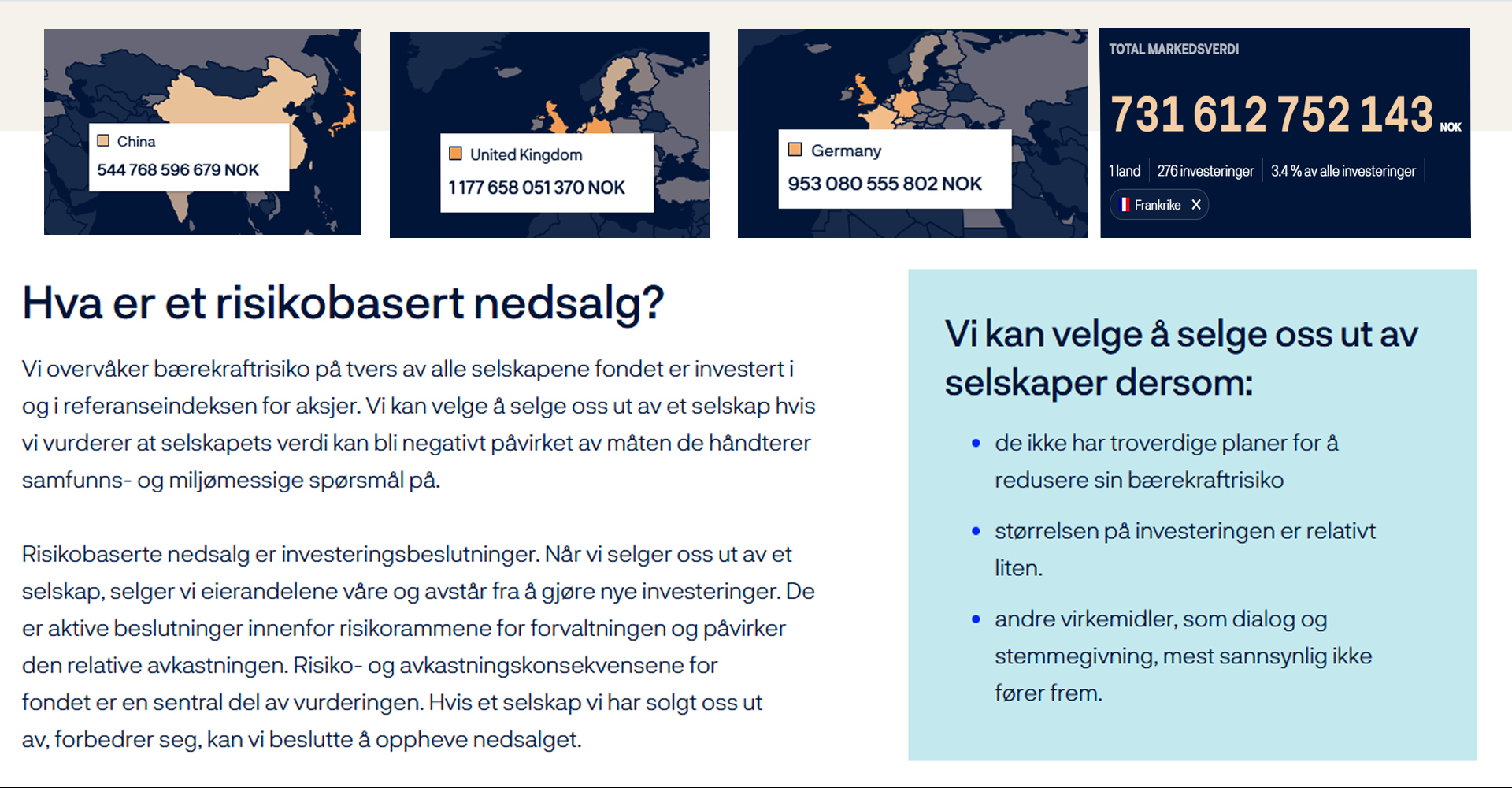
Looking at the oil fund's total assets in France, currently valued at 731 billion kroner, it is important to note that as much as 238 billion is in interest-bearing securities, or bonds, spread across 66 types. That is a third of the oil fund's investments in France. Here are the securities most vulnerable to high energy prices. We have picked out the top 10 on the worst-offenders list.

These are exposed

Electricite de France SA (EDF) - The state-owned power company is being strangled by astronomical debt, a maintenance backlog on its nuclear reactors and political price caps on electricity.

Schneider Electric SE - Heavy bond loans to the industrial-equipment giant, which is hit by high unit costs at its European plants.

Engie SA - Energy production and gas infrastructure exposed to commodity-market fluctuations and political intervention.

Cie de Saint-Gobain SA - Loans to the glass and packaging giant, where gas consumption in the melting furnaces is a critical cost.

Arkema SA - Chemicals production with high energy intensity and direct vulnerability to gas prices.

Legrand SA - Industrial electrical manufacturing squeezed by the European cost level.

Air France-KLM - Airline directly vulnerable to fuel prices (jet fuel) and to the weakening purchasing power of European consumers.

RCI Banque SA (Renault's financing arm) - Exposed to the car market and to electric-car margins under pressure from Chinese and American competition.

Air Liquide Finance SA - Bond loans to chemical gas production with enormous power needs.

Coentreprise de Transport d'Electricite SA (RTE / the power grid) - The French power grid, which must make gigantic investments at a time of high capital costs.

Double problem

Combine the share portfolio with these bonds and you get a large France risk in the oil fund. Not only on the stock exchange, but also through the credit market. A serious French deindustrialisation would therefore be not just a share problem, but a bond problem too.

Hard facts

Cheap Russian gas is in practice no longer available to German industry in the same way as before 2022. If energy prices in France remain structurally higher than at competitors in the USA and Asia, the competitiveness of energy-intensive industry is weakened. German BASF's multibillion investment in China illustrates this development, because the company is placing new production capacity close to a market with strong growth and access to competitive raw materials and energy.

ECB

If high energy costs contribute to persistent inflation, the European Central Bank (ECB) may have less room to cut interest rates quickly. Higher rates for longer will put pressure on the bond market. Market rates will rise, and the value of existing bonds will fall. This could produce a negative return for the oil fund's holdings of French corporate bonds and other French interest-rate instruments. The ECB is the central bank for the eurozone countries and has its headquarters in Frankfurt, Germany.

Welfare

The oil fund has invested 731 billion in France, but only 544 billion in China. What is the oil fund's strategy? It is beyond doubt that the oil fund's skilled employees and its chief are well aware of the risk in their French portfolio. Yet there is no talk of moving investments from Britain, France or Germany to safer placements elsewhere. Are we talking about politically directed Norwegian welfare for the eurozone? In that case the money will fly out of the window at a pace that makes the gifts to Ukraine look like small change.

Home page

MOTPARTEN

The other side of the story. An independent newspaper from Norway.

Contact

Address

Motparten.no
Elevine Heedes vei 2
4839 Arendal
Norway
Editor-in-chiefJesper Enerstvedt

About

Follow

© Motparten.no · All rights reserved. Independent since 2021 · Published in Arendal, Norway