Want to nationalise Fensfeltet
Not all that glitters is gold
The Centre Party and the Red Party want a state-owned mineral company of their own that would own, not just manage the planning process for, what they believe is a Norwegian Klondike. They clearly haven't read motparten in recent days. Most likely, Fensfeltet will not yield any return at all.
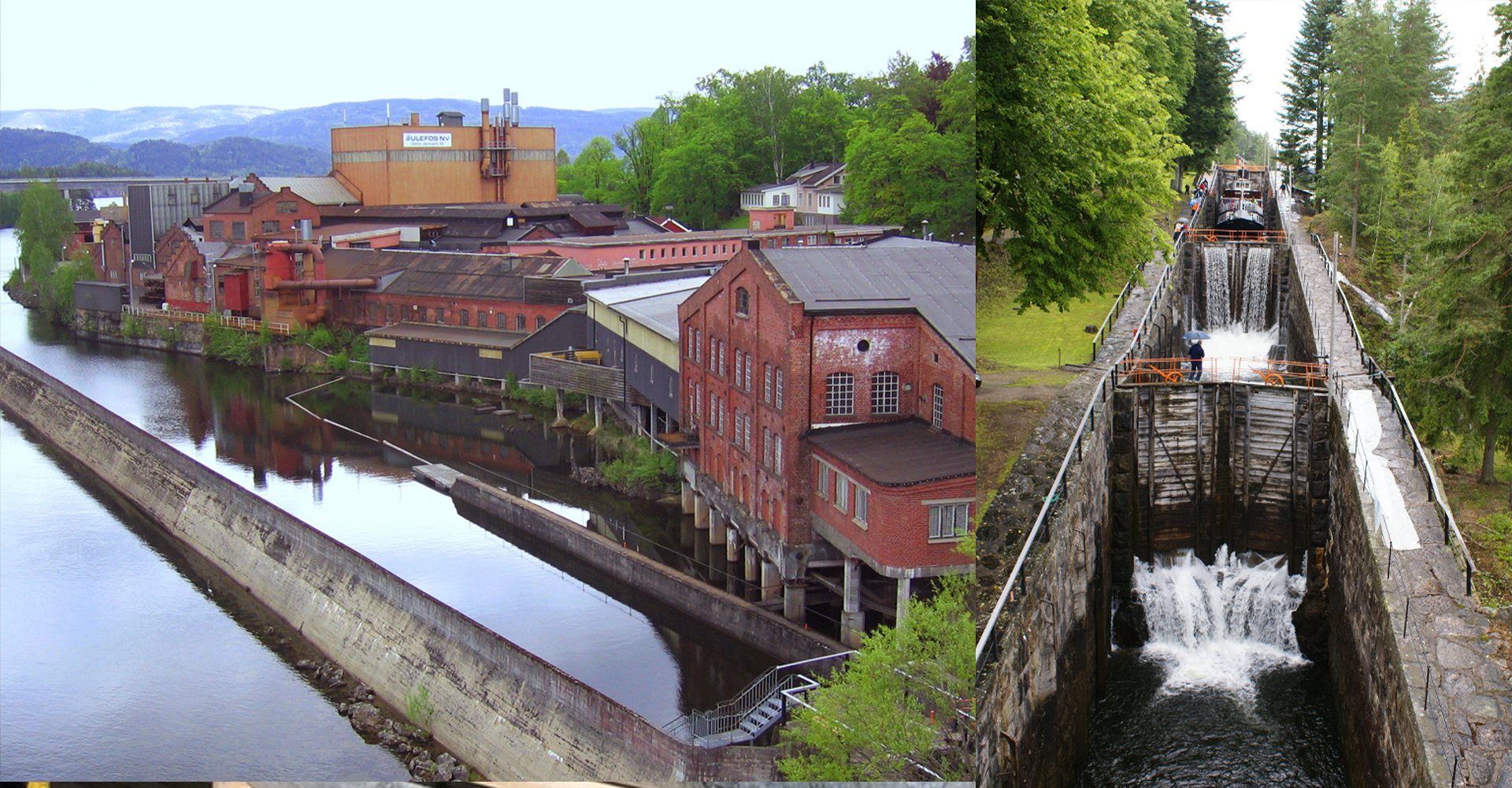
The area has many buildings worth preserving, locks and unique nature. Perhaps both Norway and the environment stand to gain from leaving them in peace. In the picture we see the old ironworks at Ulefoss, founded in 1657. To the right in the picture, the Vrangfoss locks.
TopPhoto: Krg CC BY-SA 4.0/Christophe Dayer/CC BY-SA 2.0/theContrapart
Text: Atle David Torkildsen
Date: 5 August 2026
Translated from Norwegian with the help of AI · Read the original
A kind of mythical notion has taken hold that Norway will soon be swimming in money thanks to the sought-after minerals in the ground. Sure, they are there, but making good business of them is by no means simple. Still, there is no harm in believing. Recently motparten revealed that comparable companies in Australia and the USA have been unprofitable for 25 consecutive years and have never paid a dividend.
Comparing with oil
The Centre Party's (Sp) spokesperson on business policy, Geir Pollestad, draws a direct parallel with the oil story. He believes the same should be done with minerals now. Sp has also put forward a concrete proposal on this in the Storting (Norway's parliament). Sp leader Trygve Slagsvold Vedum has also told NRK that the state should take an active role in ownership and cooperation with private players to secure national control.
The bug
The Socialist Left Party (SV) also wants a state mineral company, but for slightly different reasons. SV wants a state mineral company to secure national control and take environmental concerns into account. The trade union movement and the Norwegian Confederation of Trade Unions (LO) also argue for a possible state mineral company. They have all been bitten by the bug that says a solid vein of gold has been found, just waiting to be dug out. It is not that simple, however.
Fensfeltet has been hyped up and portrayed as a new Klondike, where great veins of gold are just waiting to be brought to light and make everyone filthy rich. That is not the case, as motparten recently revealed. On the contrary, there is a high probability that mining there will never yield a return.
The centre-right holds back
The centre-right parties are more restrictive on state ownership. They support state planning control. The Conservatives (Høyre) and the Progress Party (Frp) have backed the state taking over the planning process to speed things up. Høyre's Bård Ludvig Thorheim justifies it by saying that a gigantic industrial project requires clarifications and case-handling capacity. Høyre's Mahmoud Farahmand has warned that Norwegian sluggishness could give foreign players, such as China, access to the resources, while also pointing to the importance for European independence. Frp's Marius Arion Nilsen wants the matter speeded up out of concern for security of supply. He wants to increase self-sufficiency.
Støre and Stoltenberg
Prime Minister Jonas Gahr Støre (Labour) has described the state's takeover of planning responsibility, decided in April 2026, as important for access to critical minerals going forward. He talks about jobs and new industry in Telemark, but the government has so far not come out in favour of a state-owned company of its own. So the days go by in the cold north, but beneath the surface, political guidelines are smouldering. With Stoltenberg whispering in his ear, Støre is no doubt following closely. The former NATO chief has no doubt said that these things will be needed in a third world war, when China shuts up shop again.
China
China today dominates around 90 per cent of the extraction and value chain for rare earths, and has shown a willingness to use this as a means of pressure. The project is technically and economically demanding; the company Rare Earths Norway itself says that state co-ownership could provide the necessary financing structure, provided the state is a long-term investor. A comparison with how Norway secured national control over hydropower and oil through state ownership. The minerals neodymium, dysprosium and terbium are used in everything from F-35 turbines to wind turbines and electric cars. The state-owned LKAB in Sweden is highlighted as an example of how the state can combine commercial operations with strategic considerations.
EU
The EU has adopted the Critical Raw Materials Act (CRMA) as a framework for reducing dependence on China, but Fensfeltet is not specifically mentioned by the leadership of the European Commission in its latest "giga plan" on critical minerals. The EU-funded innovation network EIT RawMaterials, on the other hand, has described the field as a possible world-class resource for European security of supply. As long as peace reigns on earth, no one can make these goods as cheaply as China. So the EU, too, most likely has a third world war in the back of its mind.
HomeMuch suggests that nationalising Fensfeltet would be a big blunder. It is far from comparable to oil. On the contrary, experience from Australia and the USA shows that this kind of mining will not be profitable for the foreseeable future. There are most likely other driving forces behind the tremendous enthusiasm some politicians are showing. Here the Centre Party should be careful not to be lured into a cunning trap set by Stoltenberg and co., who see the military-industrial side of the matter. Powerful forces in the USA and Europe would like to see Norway subsidise the rare metals so that they don't have to buy them from China.
Missiles and fighter jets
About 19 per cent of the documented rare earth oxides in Rare Earths Norway's part of the field consist of neodymium and praseodymium. These are the most important metals in the production of strong permanent magnets needed in missiles, fighter jets, frigates and submarines. Europe is today dependent on imported magnets. SINTEF is already leading a research project to develop a European value chain from Fensfeltet to finished magnets. The Norwegian Confederation of Trade Unions (LO), the Confederation of Norwegian Enterprise (NHO), Norsk Arbeidsmandsforbund, Norsk Industri and Norges Bergindustri have recommended that a complete value chain be established in Telemark.
Enter the Swedes
The Swedish state-owned company LKAB has shown interest in Fensfeltet. That is only natural. LKAB has its own deposit in Sweden, the Per Geijer field near Kiruna, which is considerable but not as big as Fensfeltet. LKAB and the investor Brennebu are co-owners of the company Reetec, which is to carry out the separation process for rare earths at Herøya in Porsgrunn. So there is an ownership interest in a Norwegian separation plant. Sweden has, after all, just led the way for Norway as an example of how to go bankrupt with a battery factory in competition with China. Now they want to do the same with the minerals underground.
Let them have it
The interest from the state-owned LKAB makes the question of national control a live one. LKAB is an industrially strong mining company. But Swedish state ownership is not the same as Norwegian public control. If LKAB buys into Rare Earths Norway, the Swedish state could gain a controlling ownership position in Europe's largest deposits of rare earths while the Norwegian state stands on the sidelines. For the time being, the Storting is dithering with so-called "feasibility studies" but could grow old and grey before this results in anything concrete.
Volvo
Norway has come close before to tying rights to non-renewable natural resources to Sweden. In 1978, the government of Odvar Nordli negotiated the so-called Volvo agreement with Volvo chief Pehr G. Gyllenhammar. The Norwegian state was to buy 40 per cent of Volvo, while Volvo Petroleum was to receive rights in three areas on the Norwegian continental shelf. Unlike Fensfeltet, which will most likely prove a bad business, an oil deal with the Norwegians would have been a good business for Sweden. Now they can have Fensfeltet instead, which will almost certainly not yield any dividend for shareholders for the foreseeable future.
Amazon
The oil-for-petrol-car deal was signed, but collapsed in January 1979 because a blocking minority of Volvo's Swedish shareholders felt the carmaker was being valued too low. It was thus largely Swedish opposition, not Norwegian political caution, that stopped the deal. Norway can count itself lucky for that today, while Sweden has it as a permanent industrial-history headache. It is still galling that Norwegian authorities were willing to use rights on the Norwegian shelf as part of the payment for a stake in a Swedish firm that made the Volvo Amazon.
Barter
At Fensfeltet the situation is different. Norway already knows that the deposit is world-class and that the minerals are of crucial importance to European technology and the defence industry. Now there is a chance of a lifetime to swap this for something that is truly valuable in Sweden. Norway could, for example, get property in the Swedish archipelago from Koster to Smøgen. The Swedes would surely say yes to such a deal because they don't want to repeat the blunder of the 1970s. There is no need to tell them that comparable companies in Australia and the USA have not made a profit in 25 years and have never paid a dividend.
MOTPARTEN
The other side of the story. An independent newspaper from Norway.
Contact
- Newsroomredaksjon@motparten.no
- Advertisingannonser@motparten.no
- General enquiriespost@motparten.no
Address
Motparten.noElevine Heedes vei 2
4839 Arendal
Norway Editor-in-chiefJesper Enerstvedt