Cheap advertising for AI companies
Gullible politicians
Biological weapons, hacking, fake news, blackmail and threats. There is apparently no evil that AI programs are not capable of carrying out. More and more politicians are now jumping on the fear carousel, but there are also those who simply laugh at the fuss.
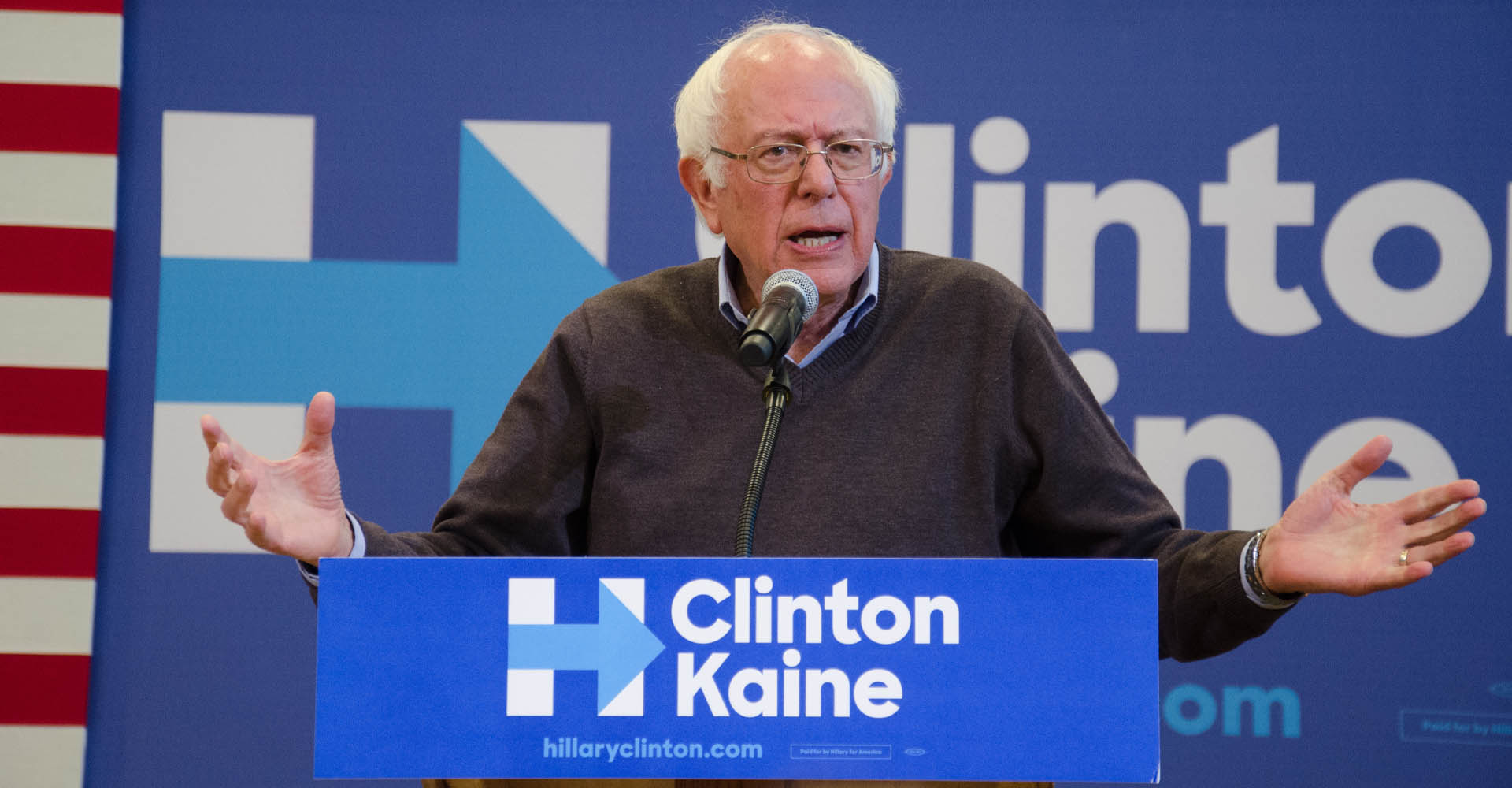
The ageing politician became an easy victim of smart AI companies. Here we see Bernie Sanders campaigning for Hillary Clinton at Nashua Community College in October 2016.
TopPhoto: Tim Pierce/CC BY-SA 4.0/motparten
Text: Ludvig Storn
Date: 14 October 2026
Translated from Norwegian with the help of AI · Read the original
Motparten recently wrote about critics who believe the AI scare stories are manufactured by the industry to create buzz around a product that has not proved nearly as useful as many had hoped beforehand. AI has not solved a single scientific problem. It still takes good old-fashioned brilliant minds like Albert Einstein or Stephen Hawking to describe universal laws. Yet the AI companies scare the living daylights out of people about how frightening their machines are.
Wants to kill you
That the AI machines will soon take over and make biological weapons that will kill us all is therefore something you only hear from those who sell the AI products. They have already got a number of politicians to fall for the trick, if that is indeed what has happened. The news agency Reuters, for example, recently reported that Anthropic said it had stopped an attempt to use its AI model to develop biological weapons. Exactly who was behind it and how is stated neither in Reuters' press release nor in Anthropic's official statements.
Russia too
The same company also claimed that its AI model Claude was used in a Russia-linked cyber espionage campaign and by an Iranian propaganda institution, but here too readers get no detailed knowledge of what actually happened. The AI developers make themselves both defenders of national security and those who ensure that national security can be threatened. Critical journalists have so far only managed to prove that AI has been used to make fake dating apps and carry out Wi-Fi fraud, but this also happened before AI was developed.
Can't ban everything
There is reportedly a long report listing state-backed groups and criminals who misuse the technology. The same groups had computers before the technology came on the market. The question is how much more effective groups that are up to no good become with new AI tools. We don't ban cars just because there are drink-drivers. We don't ban weapons just because people get murdered. But we try as best we can to regulate this with bans and updated rules. The same is now happening with AI.
Crafty companies
When firms like Anthropic go out and frighten people by saying there are evil people out there who have tried to make biological weapons, this is very serious. That is why Anthropic uses sharp lawyers to read through its statements before they reach the market. In the statements about biological weapons, Anthropic added ten more sentences saying that "The same information that can be used to develop a biological weapon can be used to develop, for example, a vaccine or a cure for a disease."
Like a cartoon
Anthropic's head of threat intelligence, Jacob Klein, told the New York Times "it's not a cartoon way of saying: Hey, I want to build a biological weapon to kill everyone". The statements thus hint that nobody has asked AI to make a biological weapon, but that Anthropic has received enormous press coverage about something that could theoretically have become a biological weapon. Critics believe this is a highly speculative way of getting attention, especially because no independent oversight group is given access to Anthropic's files. They are secret.
Home pageThe AI issue is starting to resemble the gun debate in the USA. It is unthinkable to ban something most people see as a fundamental freedom. The problem is that weapons, like AI, can also be misused by those who wish to. So can an ordinary kitchen knife in the wrong hands.
Not specific enough
The Anthropic report also mentions six cases where Claude was used "to develop software for firearms, missiles, armed drones, bombs and other ammunition". But for years people have been able to ask Google how to make black powder or a homemade contraption, without necessarily intending to build either. For an AI firm that needs attention, it is certainly possible to find something scary that someone has searched for, and then present it in a way that gets the company noticed.
Snitching to the authorities
There are also specific groups with evil intentions mentioned in the Anthropic report. One of them is the hacker group ShinyHunters. The report also mentioned the Russia-based hacker group Midnight Blizzard. Anthropic admits that it shares intelligence with the authorities, but that fact in itself is more than enough to rile most hacker groups.
Fumbling attempts
Some politicians, such as the Democrat Bernie Sanders in the USA, are now coming forward with bills to ban what Trump has renamed superintelligence within artificial intelligence. He is doing so after Anthropic warned that AI is developing so fast that there is a more than 10 per cent chance that AI "could kill all humans" within the next decade.
US President Donald Trump has no plans to lose the AI race with China. He is the last person on the planet who would make laws restricting American research and development. Whether AI should be regulated or not, it will by all accounts not be the USA that sets a good example. Nor are there any international courts, because the USA is opposed to them.
Competitors
Because China also makes AI, it becomes odd to read about those who want to limit research and development. For example, OpenAI chief scientist Jakub Pachocki wrote in an article on 6 September that the industry should implement "voluntary slowdowns" until safety measures are in place. Whether he meant his own company, the Chinese firms or the competitors' firms was not specified. It is natural to think that OpenAI will not set a good example, and that this move too was well suited to creating buzz around its own company.
Think first – demand proof
Now the press should tread carefully, so as not to become simple, gullible microphone stands for companies where the press itself has no insight into, or means of checking, the information. You simply have to take their word for it. For example, the aforementioned Pachocki managed to squeeze in a lot of positive things about OpenAI's role in the market. He said he was "worried that no one is prepared for the consequences of a continued rapid increase in machine intelligence", but then added that OpenAI, which makes ChatGPT, will work on building safety measures. That is pure advertising. It is doubtful that OpenAI is any better a white knight than Anthropic or, for that matter, China's Deepseek.
MOTPARTEN
The other side of the story. An independent newspaper from Norway.
Contact
- Newsroomredaksjon@motparten.no
- Advertisingannonser@motparten.no
- General enquiriespost@motparten.no
Address
Motparten.noElevine Heedes vei 2
4839 Arendal
Norway Editor-in-chiefJesper Enerstvedt