Rolled over without a krone
Norway, the bailiff's whore
Other democratic countries such as the USA, India and Brazil have built defences against supranational arbitration panels. Norwegian politicians do the opposite. They uncritically follow rulings from the international court PCA
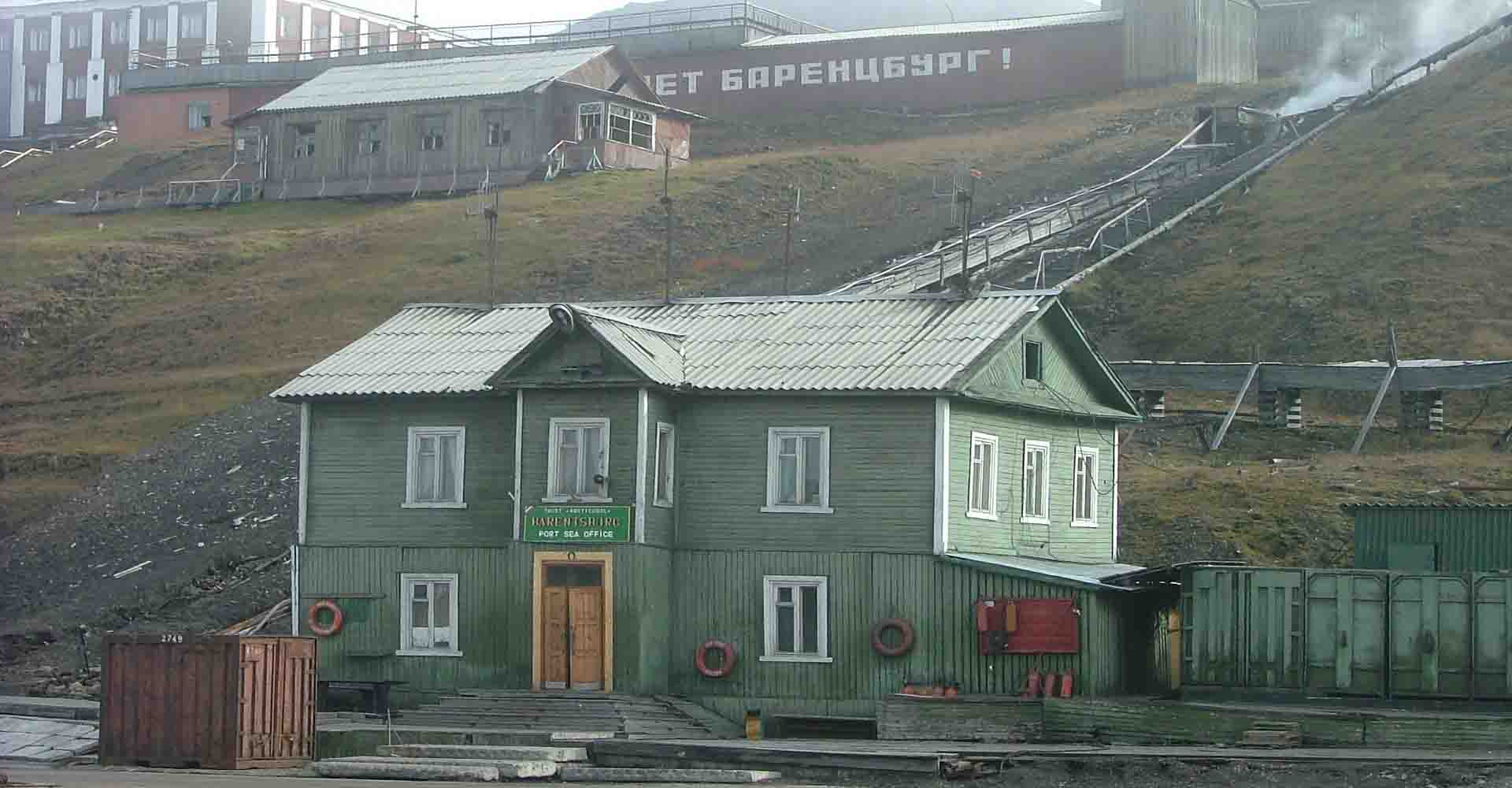
They were not particularly impressed with Norway, which chugged into the harbour with a coast guard vessel and seized the only ship that brings food and transports people to an icy region far out at sea.
TopPhoto: Bingar/Bjoertvedt/M_H.DE/CC BY-SA/3.0/4.0/motparten
Text: Stein Olav Krosby
Date: 24 September 2026
Translated from Norwegian with the help of AI · Read the original
Norwegian politicians evidently don't think it is enough that the country has submitted to fifteen thousand EU directives. So, without asking the population and without being paid, they have rolled over for the Permanent Court of Arbitration (PCA) in The Hague. Norway is thus doing exactly the opposite of other democratic countries, which make laws to protect themselves against such supranational institutions.
Unpaid bailiff
A direct consequence of Norway giving up sovereignty is that the Governor of Svalbard (Sysselmesteren) has to act as an unpaid bailiff and seize a Russian ship in the Russian town of Barentsburg. Norway rolling over without a krone has soured the good cooperation between Longyearbyen and Barentsburg, which took several decades to build up.
Embarrassing and souring
When officers from the Governor of Svalbard recently boarded the Russian vessel "Professor Moltsjanov" at the quay in Barentsburg, the operation was presented to the public as an ordinary civil enforcement action. A legally binding ruling from the Permanent Court of Arbitration (PCA) in The Hague had been approved by Nord-Troms and Senja District Court, and the enforcement authority carried out its statutory duty. The northerners had no choice. The politicians in Oslo had signed an agreement that forces Norway to do bailiff's work for foreign powers.
Poorly made
Norwegian elected officials have constructed a body of law in which a private arbitration award from abroad automatically triggers the coercive power of the state. When this happens in one of the world's most sensitive geopolitical areas – without the Norwegian government having any say whatsoever – it becomes downright idiotic. Incidents like this explain why many other democratic countries have not let themselves be fooled the way Norwegian politicians have.
PCA
The boat case that culminated in the embarrassing seizure of the Russian ship in Barentsburg originates in the arbitration case PCA Case No. 2017-16. On 12 April 2023, the tribunal under the Permanent Court of Arbitration in The Hague issued its final award. The Russian Federation was ordered to pay the Ukrainian state energy company Naftogaz five billion dollars in compensation for expropriated assets in Crimea.
The way Norway has handled the case is clumsy. It is embarrassing, petty, and could have enormous consequences in the future. Many are asking why Norway is seizing the only ship that delivered food to a small Arctic community.
Took the Professor
Moored at the quay in Barentsburg lay the Russian research and supply ship "Professor Moltsjanov", formally owned by the Russian Federation through the state hydrometeorological institute. That is an institute entirely innocent of what is happening in Ukraine, or anywhere else on the globe for that matter. For the district court judge in Tromsø and for Governor Lars Fause, however, there was no room for discretion. Under section 45, first paragraph, of the Arbitration Act, an arbitral award shall be recognised and enforced.
Typically Norwegian to polish shoes
Under the law Norway has subjected itself to, considerations of Norway's strategic neighbourliness, the fisheries negotiations in the Barents Sea or the risk of Russian countermeasures are completely irrelevant. The contrast with how other democratic countries protect themselves against such supranational commitments is striking. One has to wonder what on earth the politicians were thinking when they signed. Weren't the supranational problems with the EU enough?
Smarter
The USA, for example, refuses to submit to arbitration that threatens its own states' room for manoeuvre. Washington has therefore refused to ratify the UN Convention on the Law of the Sea (UNCLOS) precisely to avoid maritime decisions being overturned by PCA tribunals. Federal courts systematically use the political question doctrine and the Foreign Sovereign Immunities Act (FSIA) to reject enforcement actions that collide with American foreign policy interests.
Deciding for themselves
We see exactly the same pattern of protecting themselves and their citizens in Brazil. The country has enshrined in its constitution that its public funds and natural resources shall be managed exclusively under Brazilian jurisdiction. Brazil has consistently refused to join the World Bank's investment arbitration body (ICSID) and has systematically rejected agreements that give external courts coercive power over the state.
Front pageNorway's incomprehensible capitulation to the international court could have several serious consequences. In the worst case it will hit the strategic buffer zone in the Barents Sea. Billions are then at stake.
Not as stupid as Norway
India doesn't roll over for a krone either. Once bitten, twice shy. Earlier it did as Norway does, but it woke up after arbitration panels under the PCA in The Hague ordered the country to pay billions in compensation in disputes with companies such as Vodafone and Cairn Energy. The Indian response was blunt. From 2016, New Delhi terminated more than 70 bilateral investment treaties. Today Indian law requires that national remedies must have been exhausted for at least five years before arbitration can even be considered.
No balls
All these states, and many others, give priority to national sovereignty. As usual, Norway has chosen a spineless, rigid formalism in which international arbitration awards trump national security and the right to decide for oneself. In the long run, that kind of thing brings down governments. People can't be bothered to put up with their leaders handing power to foreigners. That is why the people have voted no to the EU twice.
Warning
The arrest of the "Professor Moltsjanov" is now causing concern in leading legal circles. Peter Ørebech, a former professor of jurisprudence at the Norwegian College of Fishery Science (UiT), has for many years warned against Norwegian administration of justice. The Svalbard Treaty obliges Norway to treat the citizens and companies of the signatory states equally under Articles 2 and 3. When Norwegian authorities in practice allow private companies to use Norwegian coercive power against state supply vessels in Barentsburg, the limits of the treaty's principle of equal treatment are tested. It is naive to believe that this will not be met with legal and political countermeasures from the Russian side.
This kind of behaviour could become extremely costly for Norway in the future.
Dubious practice
Professor emeritus of international law at the University of Oslo, Geir Ulfstein, who is regarded as Norway's foremost authority on the Svalbard Treaty, points out that state-owned property used for non-commercial purposes enjoys absolute immunity under customary international law. When the Norwegian legal system suddenly, on the orders of foreign powers, defines a vessel that supplies an isolated Arctic community with food and provisions as a purely commercial ship in order to prepare the ground for a forced sale, Norway is moving into murky and dangerous waters where international law is stretched to the limit. It is therefore not surprising that the director of Trust Arktikugol, Ildar Neverov, has announced that the case will be pursued through the legal system with a demand for the arrest to be lifted in full, citing state immunity and the security of supply for the settlement.
Hanging by a thread
The consequences of this automatic enforcement action extend far beyond the quay in Barentsburg. Russia has repeatedly signalled that the established framework of agreements in the north hangs together. When supplies to Barentsburg were stopped at Storskog, the head of the Russian State Duma, Vyacheslav Volodin, gave the Duma's foreign affairs committee a formal order to consider terminating the 2010 maritime delimitation agreement.
This kind of behaviour could become extremely costly for Norway in the future.
A poor hand
If Moscow uses the arrest, and a possible forced sale of the ship, as a crowbar to declare that the premises of the 2010 agreement have been broken, a maritime area of 175,000 square kilometres is put at stake. A return to the pre-2010 "grey zone" would paralyse all further Norwegian resource extraction, seismic surveys and exploration in the eastern Barents Sea. It would be an economic and territorial catastrophe for Norway.
Useful idiots
Norway does not receive a single krone of the compensation owed to Naftogaz. The Norwegian state is not a party to the dispute. Even so, successive governments, from Einar Gerhardsen's to Kjell Magne Bondevik's and now Jonas Gahr Støre's, have built a system that deprives national authorities of any ability to steer. This fits neatly with the establishment's yearning to create the United States of Europe, a copy of a USA they have all looked up to since childhood, but which has now seen its best days. The old generation of politicians has too, presumably. Støre looks tired and knows deep down that a new generation led by Sylvi Listhaug is about to take over.
MOTPARTEN
The other side of the story. An independent newspaper from Norway.
Contact
- Newsroomredaksjon@motparten.no
- Advertisingannonser@motparten.no
- General enquiriespost@motparten.no
Address
Motparten.noElevine Heedes vei 2
4839 Arendal
Norway Editor-in-chiefJesper Enerstvedt