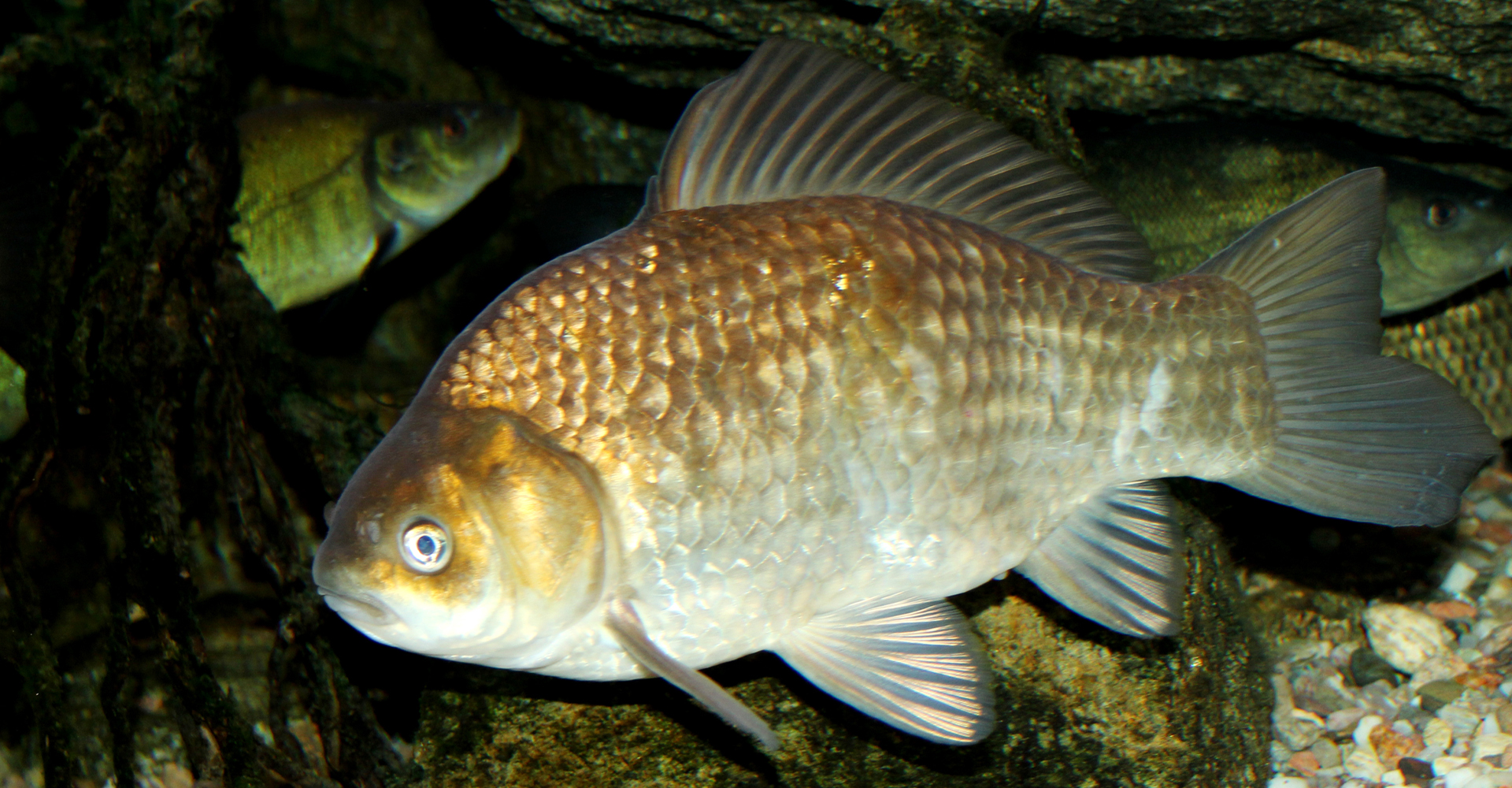
Photo: Karelj, offentlig eiendom/Piet Spaans (Viridiflavus) CC BY 2.5/theContrapart
Text: Christer Andre Mæland
Date: 19 June 2026
Translated from Norwegian with the help of AI · Read the original
When small lakes and ponds freeze over, people think all the fish die. Nothing can live once the water turns into a block of ice and the oxygen disappears. But on Tromøya, outside Arendal, a little fish does the impossible. It does something no other Norwegian fish can do. It converts the waste product lactic acid into alcohol. Yes, you read that right! Alcohol! As the most natural thing in the world, the fish sends the ethanol out through its gills and stops its body from being poisoned by its own metabolism. We are talking about a proper booze fish!
Doesn't suffocate
Other fish suffocate quickly when the oxygen under the ice runs out. The crucian carp takes life easy. It calmly lets itself be frozen into a block of ice. It just moves its tail a little so the ice won't squash it flat as it expands. For months the fish lies inside the block of ice without oxygen. Unsuspecting children skate right over the crucian carp's head as it lies frozen in ice, in darkness and cold, all winter. The crucian carp is clearly living on the very edge of the impossible. It is a bit like the people of Arendal themselves. For a long time they have lived in conditions where others would have gone under.
Backup generator
Like the permanent residents of Arendal, the crucian carp combines cold tolerance, oxygen deprivation and alcohol production in a way that has hardly an equal among vertebrates. It is as if nature has equipped it with antifreeze, a backup generator and emergency rations all in one package. Every spring you can see both Arendalians and crucian carp peering out in wonder, as if they don't quite realise themselves that they are one of God's own marvels.
Like people, like fish
The crucian carp flies under the radar for most people. It rarely becomes a giant. That is why it flies under the radar for anglers. But behind the anonymous appearance hides one of Norway's most extreme survivors. The crucian carp is like the people of Arendal – an organism that can sit stuck all winter, produce its own alcohol and pop up alive and kicking when spring finally comes.
Top
Like the permanent residents of Arendal, the crucian carp combines cold tolerance, oxygen deprivation and alcohol production in a way that has hardly an equal among vertebrates.
Northerners and cod
Northern Norway, too, has a fish that is good at dressing for cold winters. It is none other than the cod! It can also do something that sounds like pure science fiction, even if it can't quite compare with the crucian carp from Arendal. But it is a fact that the cod makes its own washer-fluid substance in its blood when the winter cold sets in. When the sea water drops to temperatures below zero, the cod switches on genes that produce special antifreeze proteins.
Ethanol as antifreeze
The proteins work like the antifreeze in a car's washer system. Without them, blood and body fluids would freeze to ice in the Arctic Ocean. Researchers describe the proteins as highly effective. They prevent the formation of ice crystals. Thanks to its biological frost protection, the cod can stay right under the sea ice in winter. It swims around in areas where other fish species would freeze to death at once. The cod therefore has access to food and habitats that are unavailable to other fish.
The crucian carp is clearly living on the very edge of the impossible. It is a bit like the people of Arendal themselves. For a long time they have lived in conditions where others would have gone under.
Sub-zero temperatures
Incredibly, the cod tolerates water that is colder than water's normal freezing point. It actually swims around without being transformed into a fish finger. The cod's secret antifreeze shows how evolution has created one of the sea's most impressive survival creatures. In Norway many people think the only habitable zones lie between Oslo and Trondheim, but both in Sørlandet (the southern coast) and in Northern Norway people cling to life. Every spring they reappear – a little wary of strangers – but with genetics made to withstand anything.
Home page