Nuclear submarine sank in the Norwegian Sea
Two atom bombs on board
1,680 metres below the surface of the Norwegian Sea lies a Soviet nuclear submarine with two nuclear warheads on board. Now new research confirms what scientists have long feared: the reactor is rusting to pieces, and radioactive material is still pouring into the sea.
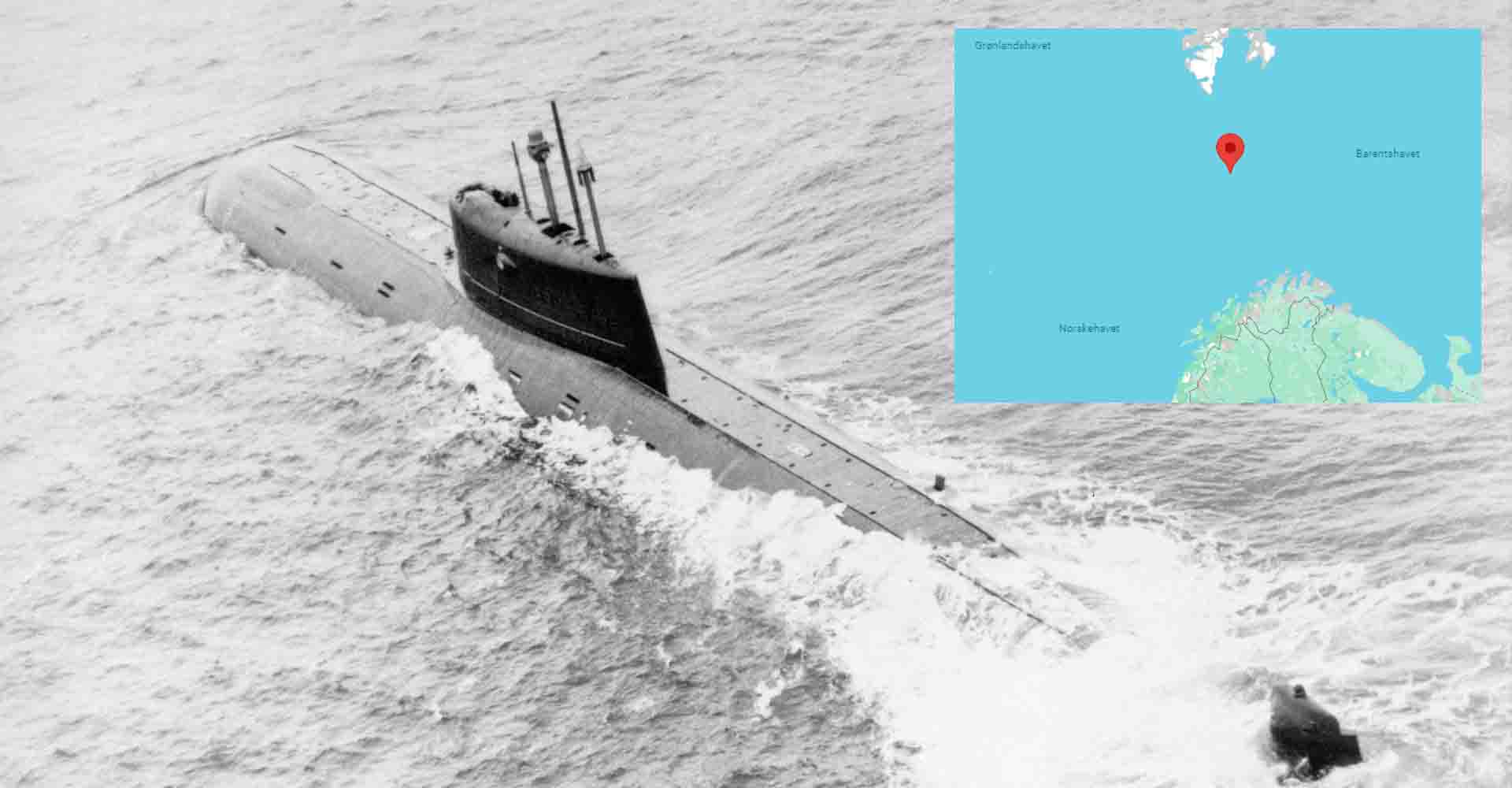
Here it sank, and here it still lies. Some say we can relax, while others say all the fish could die.
TopPhoto: Desken/DoD ID: DN-SN-87-07042/motparten
Text: Stein Olav Krosby
Date: 19 September 2026
Translated from Norwegian with the help of AI · Read the original
It was just after 11 in the morning on 7 April 1989 when the fire alarm went off on board K-278 Komsomolets, the Soviet fleet's most advanced attack submarine. Six hours later it was on its way to the bottom of the Norwegian Sea, south-west of Bear Island (Bjørnøya). It took 42 of the 69 men on board with it. And it took a nuclear reactor and two torpedoes with nuclear warheads.
Many are anxious about what will happen when there is a real leak – because it is coming.
Leaking
The submarine K-278 “Komsomolets” sank off Bear Island in 1989. The vessel had a nuclear reactor and took two nuclear missiles with it into the depths. 42 sailors died. Today, 37 years later, the wreck is still there. And it is leaking. A recent study, led by researcher Justin Gwynn at the Norwegian Radiation and Nuclear Safety Authority (DSA) and published in the renowned scientific journal PNAS, confirms that radioactive material is still seeping out of the reactor.
Norwegian experts are aware that the wreck is leaking, but there is little they can do about it, other than look out for glow-in-the-dark fish.
Norwegian research
Close to the submarine's hull, the concentrations of strontium-90 and caesium-137 are up to 400,000 and 800,000 times higher respectively than is normal in the Norwegian Sea. The figures come from a Norwegian research expedition in 2019, when the remotely operated underwater vehicle Ægir 6000 took samples and filmed the wreck up close for the first time. What the researchers found surprised no one who has followed the case for three decades. On the contrary. It confirmed the suspicions.
Pumping out poison
According to the DSA report, the discharges come in bursts from two specific places on the hull: a ventilation pipe and a metal grating near the reactor compartment. When the researchers captured one of these outbursts on video, the concentration of caesium-137 in the water samples rose a thousandfold compared with samples taken just before.
Plutonium
What is making the researchers raise their eyebrows now is something else: traces of plutonium-239, plutonium-240 and uranium-236 in the discharges. These isotopes do not come from the seawater around the wreck. They come from the reactor fuel itself. The ratio between the different plutonium isotopes suggests that the fuel rods are damaged, and that the nuclear fuel is now in direct contact with seawater, and corroding. The observed discharges, as well as the specific ratios between the plutonium isotopes, indicate that the fuel elements are damaged and that the nuclear fuel is breaking down in contact with the seawater, the DSA report states.
According to the DSA, the reactor on board was shut down as early as the first phases of the accident in 1989, but it still contains an estimated radioactivity of around 3 petabecquerels, mainly caesium-137 and strontium-90. That is a lot.
Can relax
So far, however, there is no reason for public panic, according to the researchers behind the study. The extreme readings were taken right next to the leak points on the hull. Even a short distance away the levels fall sharply, because the radioactive material is quickly diluted in the enormous body of water. Samples of sponges, corals and sea anemones living on and around the wreck show only slightly elevated caesium levels, with no visible signs of damage.
Home pageThe nuclear fuel is now in direct contact with seawater, and corroding. Now all we can do is wait for the Netflix film about the shark that was born at the wreck and becomes a mutant killer shark.
Lies deep
The location also plays a part. The wreck lies at a depth of 1,680 metres, in ice-cold water, far from busy fishing grounds. The combination of depth, cold and distance is probably the main reason why neither environmentalists nor politicians have sounded the full alarm, even though the leaks have now been going on for over three decades. But the question hangs in the air: could it suddenly get worse?
The torpedo room
It is not the reactor alone that is cause for concern. In the bow of the wreck lies the torpedo room, where the two nuclear warheads are still located. When Komsomolets hit the seabed in 1989, a powerful explosion, most likely triggered by hydrogen gas from the submarine's batteries, tore open the titanium hull and left the torpedo room open to seawater.
Fears dangerous release
As early as 1993, Igor Spassky, the chief designer of the submarine at the Rubin Institute, warned of the consequences. In an interview with the BBC he estimated that the two nuclear warheads would be completely corroded by an electrochemical reaction with the seawater within a decade, and that the highly toxic plutonium could then escape into the environment.
Cold water
The following year, in an interview with the American trade journal US Naval Institute Proceedings, Spassky nuanced the picture. He pointed out that the corrosion rate he had calculated applied to water at 20 degrees, while the temperature at the wreck is in fact around minus one degree. The extreme cold slows the breakdown considerably. By Spassky's estimate, the route to the plutonium cores, through a labyrinth of structures to the ventilation tower, should provide between 20 and 50 years of protection. It is now 32 years since that estimate was made.
Sealed
In 1994 Russia sent a team down to the wreck to seal parts of the damaged torpedo room, precisely to reduce the flow of seawater through it. The good news from the 2019 expedition: the 1994 seal is still in place, and the researchers found no traces of plutonium from the warheads themselves in the area around the torpedo room. So far everything suggests that the two nuclear weapons are still intact.
Norwegian military
Not all the predictions from the 1990s have come true. Tengiz Borisov, who at the time headed the Russian special committee for underwater operations, stated in 1994 that if a leak occurred from the wreck, fishing in the Norwegian Sea would become impossible for 600 to 700 years. In Norway, the Norwegian Defence Research Establishment has commented on the matter. In a report from 1997 it concluded with an even longer time perspective. It believed that neither the submarine hull nor the reactor vessel itself would be broken down by corrosion for at least 1,000 years.
Fishing
Thirty years later, fishing in the Norwegian Sea goes on as normal. But the reactor is leaking, and now, for the first time, the researchers have chemical evidence that the fuel inside it is actually corroding, not just that radioactive substances are seeping out through cracks and pipework. That is precisely why the researchers behind the PNAS study believe monitoring must continue. Russia itself has been responsible for most of the physical securing of the wreck since the 1990s.
Lights up
Norway has carried out annual measurements since 1990. It is this Norwegian monitoring, combined with the new ROV technology, that made it possible only in 2019 to take samples right up against the hull. Norwegian research provides the clearest picture of the condition of the seabed off Bear Island. Even so, everyone asks what will happen when the salt water finally wins out over the titanium and steel. The submarine lies where it lies. Sooner or later the torpedoes must yield to the relentless course of nature. Then there could be glow-in-the-dark fish on the dinner table.
MOTPARTEN
The other side of the story. An independent newspaper from Norway.
Contact
- Newsroomredaksjon@motparten.no
- Advertisingannonser@motparten.no
- General enquiriespost@motparten.no
Address
Motparten.noElevine Heedes vei 2
4839 Arendal
Norway Editor-in-chiefJesper Enerstvedt