Spy thriller from the Arctic
Like an XXX film
You have seen it in action films. Planes come in low and pick up superheroes or equipment with a kind of hook hanging from a rope. In real life, the invention was created in a way that outdoes the movies.
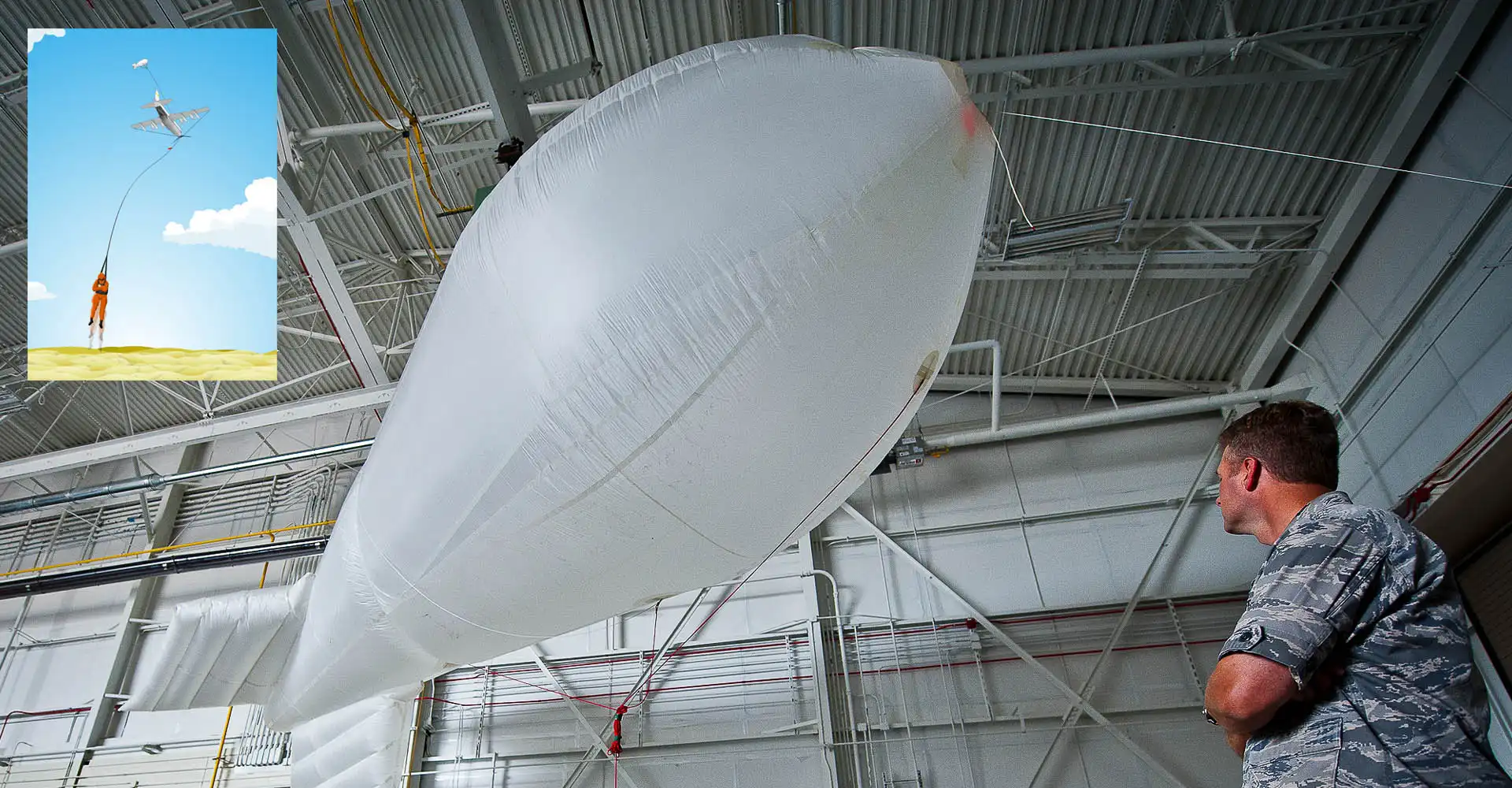
Sgt. Samuel King Jr. admires the balloon that Edison used to lift the rope that the plane's hook was meant to catch.
TopPhoto: U.S. Air Force photo/Tech. Sgt. Samuel King Jr./motparten
Text: Christer Andre Mæland
Date: 4 October 2026
Translated from Norwegian with the help of AI · Read the original
In 1962, a CIA plane took off from a base in Canada. The words “Intermountain Aviation” were painted on the fuselage. Today we know it was a front for the American intelligence service. Inside the plane sat Major James Smith together with Lieutenant LeSchack. The men were experienced paratroopers – and Russian speakers.
Historic
Hours later, both of them jumped out into a white inferno at twenty degrees below zero. They were near the North Pole. In a carefully planned operation, the men found what they were looking for: a top-secret Russian research station. The CIA agents stole everything they could carry and got ready to be picked up – in what is now known to be the first Skyhook operation in history.
Wrecked airstrip
The background to scenes that could have come from any top action film or James Bond film was that the Russians had been unlucky. That is, the ice had decided to break up their airstrip. They had therefore been forced to abandon the station. Because they could no longer go back, the Russians assumed that no one else could either – but in the USA a technician was working flat out on a new system.
Edison takes the case
The man the CIA had picked to solve the problem was none other than Robert Edison Fulton Jr. He got his middle name because his father was a friend of the world-famous inventor Thomas Alva Edison. Before the Second World War, he travelled the world with a camera in hand on assignments for the airline Pan Am.
Flight simulator
During the war, Edison also developed a machine that showed film inside a small booth. The film trained gunners for air combat. Today it is known that Robert's machine was the forerunner of today's flight simulators. The man was a wellspring of clever, practical ideas. After the war he therefore stayed on at the CIA, and when an apparently unsolvable problem came up in 1961, he was still there.
Thought they were safe
The CIA knew that the Russians had abandoned their base near the North Pole, but they could not retrieve the top-secret documents. Perhaps there was also new Russian technology and measuring instruments there. The case was therefore given top priority. The technology the Russians had in the hut on the ice would be invaluable intelligence for the US Navy. The Russians, for their part, were not much worried about the Americans getting hold of their things. The Soviet Union made public the name of the secret station, NP9, because it believed the runway had been permanently destroyed by unsafe ice.
Home pageWe can only wait for the American operation to find its way to the cinema screen. It will make a spectacular action film.
The Russians first at the North Pole
There was zero risk that the Americans would be able to retrieve the items, unless they wanted to beat the first man who claimed to have walked to the North Pole, the rugged outdoorsman Robert Peary, who said he had reached the pole in 1909. The claim is, however, strongly disputed. Many would say refuted. The first to reach the North Pole on the ground with certainty were a Soviet expedition in 1948, but with Russian modesty and a taste for secrecy, the world never learned who those men were, or who led the Russian expedition.
Heavy load
Given the harsh conditions, not many in the USA felt like trying. It is also doubtful whether either Peary or the Russians from the 1948 expedition could have managed the job. Both had to think about weight and rations. Taking extra baggage was out of the question. Here every gram counted. The aim of the new CIA operation was to bring out more than a hundred kilos.
Guinea pigs
When Edison came up with his idea, many at first just laughed. Edison had been in England during the war for the airline Pan Am. There he had seen how the English used cables to pick up mail to planes from the ground. Fulton's idea was rather crazy. He wanted to try the same thing with people. Edison called the system Skyhook. The CIA had a taste for somewhat more dramatic wording. They gave the operation the name Project Coldfeet – cold feet. Now they wanted to find out whether Edison's idea was possible to carry out at all without tearing apart the people lifted up by the hook.
Used a balloon
In practice, Edison scaled up the British system he had seen in England. He made it more elastic so that the jerk would not hurt the people. In practice this meant a harness attached to a rope more than one hundred and fifty metres long, which was to ensure the elasticity. So that the plane's hook would not have to drag along the ground and catch on bushes and scrub, Edison created a system with a helium balloon that lifted the middle of the rope into the air, so that the plane could catch it. Despite the effort, it was still far from harmless. Countless hours of training went into it before both pilots and ground crew mastered the system.
Great significance
When the paratroopers finally landed in the icy wasteland, they hit the jackpot when they entered the research station. It was intact! The American agents therefore got away with several hundred kilos of documents, measuring instruments and exposed film. It showed that the Russians had developed far more advanced Arctic anti-submarine technology than the Americans thought they had.
MOTPARTEN
The other side of the story. An independent newspaper from Norway.
Contact
- Newsroomredaksjon@motparten.no
- Advertisingannonser@motparten.no
- General enquiriespost@motparten.no
Address
Motparten.noElevine Heedes vei 2
4839 Arendal
Norway Editor-in-chiefJesper Enerstvedt