Ukraine fires on Iran and Russia in the Caspian Sea
Dangerous mosquito bite
Ukraine has sunk two cargo ships and a Russian missile boat, and has hit an oil platform in the Caspian Sea. The attacks targeted the extensive transport link between Russia and Iran.
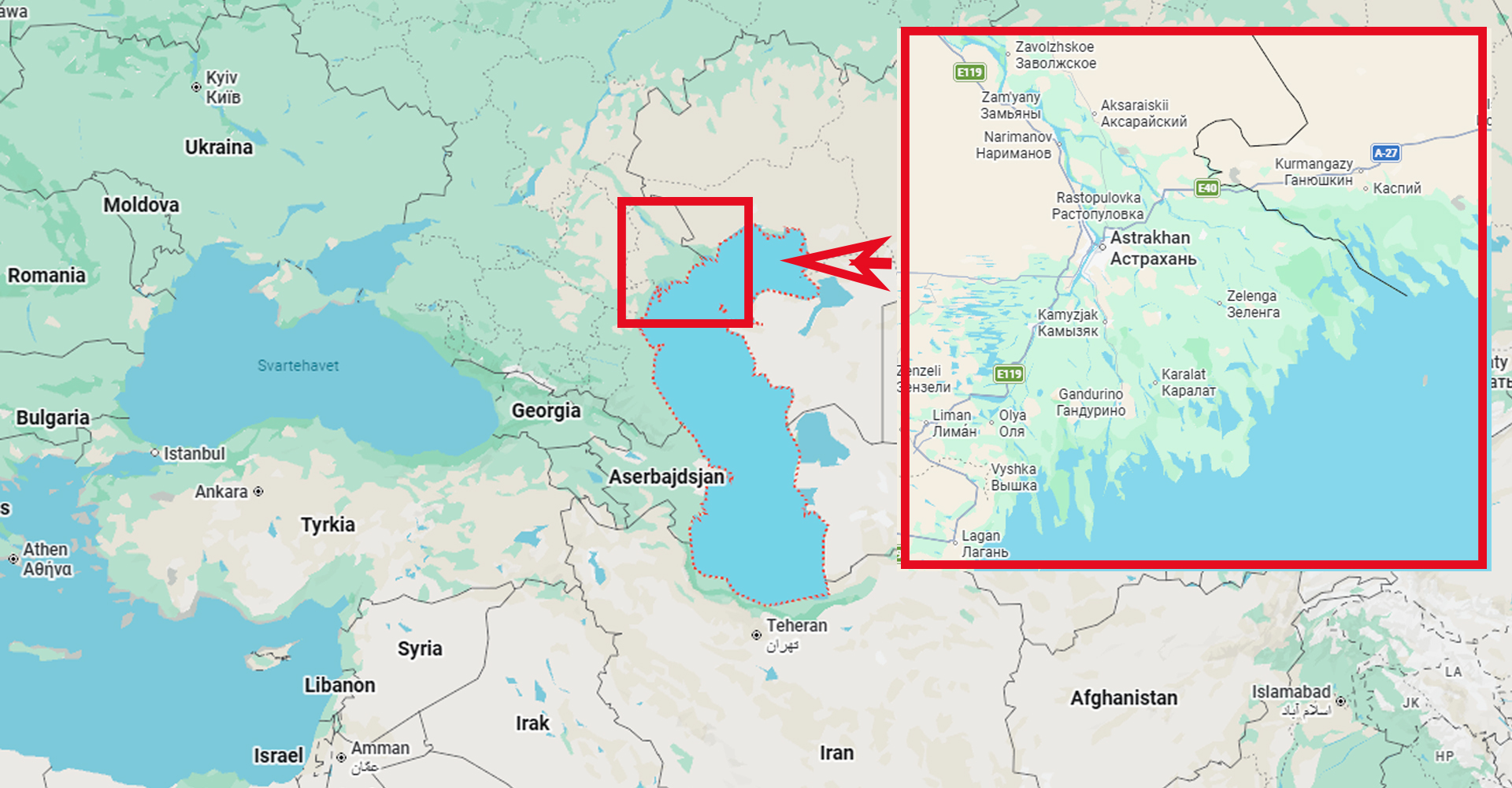
Technically, there is only one country between Ukraine and Iran. The Ukrainian drones only need to cross Russian territory before they drop down onto Iranian and Russian boats in the Caspian Sea.
TopPhoto: Private collection/theContrapart
Text: Rune Ollestad
Date: 3 August 2026
Translated from Norwegian with the help of AI · Read the original
For all of us who are not quite sure of the geography north of Iran, Motparten can reveal today that it is a fairly large sea stretching from Iran's northern border all the way up to Russia. In the northern part of the Caspian Sea lies the mouth of the great river Volga. Here one finds several important Russian port cities that send a steady stream of goods south towards Iran.
Firing on Iran
Ukraine's Security Service (SBU) announced on 25 July that its long-range drones had attacked several targets in the Russian part of the Caspian Sea. The cargo ships Port Olya 2 and Begey are said to have been hit. Ukraine has also attacked and hit an Iranian cargo ship. According to the SBU, the vessels have been used to transport military materiel between Russian and Iranian ports. Ukrainian authorities reported at the same time that the Russian missile boat Molniya had been hit. The extent of the damage to the vessels has not been confirmed by independent sources.
Dangerous mosquito bite
President Volodymyr Zelenskyj described the operation as part of Ukraine's long-range attacks on Russian targets. It nevertheless differs drastically from attacks inside Russia. Although the sinking of two ships amounts to a small mosquito bite in the great volume of trade traffic in the Caspian Sea, many analysts nevertheless fear the consequences. By attacking Iranian ships, it may look as though Ukraine is trying to extend the war to the Middle East. Perhaps they believe that by siding with the Americans in the war against Iran they will gain advantages.
Important trade corridor
If the ships have gone down with all hands, it is serious, but it still means little for trade in the so-called Caspian corridor. Official figures from the Russian customs service and Iran's IRICA show an annual bilateral trade value of around fifty billion kroner, of which over 96 % is now settled in the national currencies, roubles and rials. This means it goes under the radar of SWIFT and Western dollar systems.
Grain and steel
Russia exports goods worth roughly thirty billion kroner a year across the Caspian Sea. This is mainly grain, but we are also talking about millions of tonnes of fertiliser, timber and steel. Iran exports goods worth about twenty billion kroner a year northwards to Astrakhan and the Volga delta in Russia. Officially this consists of agricultural products, building materials and chemicals. .
Will tie up equipment
There is little doubt that Ukraine's operation amounts to a mosquito bite in this context. On the other hand, it is an important signal. If Ukraine manages to increase the scale, it could have major economic consequences, and perhaps force Russia and Iran to protect the traffic militarily, which would tie up equipment they need elsewhere. For the time being, however, there is little to suggest that this will be necessary.
Unrecorded figures and military transport
According to a number of independent sources, the real value of the Caspian corridor is far greater than the customs figures suggest. The reason is that trade in military materiel, drones, components, ammunition and sanctioned equipment is kept out of the statistics both in Iran and in Russia. Analysts estimate that the unofficial, defence-related logistics amount to several billion dollars, but this remains speculation.
Front pageSome think it is a stroke of genius by Ukraine, while others think it is a blunder.
Iranian protest
Iran is already at war with the USA. When Ukraine attacks Iranian ships, a link between the war in Ukraine and the war in the Middle East is immediately created. Iran therefore reacted strongly when Ukraine hit the Iranian merchant vessel in the Caspian Sea. According to the Iranian foreign ministry, one seaman was killed and another injured. Ukraine's chargé d'affaires in Tehran was immediately summoned to receive a formal protest.
Double-edged sword
Many are speculating about why Ukraine is attacking Iranian civilian shipping. There is little doubt that it may look like an attempt to escalate the war in Ukraine. Iran's foreign minister Abbas Araghchi later raised the attack in talks with the EU's foreign policy chief Kaja Kallas and Russia's foreign minister Sergei Lavrov. Araghchi asked the EU and the UN Security Council to respond to the attack. But this could prove to be a rod for Ukraine's own back. It is not certain that it is wise for the USA to use too many missiles in the Middle East when Ukraine needs them at home.
Sanctioned
Port Olya 2 is a Russian-registered cargo ship with IMO number 9481881. The ship is built to be able to operate both on Russian rivers and in associated sea areas. The vessel was covered by American sanctions in May 2022. The US Treasury's sanctions body OFAC linked the ship to the Russian shipping company Transmorflot. Ukraine claims that the ship has been used for deliveries of military materiel from Iran to Russia.
Ukraine can hit the big city of Tehran without crossing any country other than Russia.
Oil platform
The attacks were also aimed at an oil platform at the Vladimir Filanovsky field in the northern part of the Caspian Sea. The field lies in the Russian sector, about 170 kilometres south of Astrakhan. The water depth in the area is around nine metres. The Russian oil company Lukoil describes Filanovsky as the largest oil field on the Russian part of the Caspian seabed. The field was discovered in 2005 and put into production in 2016.
Uncertain extent
According to Lukoil, production reached the planned level of six million tonnes of oil a year in 2018. The complex consists of several fixed platforms connected by bridges. The facility has installations for production, processing and accommodation. Neither Russia nor Ukraine has said which part of the complex was hit on 25 July. Lukoil has not published any information about damage or halts in production either.
Caspian route
The ports at Astrakhan and the Volga delta form part of an extensive transport link between Russia and Iran. Port Olya lies on one of the Volga's outlet channels in the north-west of the Caspian Sea. The vessels on the route are often designed for sailing both on rivers and in open waters. This makes it possible to transport goods between the Caspian Sea, the Volga and the Russian canal system. Russia has three ports for grain exports in the area. A new terminal in Makhachkala is scheduled to be completed in 2028 and will have an annual capacity of 1.5 million tonnes.
MOTPARTEN
The other side of the story. An independent newspaper from Norway.
Contact
- Newsroomredaksjon@motparten.no
- Advertisingannonser@motparten.no
- General enquiriespost@motparten.no
Address
Motparten.noElevine Heedes vei 2
4839 Arendal
Norway Editor-in-chiefJesper Enerstvedt