The whole world chips in for the Iran war
Hidden tax rankles
Because the dollar is the world's reserve currency, the USA exports its inflation and its debt burdens to the rest of the world. When the country goes to war against Iran and burns through more dollars, it is YOU who must pay, through exported dollar inflation.
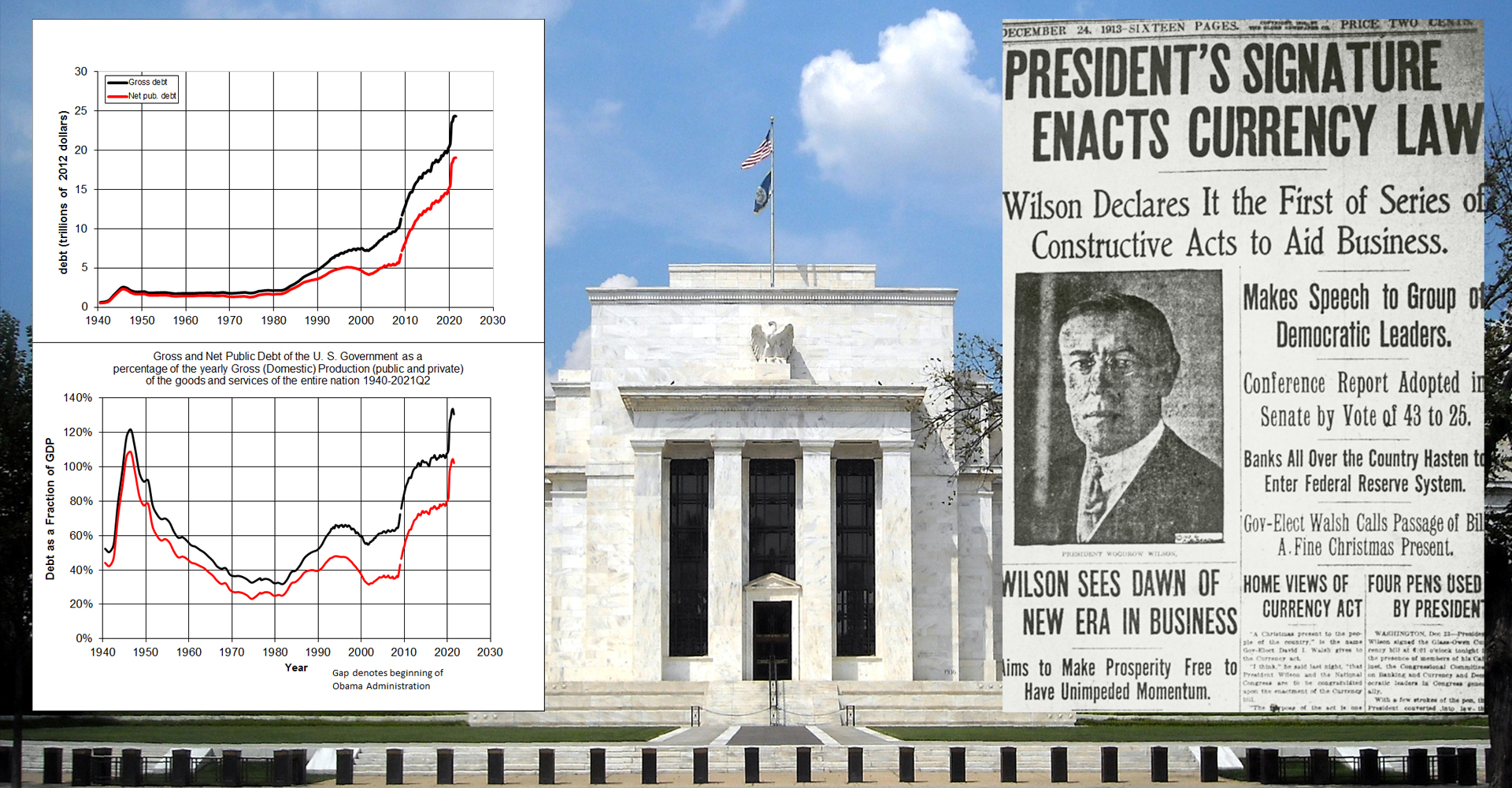
In the bar chart on the left we can see that the USA has taken off completely when it comes to printing money. The newspaper facsimile is from Christmas Eve, 24 December 1913. In the background we see the Federal Reserve Building in Washington, DC.
TopPhoto: AgnosticPreachersKid/United States Government CC BY 3:0/theContrapart
Text: Ludvig Storn
Date: 14 April 2026
Translated from Norwegian with the help of AI · Read the original
When Japan or France need money for war or big projects, they must either raise taxes or borrow money in a market that assesses their ability to pay back in euros or yen. The USA has no such needs. As the only country on the planet, it simply prints money that it lends to itself. This is how the rest of the world "pays" for every American military operation abroad. In fact, you pay twice, because you also have to pay for the consequences of more expensive fuel, energy and interest rates. This quickly shows up in higher food prices and a general rise in the cost of living.
Exorbitant Privilege
Many people who are annoyed with the USA ask why other countries, such as China, don't sell their American government bonds to hit the dollar. The answer is obvious. Since China holds so much in dollars, it would in practice wreck its own savings. Besides, China depends on Americans being able to afford to buy its goods. It becomes an impossible situation. Economists talk about America's "excessive privilege", or in the language of economics: "Exorbitant Privilege". The USA prints the currency that the rest of the world needs in order to buy oil and raw materials and to save safely. This creates a perpetual demand for dollars that no other country has, and that no other country can destroy without at the same time destroying things for itself.
Everyone chips in
The USA owes little money in Chinese yuan or euros. The USA owes in dollars because it borrows from itself. When nobody else wants to lend it money, the American central bank (the Federal Reserve) creates new digital dollars and buys the government's debt itself. It knows that nobody is able to stop it without hitting themselves at the same time. Most countries on earth are thus trapped in the American dollar trap. Every time the USA starts a new military adventure abroad, the inflation is exported to every country, so that the American war becomes a whip-round for all.
Affects us all
When the USA needs money, it raises the debt ceiling. That is a politer way of saying that it borrows dollars from itself. The beauty of such loans is that you never have to wonder whether the answer will be yes or no. You decide that yourself. The USA pumps more dollars into the system through government bonds. Two things then happen that affect the world's population:
"Seigniorage"
America's unique opportunity is called "seigniorage", or "minting profit": it costs the USA only a few cents to print a 100-dollar bill or to create it digitally. But for a coffee farmer in Brazil or a factory in China to get hold of that same bill, they must produce actual goods or services worth 100 dollars. The USA swaps paper for real resources. When more dollars are in circulation, the value of each individual dollar also falls. Since most countries hold large reserves in dollars, the value of their national wealth falls in terms of purchasing power. They are in other words paying through a "hidden inflation tax".
Front pageThe USA prints the currency that the rest of the world needs. This creates a perpetual demand for dollars that no other country can destroy without at the same time destroying things for itself.
Imposed
For now, the world accepts the system for several reasons. The strength of the dollar is closely tied to America's role as guarantor of global trade and to its military superiority. At present there is no real alternative that is large and stable enough (neither the euro, the yuan nor gold) to replace the dollar overnight, but BRICS is working to manage it.
Countries are fed up
What we are seeing in 2026, with the enormous costs after the attacks on Iran, is that trust in this system is being put to the test. Countries such as China, Russia and several other BRICS countries are now actively trying to trade in their own currencies so as to avoid financing America's deficit. If the rest of the world stops buying American debt, the USA will have to raise interest rates dramatically, which would crash its own economy. Until that happens, taxpayers in countries such as Norway or Japan must keep helping to finance American use of force and debt, because we are forced to use and hold dollars in order to take part in world trade.
Fiat currency
The American dollar is a fiat currency backed by the "full faith and credit" of the American state, which is a state that right now faces an exponentially growing national debt. A gold-backed BRICS currency could offer a stability the dollar lacks. By tying the currency directly to physical gold reserves, the BRICS countries create a new "safe haven". What is more, a haven that is immune to Western inflation policy. For nations in the Global South, the choice between a debt-based dollar and a commodity-based currency would tip in favour of the latter in order to secure long-term purchasing power.
Blockchain
By building a new currency on distributed ledger technology, blockchain, the BRICS countries can bypass the Western-controlled SWIFT system entirely. A decentralised currency allows direct settlement between central banks (CBDC) that is instant, transparent and, most important of all, unpredictable for American sanctions authorities. When transactions can no longer be blocked or monitored by Washington, the dollar's function as a political instrument of power disappears, which makes it more attractive for neutral nations to move their trade over to the BRICS network.
Commodity control
As Motparten has often written, BRICS now represents a larger share of world GDP, adjusted for purchasing power, than the G7 countries, and the control they have over strategic resources such as oil, gas and rare earths is formidable. If these nations begin to demand payment for their exports in the new currency, world demand for dollars will fall dramatically. This creates a self-reinforcing spiral: the more commodity trade that takes place outside the dollar system, the weaker the dollar's status as the world's reserve currency becomes, until the point where the "petrodollar" is replaced by a digital, gold-backed "BRICS coin" as the new global standard.
MOTPARTEN
The other side of the story. An independent newspaper from Norway.
Contact
- Newsroomredaksjon@motparten.no
- Advertisingannonser@motparten.no
- General enquiriespost@motparten.no
Address
Motparten.noElevine Heedes vei 2
4839 Arendal
Norway Editor-in-chiefJesper Enerstvedt