Photo: starship.xyz/press//theContrapart
Text: Christer Andre Mæland
Date: 28 June 2026
Translated from Norwegian with the help of AI · Read the original
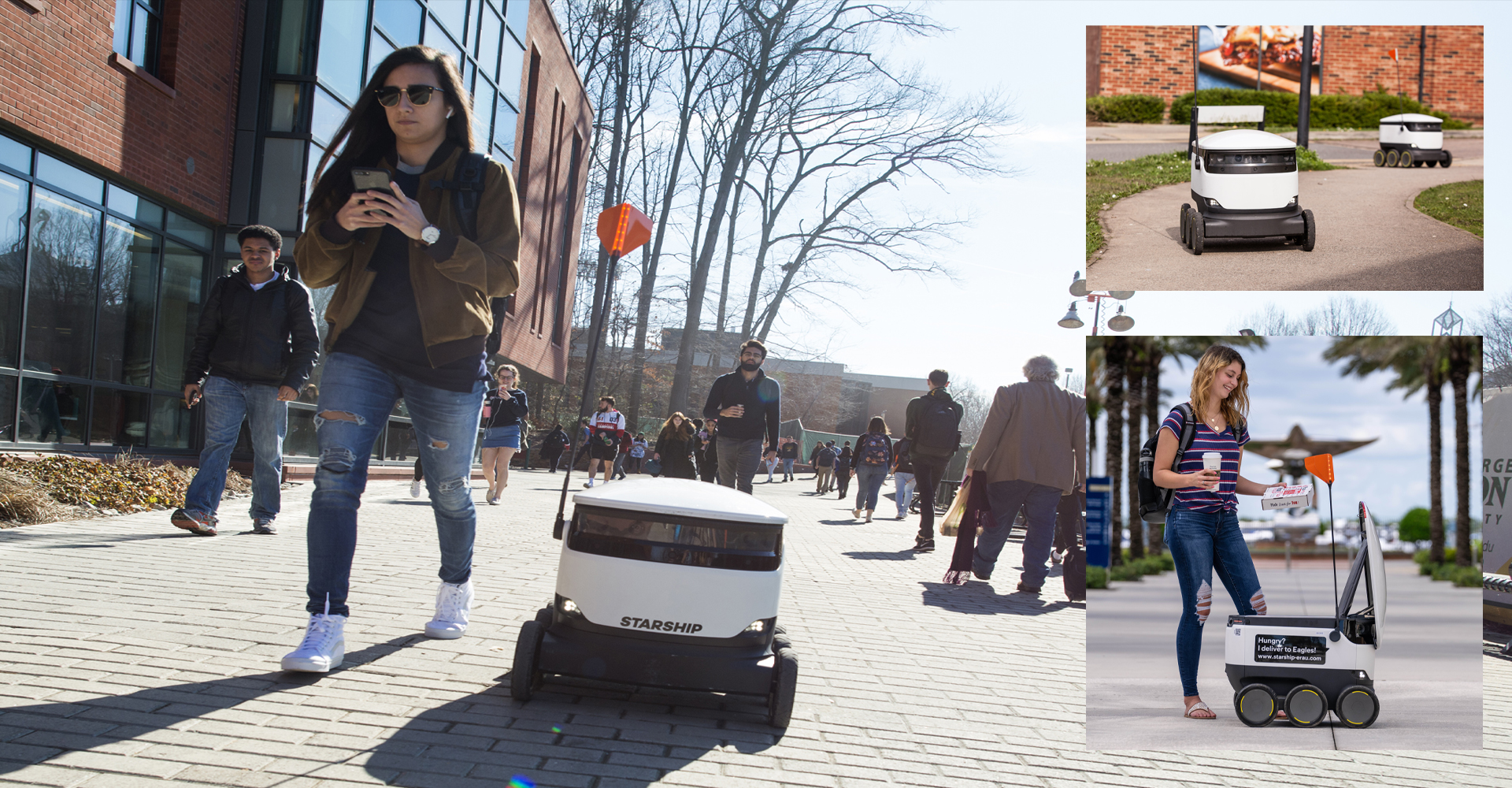
In other countries the little creatures are called "delivery robots". In Norway they may just as well end up with a nickname like "courier robots". In a number of cities in the US and the UK, the new thugs are already a common sight.
Everything is banned
The small, driverless robots Norwegian football fans see on American pavements, such as those from Starship Technologies, are not yet allowed to run you down on Norwegian pavements. In practice, this means there are no separate rules in Norway that allow them to roll around on pavements on their own. And as most people know, in Norway anything that isn't regulated is forbidden.
Rules – rules – rules
In Norway, road traffic legislation applies. The law currently contains a basic principle that every vehicle must have a responsible driver. The small driverless robots definitely do not. Self-driving vehicles can only be used in Norway if they are covered by existing rules or have been granted special permission.
Dead leg
Although many start-up founders, and surely larger established tech companies, are itching to launch driverless courier robots, they will have to be patient. But new technology has a tendency to force its way through. Without risking a fail in fortune-telling, the undersigned therefore believes it is only a matter of time before you can also risk a proper dead leg from an overeager robot coming in low from behind.
Pilot projects
The first thing we are guaranteed to see here in Norway is robots operating on exemptions through time-limited pilot projects, approved by the Norwegian Public Roads Administration (Statens vegvesen) under specified conditions. From there it is not a long way to permanent arrangements. That depends, of course, on whether anyone is injured by the robots during the trial period, but here Norway has a big advantage. By not being first, it can let other countries, such as the US, learn by trial and error.
Responsibility
It is likely that the first robots you see on Norwegian pavements will already be second- or third-generation courier robots, whose teething troubles are a thing of the past.
Still, a number of issues arise in connection with the robots' activities.
Who, for example, is responsible in the event of an accident?
Top
It doesn't help that something is well tested in a number of other countries. In Norway everything has to go through endless bureaucracy and long test periods. Then everything has to be evaluated by politicians in a series of ministries. It would have been easier if the EU had introduced courier robots. Then they would have become legal in Norway straight away.
Pedestrians
The robots' relationship and interaction with pedestrians, wheelchair users and the visually impaired could become the subject of a number of disputes. There are also many other legal questions that must be settled in Norway, the homeland of rules. What requirements should apply to speed? The e-scooter problems are fresh in our memory. Nobody wants metal boxes rolling around on the city's pavements at a hundred kilometres an hour. Most likely, the maximum speed will be set at something resembling a walking person in no hurry.
Weight
And what about size and weight? Are we to have rolling wardrobes weighing several tonnes that could crush old ladies if someone pushes them over or an accident happens? Norway is a winter country. What about ice and road conditions? Will the robots be required to have studded tyres? Will they have to pay for a studded-tyre sticker? And what will the environmental movement say about more particulate pollution?
Bureaucracy or not. The courier robots are coming soon!
Privacy
Even how the robots' sensors and cameras work will quite certainly be the subject of debate in Norway. Taking pictures of other people is strictly taboo in Norway. There are laws for that. What does the law say about small rolling boxes taking pictures of your children on their way to school? No matter how much Norway puts a spanner in the works for the robots, they have probably come to the planet to stay. In Japan, South Korea, the UK and Germany they are already rolling around with both groceries and fast food.
Environmentally friendly?
One of the biggest manufacturers and suppliers of robots, Starship Technologies, says they are both safe and environmentally friendly compared with the alternatives. Not all bicycle couriers are necessarily so sure about that. Although some trade unions have already begun to grumble, the robots seem to be marching on to global victory. A report from the analysis firm Transforma Insight tells us that by 2034 there will be more than two million courier robots on the world's pavements.
Front page