Chinese navy to protect subsea cable
Undersea Great Wall of China
Chinese authorities fear the US will cut the new undersea cable in the event of a conflict. Under strict secrecy, China has therefore launched a massive military build-up underwater. Beijing is developing what it calls "the Undersea Great Wall of China"
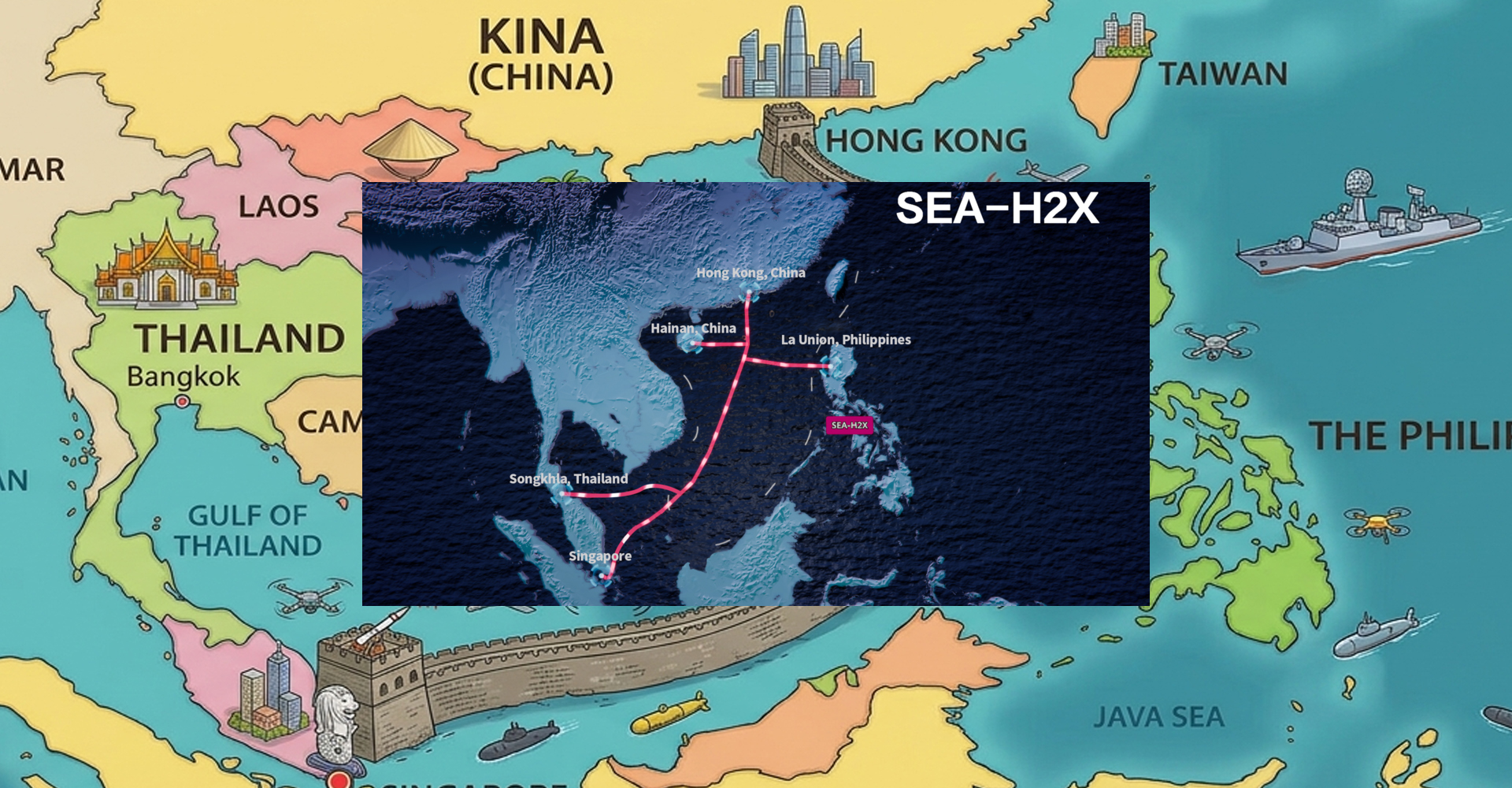
China has secretly built an extensive security network on the seabed to protect the new cable. Every vessel that comes close will be detected and dealt with.
TopPhoto: Desken/Gemini AI/theContrapart
Text: Rune Ollestad
Date: 13 August 2026
Translated from Norwegian with the help of AI · Read the original
China has secretly built a gigantic network of hydrophones, underwater sensors and autonomous robots that monitor movements along the seabed in real time. If foreign submarines approach the digital subsea cable, China's navy can move out within minutes to intercept the threat. The massive data cable measures 5,746 kilometres. By comparison, that is more than one and a half times the length of Norway's entire mainland coastline from Lindesnes to Kirkenes.
SEA-H2X
The cable has been brought ashore and links Hong Kong, the Chinese island of Hainan, the Philippines, Thailand and Singapore. The system has a total transmission capacity of more than 200 terabits per second. That gives the cable a data capacity that allows it to carry more than ten million high-definition video streams simultaneously across the vast ocean areas. China Mobile confirms that the SEA-H2X cable has now entered commercial operation.
China Mobile
The military project has become particularly pressing after the telecoms giant China Mobile completed the new gigantic undersea data cable in South-East Asia. China does not want a local Nord Stream, but admits that it will be difficult to guard the entire cable. After all, the new digital link is as long as the distance from Oslo to the North Pole and back.
Long cable
For China, subsea cables like SEA-H2X are a nightmare to protect. Despite the military's new measures, analysts believe the cable still lies unguarded over thousands of kilometres in the disputed South China Sea. There it is wide open to sabotage from submarines, divers or perfectly ordinary fishing boats that happen to drop heavy anchors or bottom trawls over the fibre. In reality, China has no way of monitoring every single metre of the cable around the clock. But unlike Nord Stream, which was unguarded, China says anyone who tries anything with the cable should not feel too safe. The navy has orders to eliminate any threat without mercy.
Home pageChina has secretly built a gigantic network of hydrophones, underwater sensors and autonomous robots that monitor movements along the seabed in real time. If foreign submarines approach the digital subsea cable, China's navy can move out within minutes to intercept the threat.
Has a backup
Cutting SEA-H2X would hurt badly, but data traffic would be rerouted immediately via China's land-based fibre network across Central Asia and other undersea routes. At the same time, military experts are crystal clear that all data traffic on the cable is held under strict, state military encryption, so that hostile powers cannot eavesdrop on sensitive Chinese command lines even if they should manage to tap into the fibre. It is clear that China is doing everything in its power to prevent the cable from becoming a kind of Asian Nord Stream.
Important to many
The build-out was carried out to meet the explosive growth in demand for computing power and data processing linked to artificial intelligence in the Asia-Pacific region. China Mobile says the new undersea line establishes a digital circle with a delay, known as latency, of just 30 milliseconds between Chinese data centres and South-East Asia. The aim of the low response time is to give businesses end-to-end security and a cost-effective infrastructure for data processing. The project links the Chinese free zone on Hainan and the industrial region around Guangdong, Hong Kong and Macao directly to the fastest-growing digital markets in South-East Asia.
Chinese control
China Mobile is the operator of the cable's global control centre, the Network Operations Center. The company says this centre will provide real-time monitoring, technical fault diagnosis and ongoing capacity optimisation to prevent network access outages and ensure stable data flow. The company is integrating the new venture with its existing subsea cables such as APG, SJC and intercontinental lines to the Middle East and Europe. In other words, the cable will not be a closed circuit, but will connect to the large global network. The enormous subsea cable joins a series of gigantic Chinese projects. Everything is biggest in China these days.
MOTPARTEN
The other side of the story. An independent newspaper from Norway.
Contact
- Newsroomredaksjon@motparten.no
- Advertisingannonser@motparten.no
- General enquiriespost@motparten.no
Address
Motparten.noElevine Heedes vei 2
4839 Arendal
Norway Editor-in-chiefJesper Enerstvedt