Researchers sound the alarm over Google
A threat to democracy
That a single company controls browsers, search, maps and advertising is deeply alarming. Many well-known researchers and politicians are now warning about the consequences of an American company having gained such a position in Europe.
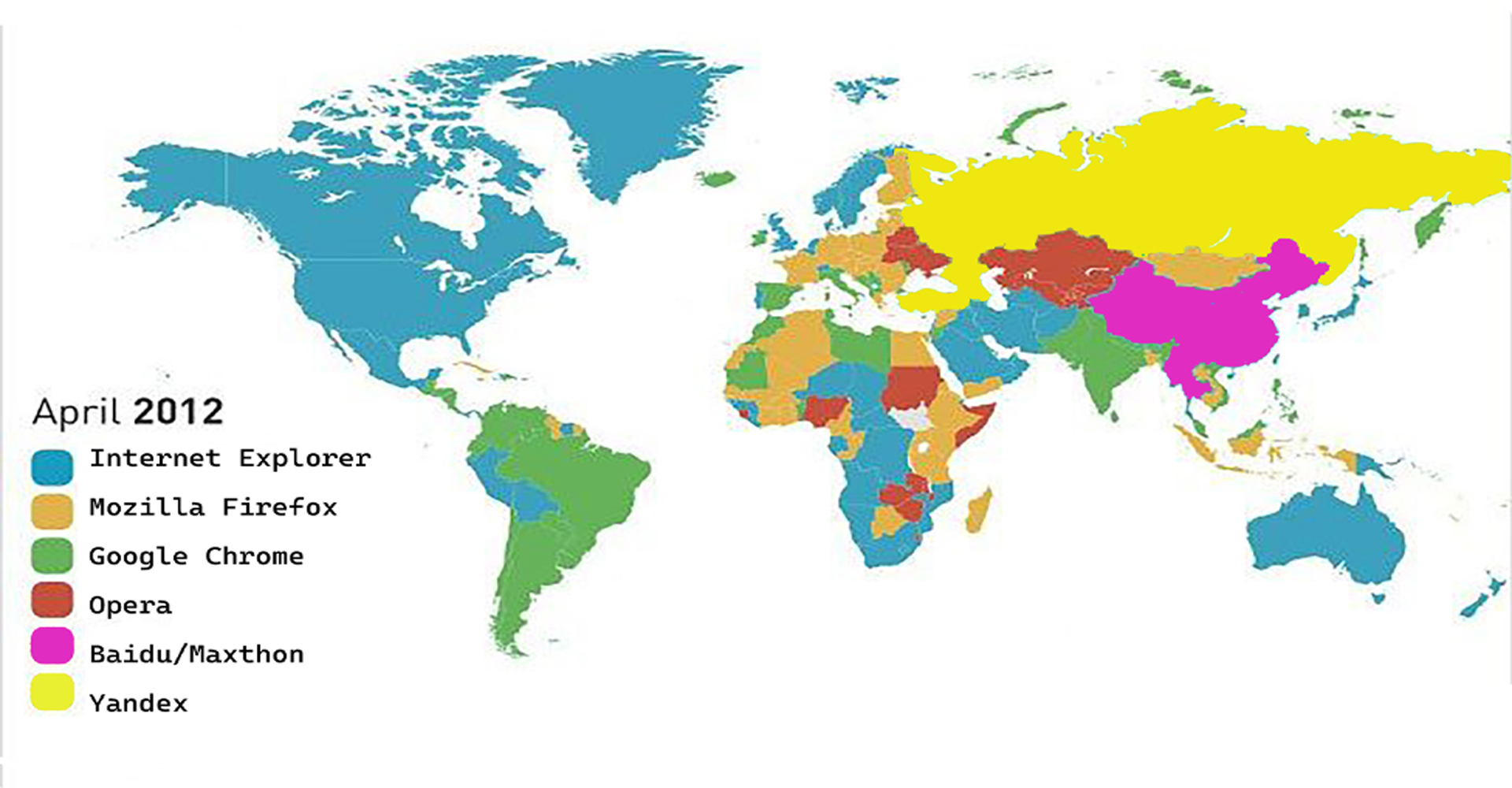
In 2012 there was still hope of a world with free competition and plenty of choice for users.
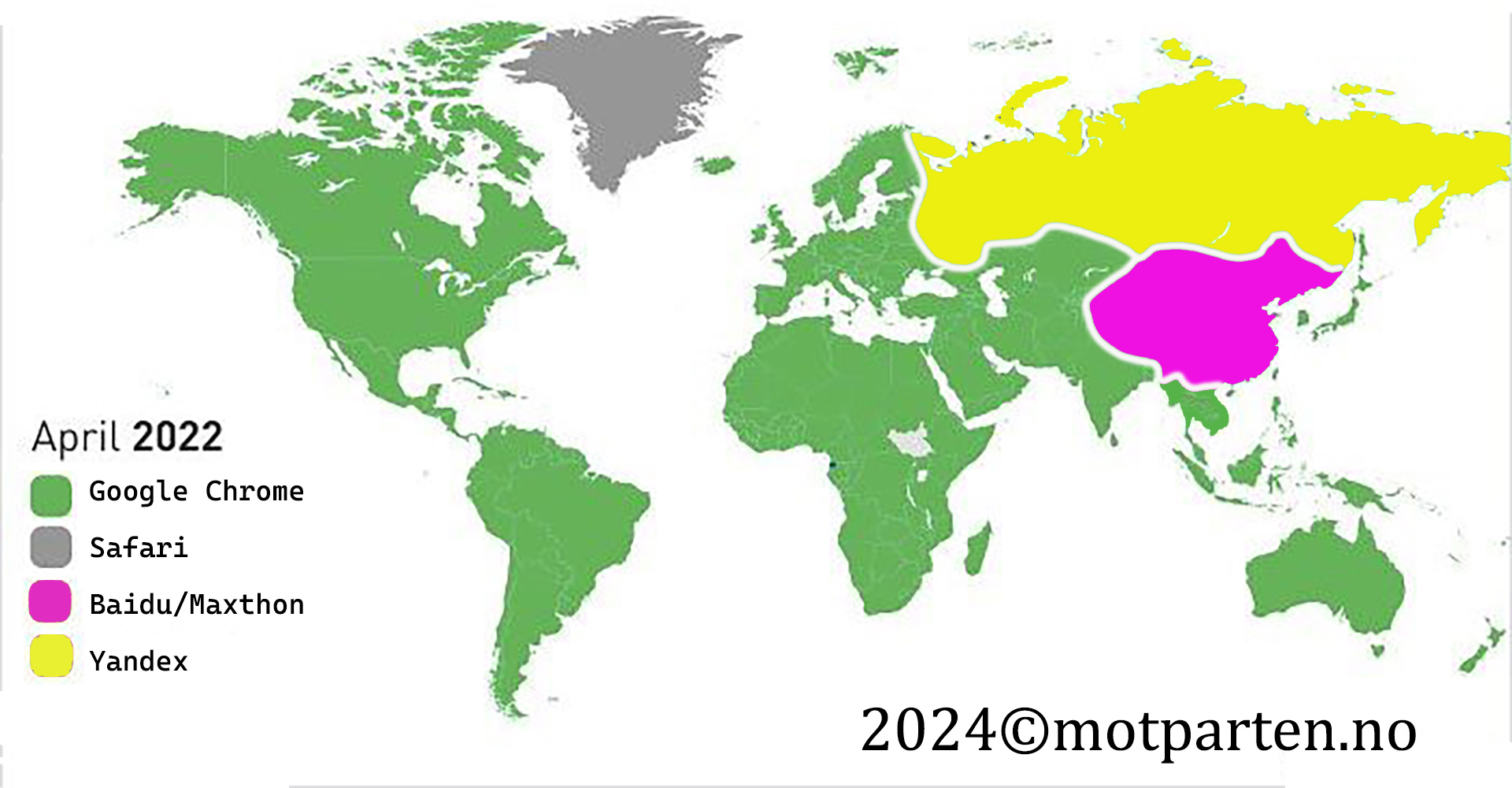
Twelve years later, all hope was gone in the West. Over the past two years Google has cemented its position by overturning a court ruling to break up the company.
TopPhoto: Motparten/Desken/theContrapart
Text: Atle David Torkildsen
Date: 28 August 2026
Translated from Norwegian with the help of AI · Read the original
If you look at the maps produced by Motparten, you can see that in 2012 many different browsers were fighting for control of the internet. The map shows how Internet Explorer, Opera, Chrome, Firefox, Yandex, Maxthon and Baidu competed in a seemingly free market with free competition. When Motparten covered the story in 2024, the picture had been turned completely upside down. Google and Chrome decided everything. Only the two countries that the democracies of the West regard as undemocratic still hold out against the new technological dictatorship. Those countries are, of course, China and Russia. When the EU troops enter Moscow, Russia too will be absorbed into what is ultimately to become a planet with one people, one country, one leader – Google Earth.
Worse than a cartel
In Norway, grocery chains can face heavy fines and prison if they collude on prices. Such illegal collaboration is called cartel activity. That is exactly what Meta and Alphabet are doing in Europe, but even on their own they are bad enough. Both have built up monopoly positions for their platforms or apps.
Dangerous for democracy
At the time of writing, there is in practice no longer any competition in the West. Google's Chrome has seized power and rules supreme. Google has a monopoly on both search and browsers. But what frightens the researchers most of all is that Google is also tightening its grip on a range of other areas, and in doing so shaking the foundations of what we call democracy.
Chickens
Most Western democracies have ended up in a kind of pool of powerlessness and confusion. They are terrified of breaking democratic rules, yet they can see that this cannot go on. In the meantime, Meta and Google exploit the confusion to bulldoze ahead and secure total power for the unforeseeable future..
Misuse of data
The EU hesitates and fumbles its way through one failed court case after another, handing Meta and Google fines that are never paid. A more dictatorial and fast-acting system could solve the problems, but then the EU would need to have the guts to impose sanctions, force companies to be broken up and order changes quickly, with no right of appeal. Financial supervisory authorities in authoritarian states operate like this – successfully.
Even though things look bleak, there are both individuals and influential organisations who believe they know how to effectively put a stop to the tech dictatorship in Europe. Read the editorial coming on 1 September.
Home pageEndless rounds in the courts and judgments worth billions run off the tech giants like water off a duck's back as they do exactly as they please. The laws and rules of nation states are set aside, and the courts are completely helpless.
Powerless
There is little doubt that Google abuses its market position to suppress competition and create various forms of distortion of competition. Regulators and antitrust authorities who would love to haul Google in for abuse of market position and antitrust violations stand powerless, with no means of taking action.
Impossible to beat Google
Two years after Motparten first put the spotlight on Google's iron grip, American courts ruled that the company had an illegal monopoly. For a while people almost believed the giant had been beaten, but no such luck. In a mysterious way, in September 2025 Google managed to get Judge Amit Mehta to side with Google. The judge suddenly refused to force a break-up of Chrome. Instead he let Alphabet keep the browser that binds the empire together. Alphabet's share price jumped 8 per cent on the stock market that same evening.
Generous judge
Nothing has been found to indicate that the judge received any money, but it is proven that in just one hour he sent the Appabet share shooting through the roof. The increase in value is estimated at 234 billion dollars added to market value in a single day. The judge's decision alone was worth 2,000 billion kroner in increased stock market value. For comparison, that is more than double Norway's entire state budget for a whole year.
The fight is not over
The Justice Department and 35 states were absolutely furious. In February 2026 they announced an appeal. It will certainly come to nothing at all. The map of browser power still looks just as uniform. Chrome rules, and no forced break-up is in sight.
China and Russia
Many who are worried point out that there are other solutions. In China, for example, several browsers share the power. 360, UC, QQ and Baidu are some of the most popular. The browser Maxthon is also popular, with over 200 million users. Russia also has many browsers and search tools, with the Russians' home-grown Yandex sitting at the top. The most used and popular search tool in Russia is Yandex. Only a few countries in the West take action to preserve their own integrity. The Alphabet spectre. Looking at the map, only Russia and China stand in opposition. It is a paradox that the West has to such an extent submitted to a powerful propaganda apparatus, when that is exactly what it criticises China and Russia for being victims of.
MOTPARTEN
The other side of the story. An independent newspaper from Norway.
Contact
- Newsroomredaksjon@motparten.no
- Advertisingannonser@motparten.no
- General enquiriespost@motparten.no
Address
Motparten.noElevine Heedes vei 2
4839 Arendal
Norway Editor-in-chiefJesper Enerstvedt