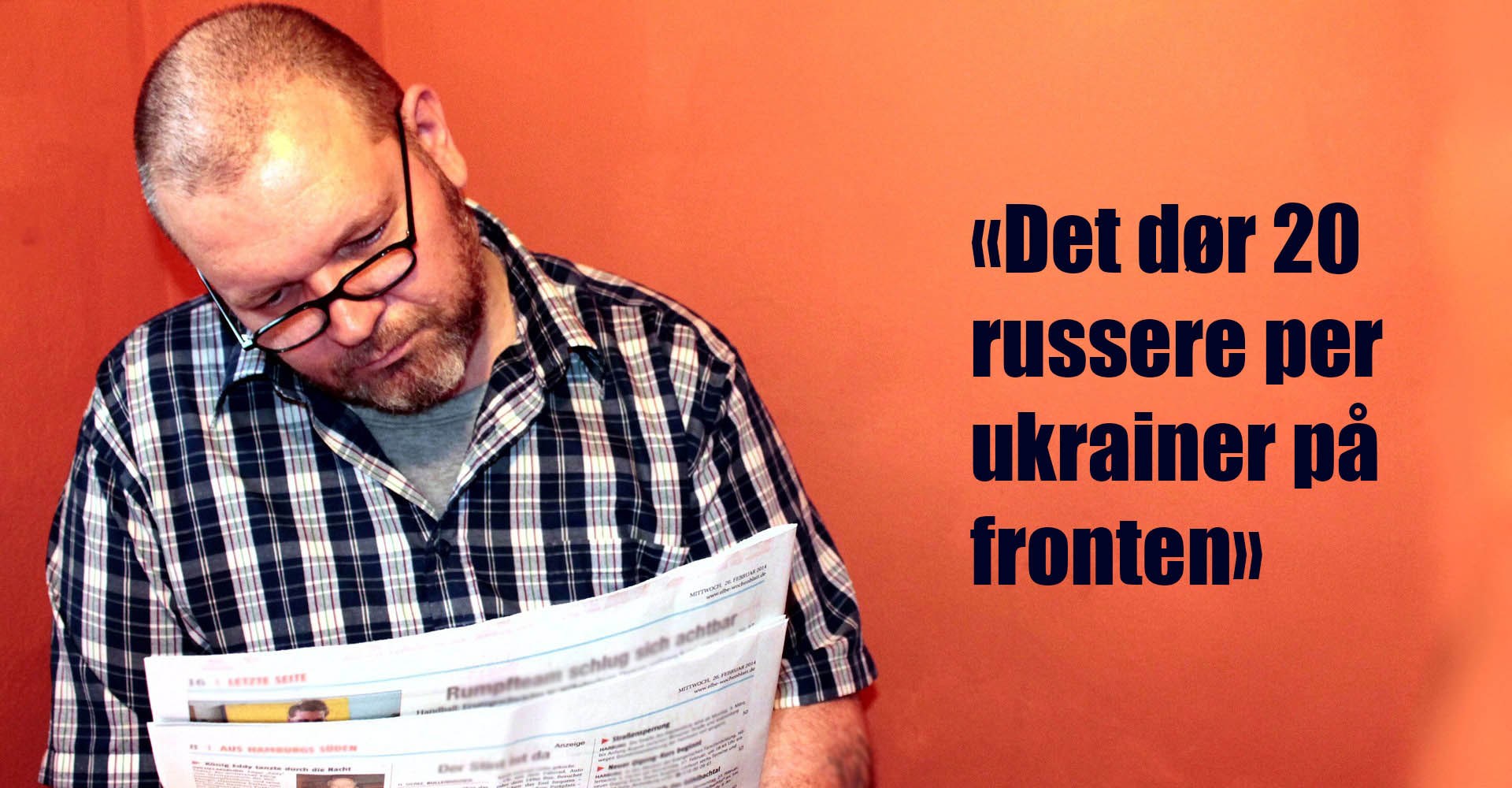
The front in Ukraine has stood still for several years, and the forces are fighting with roughly equal weapons. It is logical that the losses are equal. Yet the press, in Russia and in the West alike, fails to convey anything close to the truth.
The so-called "sources" the newspapers use are dubious at best. It is nevertheless the editor's responsibility to strike a balance.
Even though the information is freely available to every journalist, the press in no country manages to write in a balanced way about the fact that the war is a senseless slaughterhouse in which almost as many people die on both sides of the front.
The editors are not solely to blame, even though they bear the responsibility. Journalists should also strive to find as many independent and credible sources as possible.
Obviously wrong
For almost four years now, the Norwegian public has been fed utterly ridiculous claims that twenty Russians die for every Ukrainian. Russian media serve up much the same thing with the sign reversed. To anyone with common sense, it becomes completely idiotic.
The casualty figures are accompanied by a steady stream of news about progress at the front and the enemy's abuses against civilians. Nobody cares about the truth.
Victory is just around the corner
Russia is losing strategically, the Russian economy is collapsing, and with just a few billion more from the Oil Fund, Ukraine will retake its 1991 borders. Week after week, Norwegian experts have analysed village-level tactics as if they were decisive turning points. In this they have something in common with the experts on Russian TV. They all report that victory is just around the corner. But ordinary people all know that the front has stood still for years and that terrifyingly many people are dying on both sides.
In countries like Norway, with unanimity that war is the road to peace and that rearmament is the solution, there will be no evaluation of the press's role afterwards. Editor Enerstvedt of Motparten is denied access to forums such as the editors' association, the writers' association and debate programmes in national media.
Real casualty figures
In a speech in the Polish parliament, Prime Minister Donald Tusk said that Ukrainian losses have now reached around 27,000 killed and wounded every single month. Tusk stressed that the figure is based on information from Ukrainian partners, and described it as the highest level since the war began. Tusk's figure is interesting for anyone who wants a picture of what is really happening.
Norway has the figures too – but rarely uses them
For example, Forsvarets Forum wrote in another article in August 2026 that independent media have identified 242,747 Russian soldiers killed in Ukraine since the full-scale invasion began in February 2022. This is shown by a count from the Russian website Mediazona and BBC's Russian service. The figures imply that Russia, too, has between 20,000 and 30,000 killed and wounded per month. Just like Ukraine. It gives pause for thought that neither Russian nor Ukrainian media are able to capture this similarity objectively, even though it is logical that the losses are equal when the front has stood still for several years and the fighting is waged with roughly equal weapons.
Ukraine is struggling
Losing so many soldiers is serious for both countries. Because Ukraine has a smaller population than Russia, it is most serious for Ukraine, but neither country has an unlimited supply of cannon fodder. According to official figures from Rosstat and the Russian authorities, and international overviews from the UN, Russia's population is estimated at around 143 million people. The UN estimates that Ukraine's actual population in areas under the control of the government in Kyiv is now somewhere between 35 and 37 million people.