Distributing billions' worth
Thailand narco hub
The amount of drugs seized each year in northern Thailand shows that Thailand is one of the world's biggest distributors of narcotics. So many billions change hands that banks and business play a central role in the money laundering.
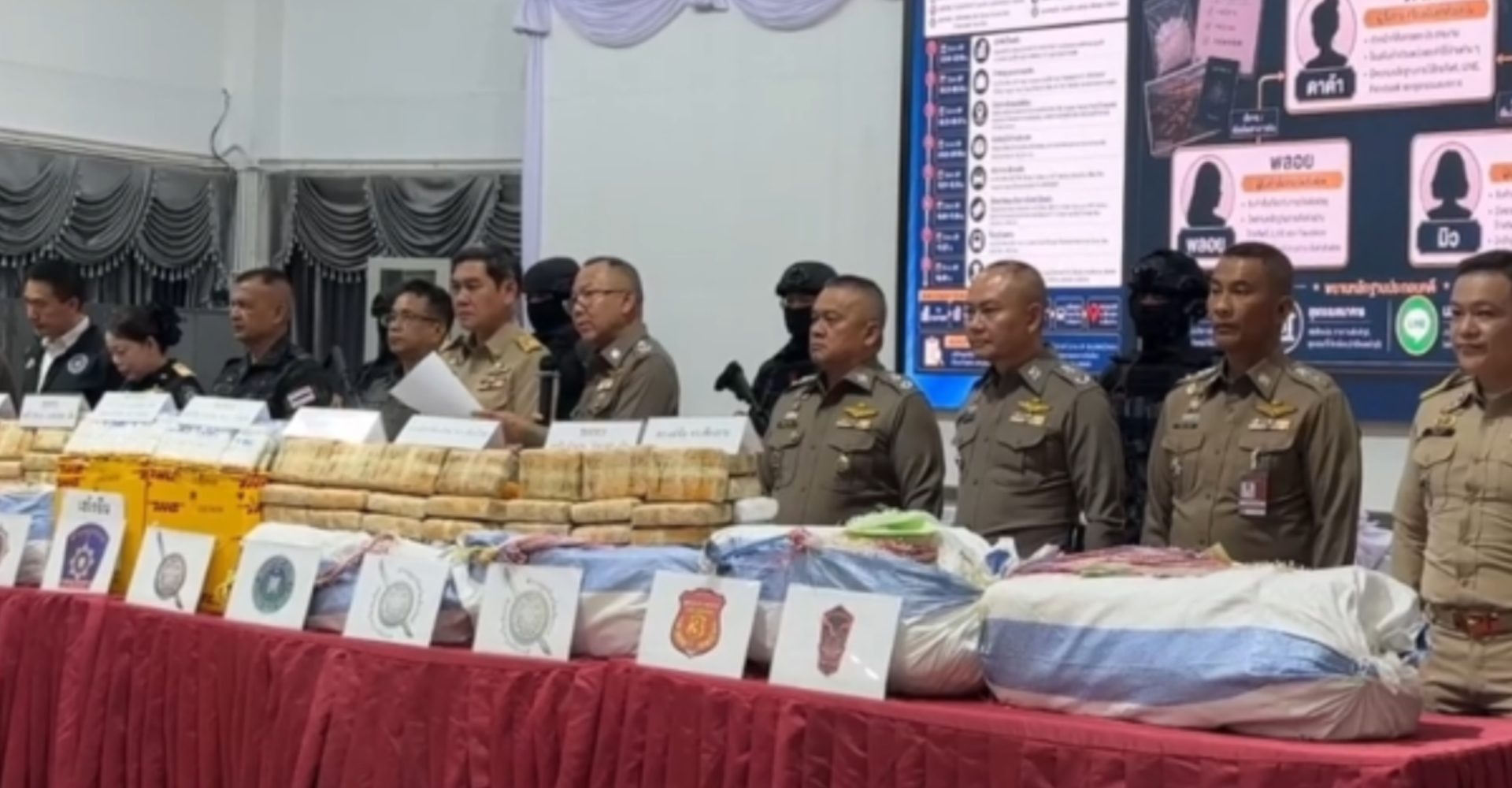
Even though the police seize tonnes, it is known to be just the tip of the iceberg. The police are, moreover, themselves suspected of being involved in a network that reaches all the way to the top in both politics and banking.
The topPhoto: Thaibloid/Provincial Police Region 5/theContrapart
Text: Rune Ollestad
Date: 25 August 2026
Translated from Norwegian with the help of AI · Read the original
From 1 October 2025 to 5 August 2026, Provincial Police Region 5 registered a total of 27,345 drug cases, of which 315 are categorised as major cases. When a case is called major in Thailand, it is not a matter of a few thousand pills, as in Norway. It is a matter of millions. And that is just the tip of the iceberg.
Wide selection
In the past year alone, Provincial Police Region 5 seized over 420 million yaba tablets. Yaba is the Thai name for amphetamine pills. In the same period, over ten tonnes of crystal methamphetamine were seized. Thailand is at the top of the world in distribution. In addition, 105 kilos of heroin, over 1,300 kilos of ketamine and 410 kilos of opium were seized. The police's own valuations put the goods at no less than 1.58 billion baht.
Tip of the iceberg
If you assume that the police manage to catch only a few per cent of what is smuggled, you get an idea of how much is really involved. We are talking about billions of amphetamine pills, hundreds of tonnes of crystal methamphetamine and many tonnes of top-quality heroin. Before it is multiplied many times over by costly middlemen abroad, the sales value is already at least 50 billion baht, or about 17 billion Norwegian kroner, by the time it leaves Thailand.
Like Colombia
By comparison, according to UNODC's latest survey of coca in Colombia, 2,664 tonnes were produced. Colombia alone accounts for over 67 per cent of all coca grown in the world, a total of 376,000 hectares globally. UNODC claims that cocaine production in Colombia had a value of 27 billion kroner in the local market. UNODC seldom updates such figures annually, as they are very uncertain to calculate. It is important to stress that this is not the sales value in the end market, which is hundreds of times higher.
Money laundering
If you compare the exports from northern Thailand, which the police themselves put at 17 billion kroner in the local market, you see that the difference between Thailand and Colombia is not that great. That says a lot about the sums involved, and just as in Colombia, enormous amounts are laundered by local business, police and the financial sector.
The small ones get caught
Most of the seizures probably come from freelancers trying to get rich. The very biggest consignments are protected by police and border guards, and have been paid for and cleared in advance. This is clearly evident from the methods private individuals use. They differ markedly from larger consignments, where tonnes of goods are not even hidden but placed openly in lorries.
Sunscreen
Small smugglers have to be more creative than the big cartels, which can afford to pay bribes and have the power to make people keep their mouths shut. For example, last week Thai police intercepted a consignment of 8.62 kilos of heroin hidden in sunscreen bottles in Chiang Mai. Two women were arrested. The packages were reportedly ready to be shipped to Australia via an international freight company. The seizure was announced on 6 August at the headquarters of Provincial Police Region 5 in Chiang Mai.
Home pageThailand has a turnover on a par with Colombia, but a much better selection. Here you can get amphetamine, ketamine, opium and heroin. It is free choice of top-shelf goods.
Police wash their hands
At the same press conference, the police reported the seizure of 3.2 million methamphetamine tablets and the arrest of three suspects in total, also young women. Police chief Kritthaphon Yisakhon presented the results together with the governor of Chiang Mai, Ratthaphon Naradis, and representatives from the Department of Special Investigation, the Office of the Narcotics Control Board and the Third Army Region. Although the seizure seems large by Norwegian standards, most experts believe it is only a tiny piece in a pattern that, according to UN figures, makes Thailand an important hub for drug exports out of Southeast Asia.
Tip-off
It is very likely that the women were reported by a cartel because they had tried to go it alone. The shipping documents listed a sender with an address in Rim Tai in Mae Rim district, while the recipient was reportedly listed with an address in Australia. Surveillance footage shows two young women handing in the packages at the counter.
Small fry
The two suspects, aged 19 and 20, were later arrested on board an ordinary coach. Big cartels operate in a completely different way. The border station is warned well in advance that a lorry is coming, or a boat if it is on the Mekong. Many therefore believe that the police seizures are often just for show. So much money is at stake that it is unlikely that very wealthy forces in Thailand are not involved.
Norwegian book
In the 1950s and 1960s the CIA was involved in opium and heroin smuggling. Before that, the royal family had a monopoly on opium. In the book Kodenavn ROC, Motparten's editor Jesper Enerstvedt describes how Thailand's biggest bank, Bangkok Bank, was founded on the back of this traffic. They did not know what to do with all the money, and therefore lent on a large scale to criminal syndicates throughout Southeast Asia. The book can be borrowed from the library or ordered from, for example, ARK bookshop.
UN
The UN Office on Drugs and Crime, UNODC, has therefore repeatedly pointed out that Thailand in particular plays a major role as a transit country for drugs bound for third countries. In its Myanmar survey for 2025, UNODC found that the area under opium cultivation in Myanmar increased by 17 per cent from the year before, to 53,100 hectares. According to UNODC, Myanmar is the world's leading source of opium and heroin.
The press
According to Al Jazeera, a total of 236 tonnes of methamphetamine were seized in Southeast Asia in 2024. That same year, Thailand became the first country in the region to seize over 100 tonnes of methamphetamine in a single year. UNODC's acting regional representative for Southeast Asia, Benedikt Hofmann, told Al Jazeera that the official seizure figures represent a fraction of the actual amount of drugs reaching the market.
MOTPARTEN
The other side of the story. An independent newspaper from Norway.
Contact
- Newsroomredaksjon@motparten.no
- Advertisingannonser@motparten.no
- General enquiriespost@motparten.no
Address
Motparten.noElevine Heedes vei 2
4839 Arendal
Norway Editor-in-chiefJesper Enerstvedt