Thailand seizing houses and cars
Norwegians could lose EVERYTHING
The month of August has alarmed foreign homeowners in Thailand. In the popular resort town of Hua Hin, 200 police officers carried out a raid. Arrest warrants were issued for 45 foreign pensioners.
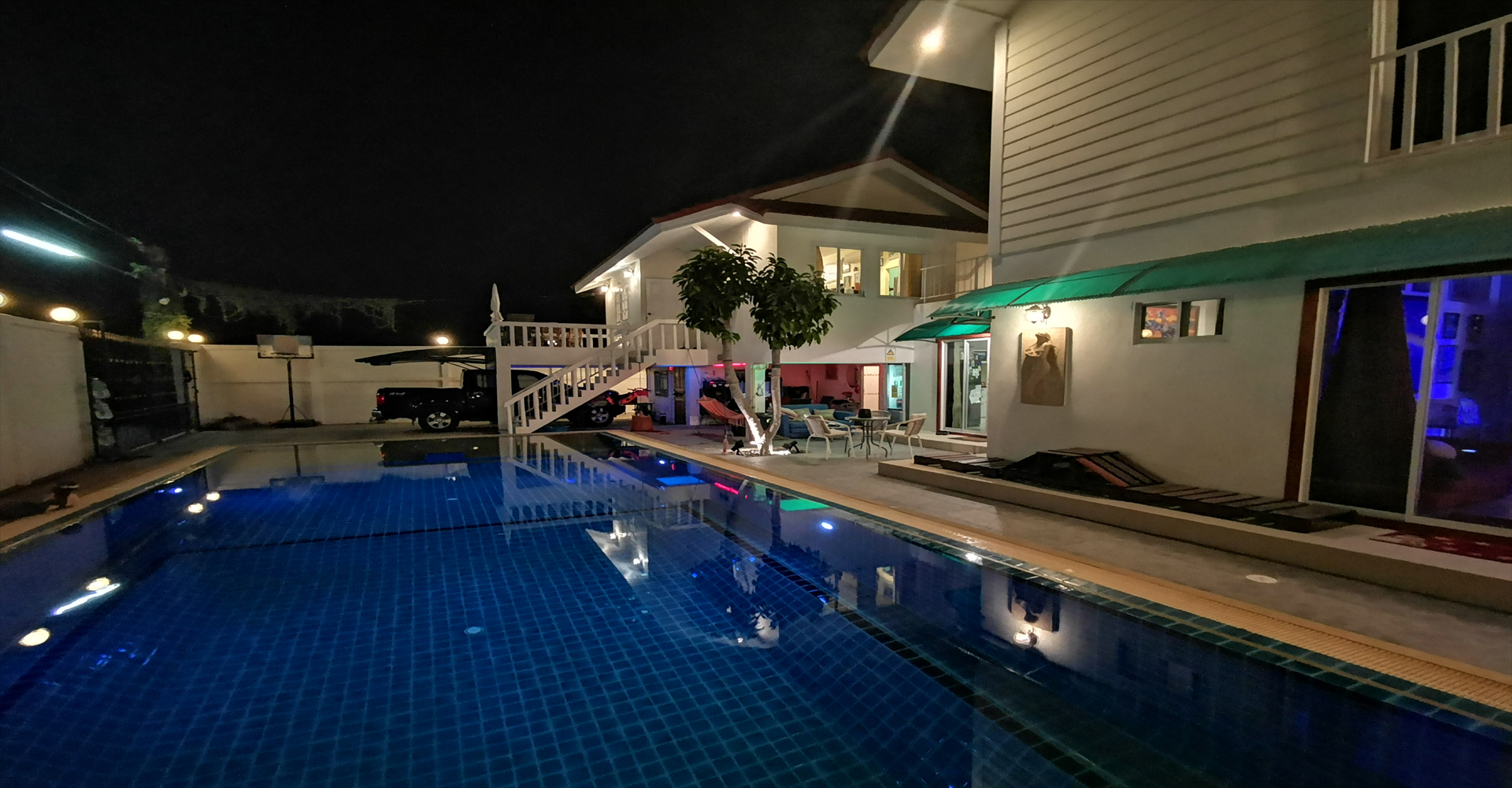
The Norwegian owner of this house used a limited company and was a minority owner. He sold out just in time.
TopPhoto: Enerstvedt/desken/theContrapart
Text: Rune Ollestad
Date: 22 August 2026
Translated from Norwegian with the help of AI · Read the original
MOTPARTEN/HUA HIN In Thailand, foreigners are in fact not allowed to own land. Thousands of foreigners, among them many Scandinavians and Norwegians, have got round this by setting up limited companies in which Thais of modest means hold 51 per cent of the shares, while the real owner from abroad is the only one with voting rights.
Always been forbidden
For those unfamiliar with Thailand, it should be pointed out that most of those who have used this system were advised to do so by local accountancy and law firms. They have had ready-made packages in which they pay Thai nationals a token sum to appear on paper as owners of 51 per cent of the shares. They then draw up articles of association under which only the foreigner has voting rights. The company then obtains title deeds to property through the local land office.
An enormous shock
The system has worked perfectly well for decades. It must truly be said that people have always said, in the everyday way, that this is not actually allowed. That it is a circumvention of the law, but because accountancy firms all over Thailand have organised the setting up of these companies, people have simply laughed off the possibility that it could go wrong. It has been almost non-existent. That is why the raids come as a veritable shock to many pensioners. Many have put everything they own into their holiday home and have built a life there, the way others use their cabin in Sørlandet (southern Norway).
A major operation
As you read this, the Thai authorities are carrying out a well-coordinated operation involving the police special units (CIB), the business ministry (Department of Business Development – DBD) and the land authorities (Land Department). They are moving out in force in a coordinated national offensive. Shocked pensioners who have spent half a lifetime in Thailand watch columns of police cars drive into the villa areas where they live. The police are now carrying out operations in Phuket, Koh Samui, Pattaya, Chiang Mai and Hua Hin at the same time. In August 2026, more than 200 police officers raided luxury villas in Hua Hin, where more than 40 arrest warrants were issued against foreigners, along with summonses for Thai nominees.
The Seamen's Church
According to figures from the Norwegian Seamen's Church (Sjømannskirken), between ten and fifteen thousand Norwegians live in Thailand. There is no official statistic on the share who live in their own home bought through a minority shareholder company, or who lease or rent. Industry sources and social media forums indicate that most long-term foreign residents in Thailand rent rather than own. One of the reasons is precisely that both the ownership structure with a Thai company and the 30-year lease are perceived as complicated and uncertain.
Worst case
If we nevertheless dare to venture a worst-case estimate, it could be that 20 per cent of permanent residents own through a company. That would mean that between two and three thousand Norwegians are now at risk of losing everything they own. They also risk both arrest and deportation.
An educated guess
The figures from the Seamen's Church are often close to reality. They are in close contact with the Norwegian embassy. They keep up to date on how many people have reported moving abroad, and how many, for example, draw disability benefit from NAV (the Norwegian labour and welfare administration). They also know how many ask for documentation of income in connection with applying for a Thai visa, or renewing one.
Some think the foreigners have only themselves to blame – others, rather, that Thailand ought to take responsibility, because accountants and lawyers have sold these packages for decades. Norwegian pensioners have been escorted straight into the accountant's office by estate agents, and met lawyers who assured them that everything was in order.
Serious this time
Let it be said right away. This time it is not just a warning shot, even though they are going after the richest first. What we are now witnessing in Thailand is part of a systematic and escalating campaign that has been under way since January 2026. The Hua Hin raid was only phase 6 of a named nationwide operation. In Hua Hin alone, the authorities inspected 233 plots in a week. We are talking about buildings and land worth 2.5 billion baht, equivalent to almost eight hundred million Norwegian kroner.
Home pageAs many as 3,000 Norwegians may be at risk of losing everything they own and have. They also risk both prison and deportation. Many pensioners who have never in their lives been involved in anything illegal are now living in fear.
New laws
What is different from earlier operations is the new rules. From 1 January 2026, the Department of Business Development requires documented proof of the origin of the money for all newly registered Thai companies. That turned out not to be enough. A further tightening therefore followed almost immediately. From 1 April 2026, the checks were extended to cover company registrations. This is where thousands of Norwegians and Scandinavians are going to struggle.
Modernising
It is not long since people in Thailand could simply move to another town if the bills piled up. There was no good national debt-collection system. The lack of an overarching, coordinated system of penalties was convenient and gave many people a sense of security. That is now changing completely. The authorities are now using AI to analyse more than 50,000 company registrations and property transactions involving foreign owners, in order to uncover suspicious patterns. For example, they look for Thai shareholders whose finances do not match the value of the shares. This is a catastrophe for Norwegian pensioners who believed they owned houses in Thailand.
Must be documented
A 51/49 set-up with Thai/foreign ownership shares is no longer enough. Real ownership must be documented. The consequences of cheating the system are serious. When an illegal nominee structure is confirmed, the land office can freeze the title deed and, under Section 94 of the Land Code, seize the property in addition to bringing criminal proceedings against the minority shareholder. We are already seeing this happen with the arrests in Hua Hin. So we are no longer talking about random spot checks. We are witnessing a structured, resource-intensive and politically anchored campaign led directly from the prime minister's office via the Interior Ministry. ) which over time will reach more and more people. Pensioners who own their house through "minority shareholder" companies in which the Thai shareholders have never paid for the shares or had any real role are now in a very precarious position.
A nightmare for pensioners
For many Norwegian pensioners, it is a nightmare to read that the business ministry is using an AI system that cross-references company registers, tax data and bank information. The system automatically flags companies in which Thai shareholders lack proven income to own their shares. The authorities have introduced a requirement that all Thai shareholders in companies with foreign involvement must submit bank statements proving that they have actually paid for their own shares with their own money.
Circumventing the law
Both the Thai business law (the Foreign Business Act) and the property law (the Land Code) state that foreigners cannot own land. It is a criminal offence to use Thai nominees to circumvent this ban. For years, however, lawyers and accountancy firms in the tourist towns have sold standard packages with nominees. In the ongoing investigations, the authorities have questioned the Thai shareholders, who admit that they never put any money into the company. They received a small sum for signing the papers. When this is uncovered, the company structure is declared an unlawful circumvention of the law, which leads to the company being dissolved and the land purchase being declared invalid.
Confiscation and deportation
Changes to the law are being considered to allow outright confiscation to the state treasury without compensation. The foreigner, the nominees and the advisers who helped all risk fines and prison sentences. The foreigners risk deportation, cancellation of their visas, and a lifetime blacklisting from entering Thailand is also a possibility.
Popular discontent
There are several reasons why the Thai authorities have changed course. Over time, strong popular and political discontent has built up over foreigners driving up house prices and owning large areas of land in the tourist provinces through illegal nominees. The measure is also part of a wider clean-up of foreign crime and unregistered business activity in Thailand.
The Norwegian in this article was lucky. He got out before the authorities struck with full force and tightened the laws at the same time. Thousands of Norwegians may still be sitting with their hearts in their mouths. Now what to do is anyone's guess.
MOTPARTEN
The other side of the story. An independent newspaper from Norway.
Contact
- Newsroomredaksjon@motparten.no
- Advertisingannonser@motparten.no
- General enquiriespost@motparten.no
Address
Motparten.noElevine Heedes vei 2
4839 Arendal
Norway Editor-in-chiefJesper Enerstvedt