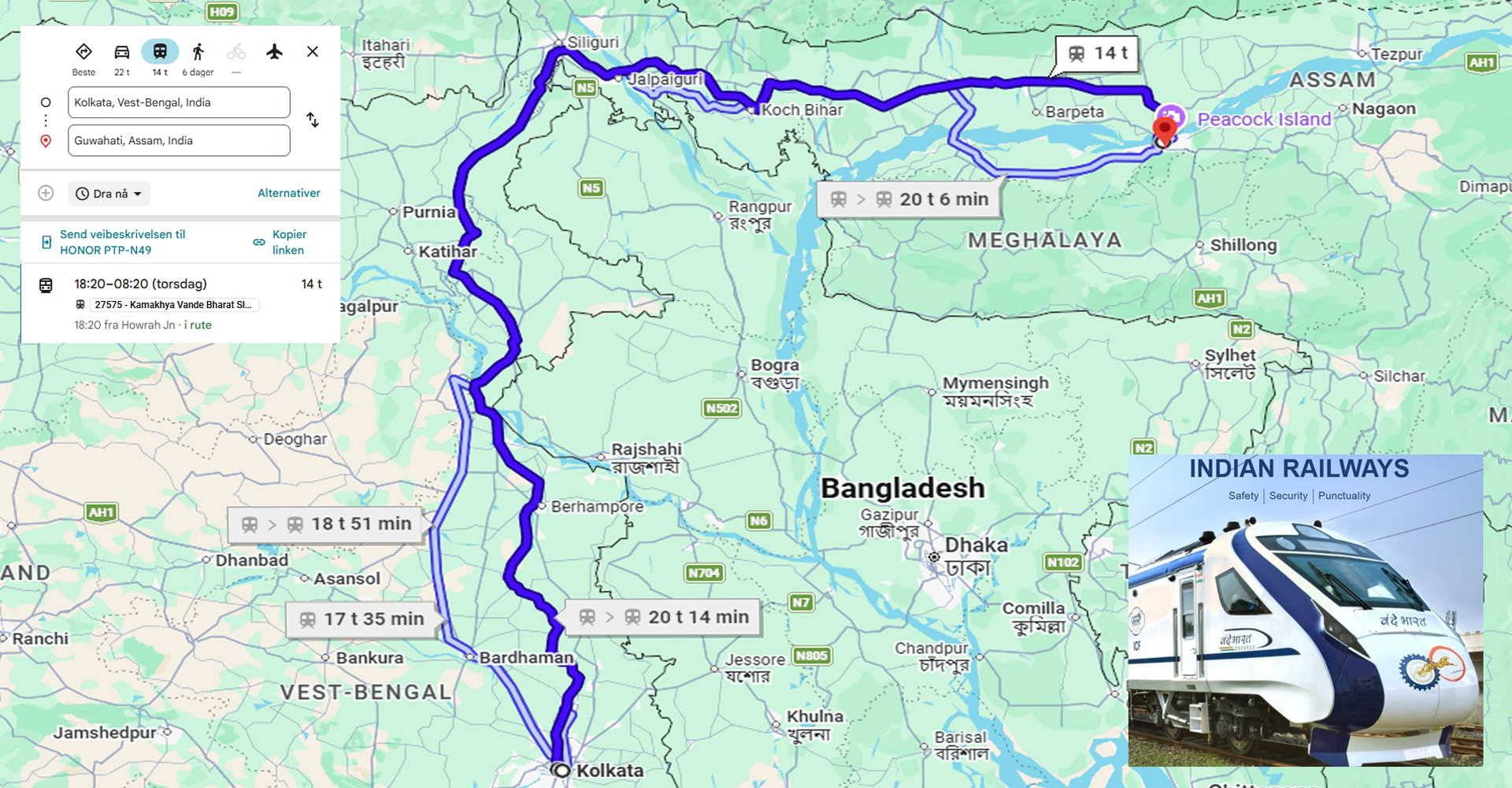
Photo: Indian Railways IRCTC-/Google map/desken collage/theContrapart
Text: Atle David Torkildsen
Date: 23 May 2026
Translated from Norwegian with the help of AI · Read the original
The first route runs from Kolkata to Guwahati and takes 14 hours. It offers one of the most varied train journeys in India. Experience colonial cities, temples, tea plantations, enormous rivers, national parks and views of the Himalayas. In the starting city of Kolkata you can see Howrah Bridge, the Victoria Memorial and the Dakshineswar Kali Temple. The city also has colonial architecture and ancient trams. You can eat plenty of good street food on Park Street and at New Market.
Himalayas
Along the way you pass Malda, with the ruins of the medieval city of Gaur. About halfway through the journey you reach New Jalpaiguri and Siliguri. If you get the chance, it is worth a stop, because you are in the heart of Darjeeling tea country. This is also where you find the branch line, the Darjeeling Himalayan Railway, a spectacular route into the Himalayas. This train, however, does not have the standard you get on the Vande Bharat, which is the name of the new train.
Elephants and jungle
After the Himalayas the train descends through misty valleys in the Dooars region. Here you can see wild elephants grazing along the railway lines as you pass through lush green vegetation. From the jungle you suddenly emerge into a completely different landscape as you arrive in Cooch Behar. Those who have time can get off and take a closer look at Cooch Behar Palace. It is an Indian mini-version of Buckingham Palace, only built in genuine Bengal style.
Rivers and villages
The train continues along the great Brahmaputra River, past villages packed close together, before finally arriving at the destination, Guwahati. Like Kolkata, it has plenty of temples and attractions too, but many tourists try to see real rhinos! There are of course elephant safaris in one of Asia's most spectacular safari areas. No wonder. Here you will also find buffalo, wild tigers and a good many other animals most people have only seen on TV.
The new trains are modern in every conceivable way. As you can see from the video at the bottom of this article, the trains keep a decent European standard. They are also much cheaper and glide through a fairytale landscape. Experience mountains, valleys, jungle, plains, wild animals and incredible architecture. All of it from the train window. And best of all – it's cheap!
Indian trains
For most people, trains, both new and old, are synonymous with being made either in Germany or in China. India, however, builds its new sleeper trains itself. They look no worse than their European or Asian competitors. They are aerodynamic on the outside and have a good, clean standard inside. There is nothing to complain about in the speed either. They rush through the night at nearly two hundred kilometres an hour.
Top
Many associate Indian trains with nightmarish, overcrowded, dirty, delayed – chaos trains packed to bursting with people. A grotesque combination of waterless toilets without toilet paper, where you do your business down a hole in the floor.
Good quality
The trains were launched by India's prime minister Narendri Modi as recently as January 2026. In a country where sleeper trains are synonymous with delays, dirt and chaos, the new trains caused a great stir both in and outside India. The trains have 823 berths. There are three classes, but so far neither single nor two-person compartments. In first class, four people share a compartment. The train's name, Vande Bharat, means greetings to India in Sanskrit. The train has automatic sliding doors and a comfortable interior, and it behaves better in every way than its older versions. After stopping at stations or at a red light, the train does not start off with a lot of jerks that nearly throw you out of your bed. On the contrary. It glides smoothly away.
For the tall, too
It has previously been a problem for people of a certain height that the beds on Indian trains have been too short. You simply could not stretch out your legs. And if you accidentally stuck them out a little into the corridor, you could get a nasty knock when passers-by try to take them along with them, or they get smashed by heavy suitcases or the cleaner's trolley. In short, in every possible way the new trains keep a standard that will satisfy a slightly fussy Western tourist. But where are they going? India is so big, so very big.
Cheap
And the price for the whole experience is by no means off-putting seen through Norwegian eyes. Tickets for the whole Kolkata–Guwahati route cost around 200 kroner for third class, where six berths share each open compartment. Second class costs 250 kroner. Here there are four berths behind curtains. In first class you share a closed compartment with three others. Nor is the price likely to shock Norwegian wage earners. The whole trip costs only three hundred kroner, and dinner and breakfast are included! You buy the tickets through the Indian Railways IRCTC website.
WATCH VIDEO