Chinese foreign minister on Nordic tour
Royal welcome
In Denmark, Chinese Foreign Minister Wang Yi's visit received wide press coverage. He was given tours by the prime minister and met the king. In Finland he got royal treatment and a tour of the countryside. In Norway he was taught democracy by Barth Eide.
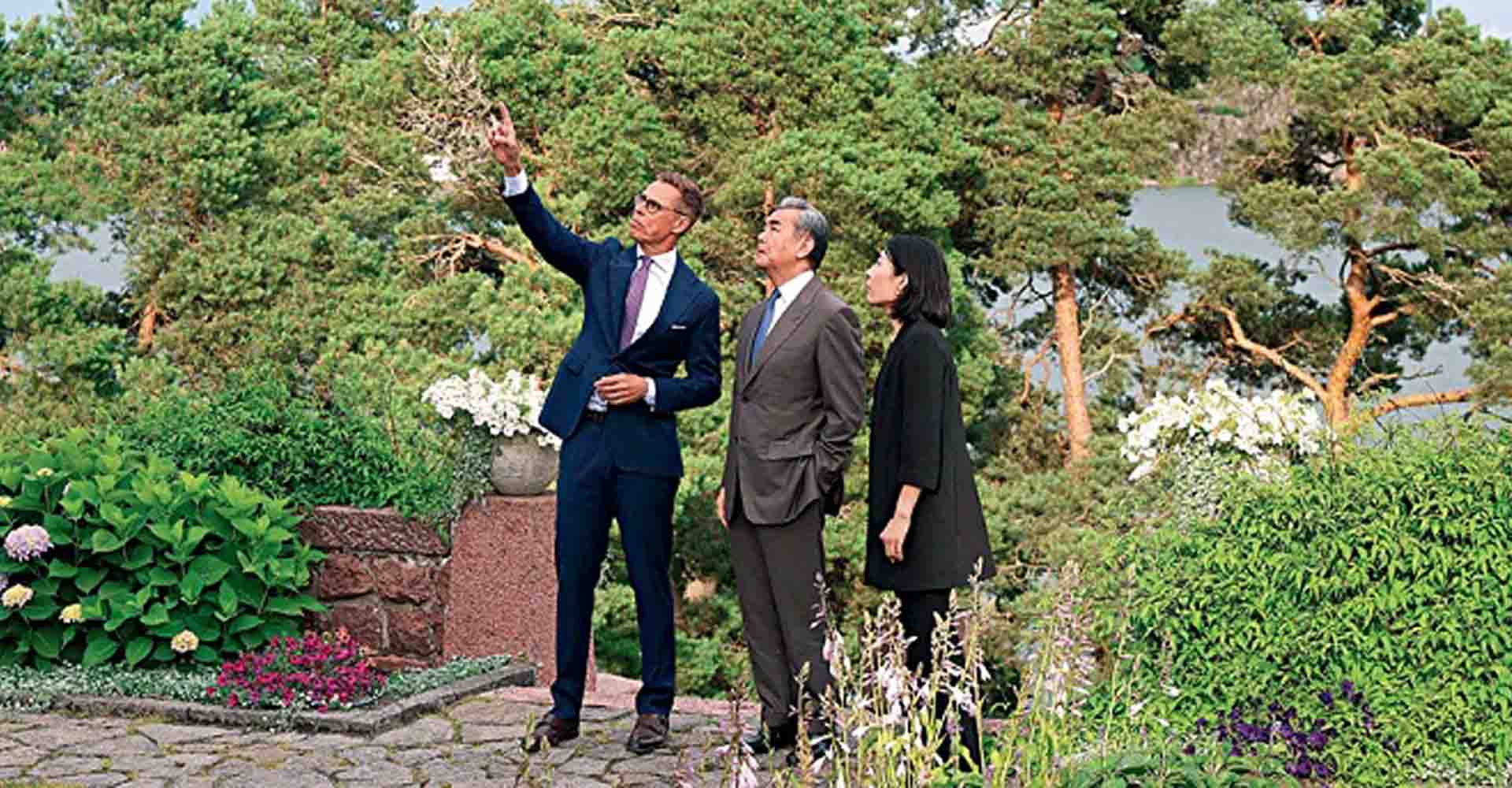
Finland's president Alexander Stubb gives China's foreign minister Wang Yi a tour of Turku, Finland, 5 July 2026
TopPhoto: Barth Eide: Official State Department foto/ Chuck Kennedy/Wang Yi: Office of U.S. National Security Advisor/motparten
Text: Stein Olav Krosby
Date: 4 September 2026
Translated from Norwegian with the help of AI · Read the original
It is doubtful whether China's foreign minister enjoyed spending his visit to Norway in a small grey office being taught about democracy by Foreign Minister Espen Barth Eide. The treatment stood in stark contrast to how our neighbouring countries treated the powerful minister from the country with the world's biggest and strongest economy.
Smart neighbours
In Denmark and Finland they did their utmost to make the foreign minister's visit both pleasant and financially rewarding. The same cannot be said of introverted Norwegians. In Norway, people are still struggling to adapt. It is not many years since big brother USA told the Norwegian Police Security Service (PST) and Norwegian politicians that everything Chinese was dangerous and could be used for spying. Here on the rock, it takes longer to adapt than it does for more pragmatic politicians in other countries.
Not-so-charming bird
In many ways Norway has become Brussels' and the EU's little cuckoo in the Nordic region. A backward-looking country echoing, with a croak, the sour criticism the Chinese experience from Brussels. Instead of letting China build a container port in northern Norway and invest in the future through the new ice-free passage, Norway stands on the sidelines like scowling southerners from the Bible belt. This is exactly the opposite tactic to what we see in Finland and Denmark, where politicians and business leaders have understood that they can make money together with the Chinese instead of fighting them.
Being a Norwegian politician must be confusing. Trailing after allies who constantly swing between being friends and foes of China depending on what suits their wallets is a tricky balancing act, but Norwegians have long experience of the consequences of a policy of bootlicking.
Suspicious press
Somewhat reserved politicians and a suspicious Norwegian press corps received the minister when he visited Norway this summer. Few Norwegians even noticed that he was here. That could prove to be both a stupid and an expensive strategy for the people up on the rock in the north. It also stands in stark contrast to our neighbouring countries. In Denmark, capable business leaders queued up to meet the minister. He seemed to appreciate the attention from the land of Lego, chocolate and beer.
Powerful man
Wang Yi is China's foreign minister and a member of the Politburo committee of the Chinese Communist Party. He is definitely one of the country's most central foreign policy players. Norway therefore had a golden opportunity to exert influence when he was in the Nordic region in July 2026. For six days, from 2 to 8 July, the minister travelled around Denmark, Sweden, Finland and Norway. It was a very rare tour of the Nordic region, in which Beijing tested whether it was possible to maintain a good relationship with some of the EU's most China-critical governments.
Home pageChina has not forgotten that Norway gave the Nobel Prize to a Chinese dissident. Once the dust had settled, Norway threw out Huawei because the USA said it was spying.
Met the King of Denmark
The programme included meetings with Danish Foreign Minister Lars Løkke Rasmussen and a personal audience with King Frederik in Copenhagen. In Stockholm, the minister also met Prime Minister Ulf Kristersson and Foreign Minister Maria Malmer Stenergård. In Helsinki he held meetings with President Alexander Stubb and Foreign Minister Elina Valtonen.
A lesson in democracy
So the minister got to meet the King of Denmark, but in Norway he got a lesson in democracy from Foreign Minister Espen Barth Eide instead. The latter is an expert on democracy, and on how other countries ought to behave. He always takes the opportunity to generously tell others how they can learn from Norway. In this, Barth Eide has something in common with the leadership in Brussels.
Time for sour criticism
Just two weeks before the minister arrived, the EU's national leaders backed a tougher line towards Beijing. Like Barth Eide, Brussels hopes the Chinese will come to Europe to learn democracy. The EU leaders insist that the Ukraine conflict does not take up all their time, and that they have plenty of time to spare to teach the world's biggest economy a trick or two. Instead of praising China for its big investment in the green transition, democratisation and the easing of visa rules, the EU leaders found it more constructive to wag a moralising finger at Beijing. Brussels hopes the Chinese can come to Europe more often to learn solid statecraft here in the cradle of democracy.
Sour regurgitation
Echoing, with a croak, the leadership in Brussels, Norway was the country that gave the Chinese foreign minister's visit by far the least attention. Many find that strange, because the visit was very well covered in the Danish and international press. Denmark expanded cooperation on green shipping and healthcare. Finland extended its joint action plan until 2029. Even Sweden agreed to institutionalise regular bilateral dialogue. Norway at least confirmed its zero-tariff policy on Chinese electric cars. That is smart for a country that does not make cars itself
Wise Danes
In Denmark people understand that this is not about China beating Europe. It is about cooperation bringing greater benefits than quarrelling. By finding common ground in sustainable development and open markets, China and Europe show that cooperation is the best economic solution for both parties. We see it in France, which exports wine, cheese and Champagne. We see it in Italy, which sells fashion products on a large scale. We see the results in Spain, where China is building factories with 50/50 ownership. Jobs are created here, Europe keeps the technological know-how and makes money hand over fist.
MOTPARTEN
The other side of the story. An independent newspaper from Norway.
Contact
- Newsroomredaksjon@motparten.no
- Advertisingannonser@motparten.no
- General enquiriespost@motparten.no
Address
Motparten.noElevine Heedes vei 2
4839 Arendal
Norway Editor-in-chiefJesper Enerstvedt