Millions of cats dead from frightening fungus
11,000 people infected
A deadly fungus that previously killed only cats has suddenly begun infecting humans too. The first reports came from Brazil. It then spread rapidly across South America. Now many fear it will soon reach Europe and the USA.
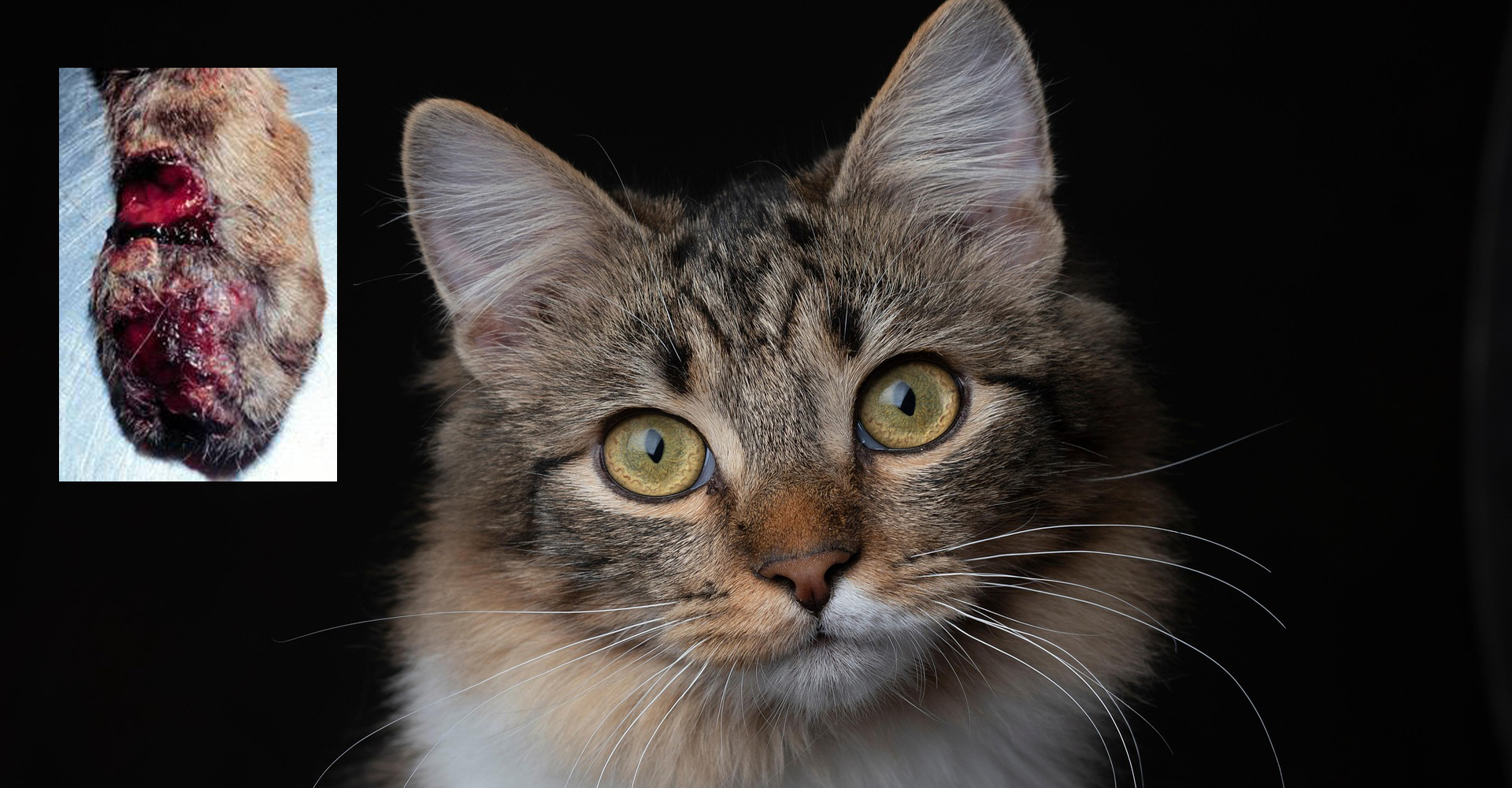
Weeping, painful sores are unpleasant for both the two-legged and the four-legged. That the fungus is spreading so fast to humans worries scientists.
TopPhoto: CC BY-SA 3.0/Pixabay/theContrapart
Text: Christer Andre Mæland
Date: 9 August 2026
Translated from Norwegian with the help of AI · Read the original
A fungus called Sporothrix brasiliensis spreads through cat bites and scratches. The fungus is named after its country of origin, Brazil, where it was first discovered. Now cats suffering a horrible death because of the fungus can be found all over South America. What worries scientists, however, is a new and frightening development. The fungus has begun infecting cat owners. It is jumping across to humans.
Hard to fight
Most of us have heard scientists say they are terrified that bird flu and other contagious animal diseases will jump to humans. Now it has happened with an animal that, unfortunately, already lives in close contact with people – the cat. It is a very frightening development. With as many as 11,000 people already infected, scientists fear it will be difficult to eradicate the fungus. Perhaps it is here to stay.
Hospital
The American medical mycologist Shawn Lockhart recently described the frightening fungal disease at a meeting in the USA. The fungus causes weeping sores. It is very unpleasant and painful for the cat, and no picnic for humans either. They need follow-up treatment in hospital. The fungus expert is almost certain that the fungus will soon be seen in Europe and the USA too. "With such large outbreaks, it is almost impossible to stop the spread."
Alarm at the borders
Lockhart is also a senior adviser at the US Centers for Disease Control and Prevention. He is now issuing the strongest possible warning and has alerted US border control to be extra vigilant. The fungus has spread beyond Brazil to cats, dogs and people in most countries in South America in record time. Paraguay, Uruguay, Argentina and Chile have been hit hardest.
Big cities
The nightmare scenario for many scientists is that the cat fungus will spread in big cities such as Bangkok and Istanbul. Cats are everywhere there. Motparten recently ran a story dedicated to the cats of Istanbul. The story was headlined "Kattstanbul". It is no exaggeration to say that the cats dominate the city. An outbreak in cities like these, which then spreads to the people, could turn into something very extensive and unpleasant.
Humans
It is no fun being a cat owner when the fungus strikes. The poor infected animals get large skin sores. If you feel around, you can notice swollen lymph glands. Unfortunately, you should wear gloves when examining infected cats, because the fungus has now learned to spread to humans.
Infection
It is important to act the moment you notice that your cat is sick and infected. The fungal infection must be treated immediately with antifungal medication. If that does not happen, the infection can develop into a respiratory disease. It then spreads throughout the body, and the cat dies with one hundred per cent certainty. Unfortunately, this fungal infection is also deadly even with treatment.
Home pageThe cat fungus is already in Europe. In South America it has spread at record speed and killed millions of cats, but what scientists fear most is all the people who have been infected. The estimate of 11,000 is most likely the tip of the iceberg. Cat owners are now being urged to be vigilant and to see a vet as soon as they suspect infection.
Europe
Fortunately, stronger and better medicines and antibiotics are now available. Even so, scientists warn that the fungus can also be deadly for humans, especially those with weakened immune systems. According to the British BBC, two Britons developed the disease more than a year after moving from Brazil. One of the family's cats had been infected. By the time it was discovered, it was too late. Even the vet who treated the cat was infected.
Relative
The fungus is a relative of Sporothrix schenckii. It is the same fungus that has caused skin infections in humans for years. Doctors call the disease sporotrichosis, but in everyday speech it is known as rose gardener's disease.
Transformation
The fungus is what mycologists call dimorphic. This means it has two forms. At first it is an ordinary mould, but when it moves into a human it becomes a yeast. In soil it has threadlike filaments. In humans these change into single-celled yeast.
The nasty fungus has not yet been observed in Norway. Because of the harsh winters, there are very few feral cats here. The hope is therefore that cases can be isolated quickly if they are discovered in house cats.
Alcohol
The good news is that you can kill the fungus with ethanol, or ordinary spirits. If you suspect your cat is infected, a cloth soaked in whisky or vodka can remove the fungus from your own skin before you take your cat to the vet. The animal doctors do, however, have a problem. Unfortunately, there is as yet no test for the fungus in Europe. Vets in Europe who suspect that Brasiliensis may be involved are asked to contact their local public health laboratory.
Uncertain extent
According to Lukoil, production reached the planned level of six million tonnes of oil a year in 2018. The complex consists of several fixed platforms connected by bridges. The facility has installations for production, processing and accommodation. Neither Russia nor Ukraine has said which part of the complex was hit on 25 July. Lukoil has also not released any information about damage or production stoppages.
Caspian route
The ports at Astrakhan and the Volga delta form part of an extensive transport link between Russia and Iran. Port Olya lies on one of the Volga's distributary channels in the north-west of the Caspian Sea. The vessels on the route are often designed to sail both on rivers and in open waters. This makes it possible to transport goods between the Caspian Sea, the Volga and the Russian canal system. Russia has three ports for grain exports in the area. A new terminal in Makhachkala is scheduled to be completed in 2028 and will have an annual capacity of 1.5 million tonnes.
MOTPARTEN
The other side of the story. An independent newspaper from Norway.
Contact
- Newsroomredaksjon@motparten.no
- Advertisingannonser@motparten.no
- General enquiriespost@motparten.no
Address
Motparten.noElevine Heedes vei 2
4839 Arendal
Norway Editor-in-chiefJesper Enerstvedt