Photo: Desken/ Christophe cagé/CC BY-SA 3.0/theContrapart
Text: Rune Ollestad
Date: 13 July 2026
Translated from Norwegian with the help of AI · Read the original
INNER MONGOLIA/RUNE OLLESTAD China's incredible forest-planting project, the “Three-North Shelter Forest Program”, looks set to be a success. The super-trees grow faster than trees do in natural forests. According to Chinese researchers, this is because the special trees react more strongly to the rising amount of carbon dioxide in the atmosphere, but it is also down to the tree species.
To stop the desert
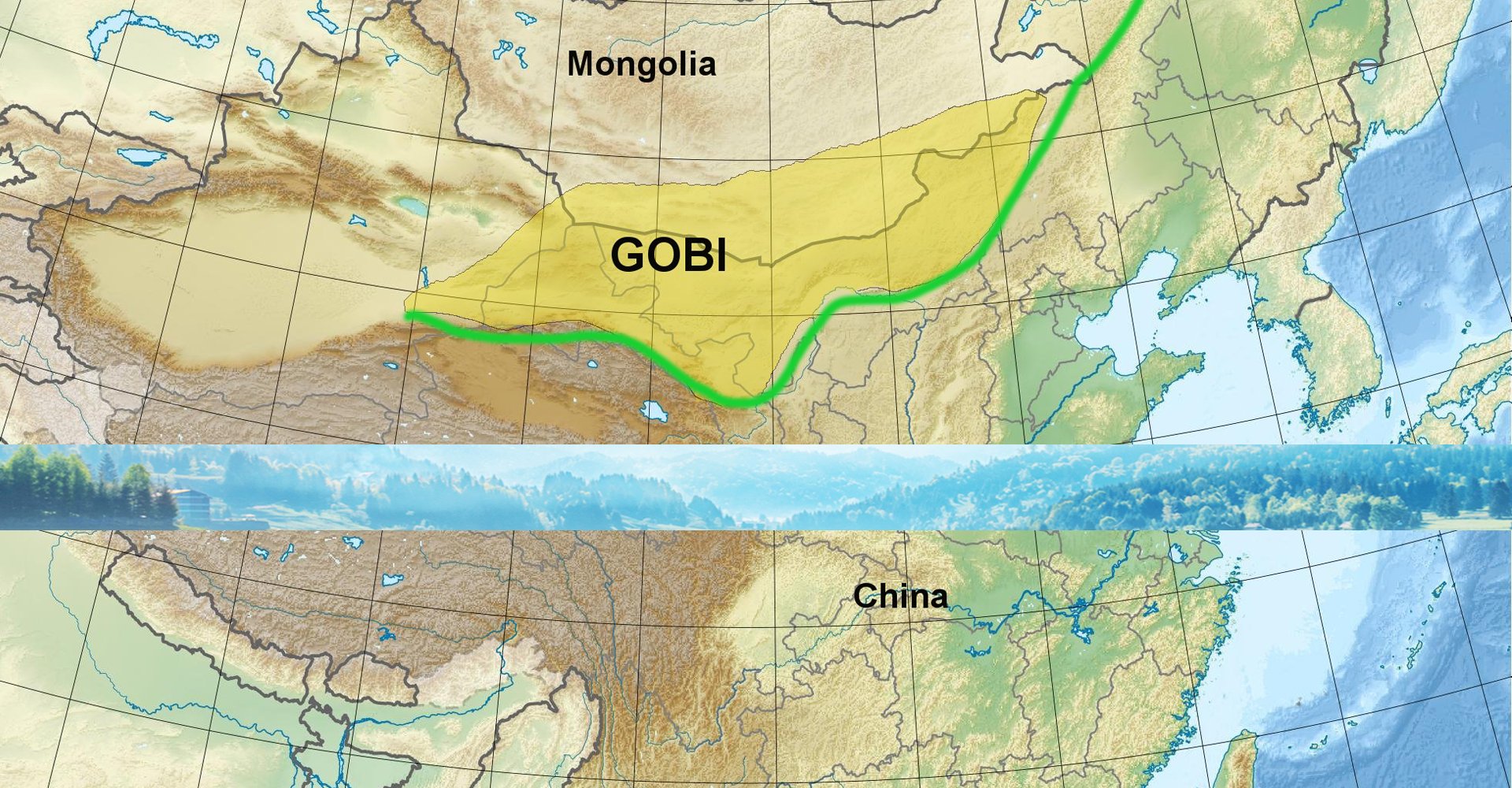
The reason for the great green wall is that the Chinese want to stop the Gobi and Taklamakan deserts from spreading. At the start there was great uncertainty over whether the whole project was madness. Would the deserts swallow the trees, or would the trees be able to hold out? Fortunately, the trees proved to be as hardy as the researchers had hoped. They quite literally took root and stayed put.
At first, many were sceptical. Today we know the wall is a success.
Strict rules
Today it is completely forbidden to cut down trees in the green wall. It serves a purpose in many more ways than just stopping the desert from spreading. The new belt of forest absorbs enormous amounts of CO2. Today there is little doubt that the green wall matters for CO2 and global climate change.
Climate benefits
Planting trees is nothing new in climate-prevention strategies, but no project can compare with the Chinese one in size. A new study published in the scientific journal Geophysical Research Letters documents that the planted trees increase their leaf area 66 per cent faster than trees in natural forests. The research shows that artificial forests react more strongly to increased carbon dioxide in the air, which accelerates growth. The Chinese authorities have deliberately chosen fast-growing species such as eucalyptus and poplar, and the vegetation is actively tended, with competing plants removed and used as fertiliser.
Top
The project is so gigantic that it is hard to grasp. The Chinese are planting a broad belt of trees so long that it can easily be seen from space. It will become the largest man-made structure on the planet. Although the wall is built to stop a desert, it also has other functions. It is good for the environment.
Peer-reviewed
The British media house BBC News has reported that the forest-planting programme has led to far greater absorption of carbon dioxide than previously assumed. Data presented by the UN's platform for the Sustainable Development Goals show that the project covers 13 provinces and autonomous regions in northern China. The official records state that China's total forest cover has risen from around 10 per cent in 1949 to over 25 per cent in recent times, which has reduced the frequency of destructive sandstorms towards the capital, Beijing.
Silenced the critics
Postdoctoral researcher Kevin Dsouza at the University of Waterloo, who has researched forest-planting models, points out to Live Science that measuring leaf area alone does not give the full picture of carbon storage. He refers to independent studies showing that natural forests accumulate more carbon above ground in their early years than the planted varieties. Satellite observations nevertheless confirm that the measure has stabilised the soil and changed the local distribution of rainfall in the region.
Water matters
National evaluations published in the journal MDPI Sustainability show that human activity has had a growing influence on the net productivity of vegetation in recent decades. In the dry and semi-arid areas, it is the availability of water that sets the biological limits for tree growth. Researchers stress that, despite rapid growth and reduced desert spread, questions remain about the long-term ecological sustainability of the monocultures.
Ahead of its time
Even the Chinese super-trees do not grow to full height at rocket speed. The project started as early as 1978. Back then the plan was to plant over thirty billion – 34 billion – trees by 2050. Now the Chinese have already planted double that.
Home page