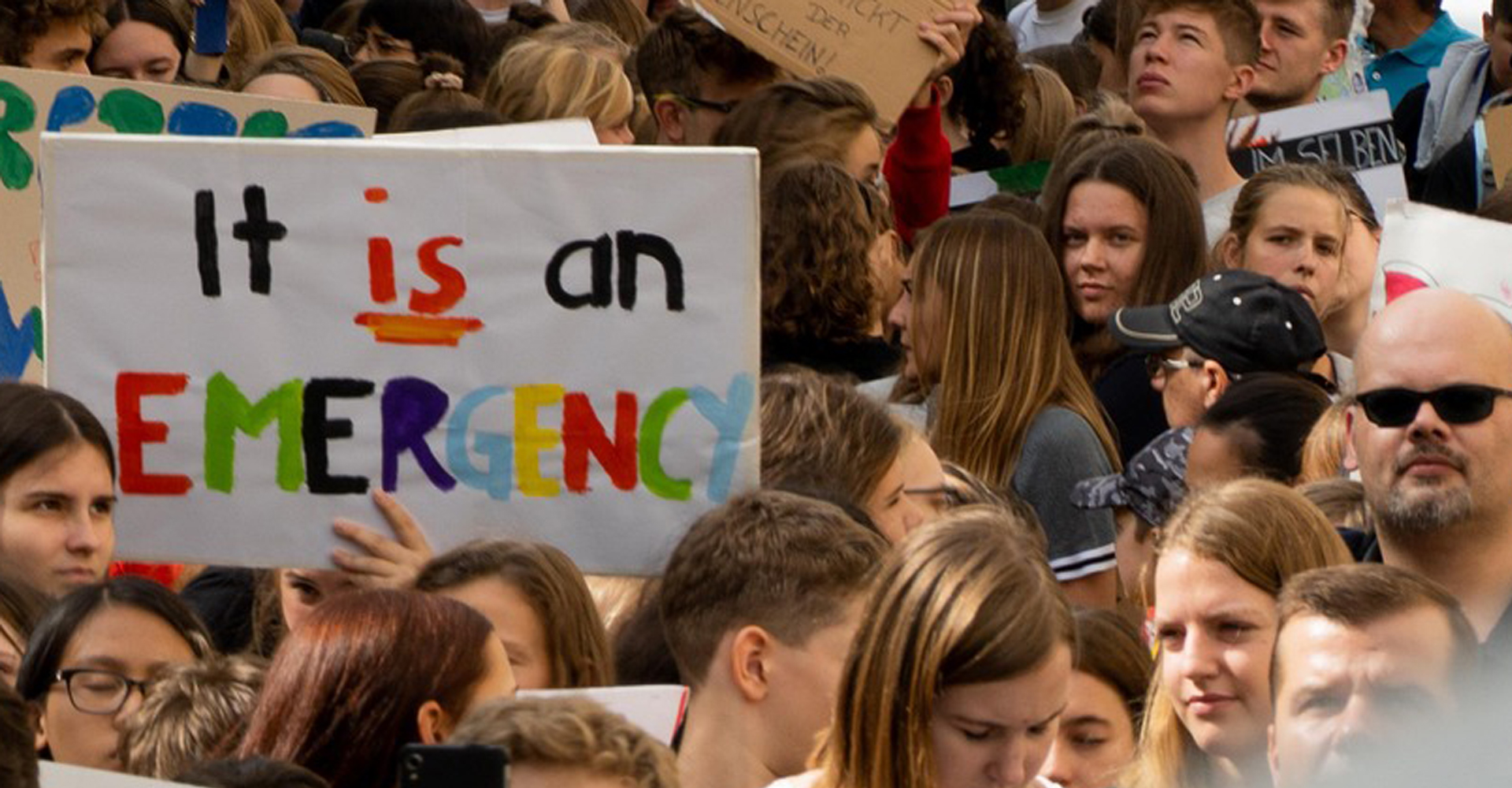
Photo: Intergovernmental Panel on Climate Change/pixabay/theContrapart
Text: Christer Andre Mæland
Date: 22 May 2026
Translated from Norwegian with the help of AI · Read the original
Green parties around the globe have been dealt a heavy blow after the UN climate panel was forced to withdraw the entire report that has frightened governments into introducing a string of expensive environmental measures over the past decades. The affair is now shaping up to become the environmental scandal of our time. We are talking many billions in misspent funds: unnecessary flood protection, carbon capture, a brake on oil exploration, electrification of platforms, wind farms and other measures have cost society an unknown number of billions.
Scandal
The fact that the report has now finally been debunked and withdrawn is also a setback for the researchers who have been handsomely paid to produce such reports, but looking at the matter with fresh eyes, there was no shortage of warnings. As early as 2020, the Center for International Climate Research (CICERO) published an analysis in the journal Nature by researcher Zeke Hausfather and senior researcher Glen Peters. In it the authors state that global emissions no longer follow the high estimates of the RCP 8.5 scenario. Growth in global CO2 emissions has levelled off over the past decade, which makes the extreme scenario misleading as a starting point for today's policy
IPCC U-turn
The UN climate panel confirmed this change in its sixth main report, Mitigation Pathways Compatible with Long-term Goals, published in 2022 by Working Group III under the leadership of Keywan Riahi. The report states that RCP 8.5 and the corresponding SSP5-8.5 do not represent a normal continuation of current policy, but are useful only as theoretical high-impact scenarios. The report specifies that baseline scenarios without new climate policy instead land in substantially lower categories.
Costly blunder
This is politician-speak, but put simply it means that politicians have acted on the wrong basis. They have been misled into introducing expensive measures. In Norway alone, we are at best talking about the misuse of hundreds of billions of kroner that could have been spent on completely different things. For if the report the politicians have relied on is so flawed that it must be withdrawn in its entirety, the political decisions that have been made must also be full of errors and shortcomings. Motparten has taken a closer look at what consequences this may have had for Norwegian politics and the economy.
COMING UP: On Sunday motparten will expose another report that has also had enormous consequences and has scared the living daylights out of millions of people. On Sunday comes the final proof that the scare report is wrong. Stay tuned to motparten.
Wrongly sized
Norway's subsidy programme for offshore wind, including projects such as Sørlige Nordsjø II, has been sized on the assumption of an acute power crisis and extreme climate change. Prime Minister Jonas Gahr Støre presented the billion-kroner investments in the government's 2022 offshore wind push as absolutely necessary to mitigate the worst scenarios. If warming follows the moderate pathways, the economic rationale disappears for projects that require more than NOK 20 billion in direct state operating support.
Forced transition
The Ministry of Transport's decision to halt sales of new petrol and diesel cars by 2025 was anchored in national climate targets based on the highest projections. Former Minister of Transport Knut Arild Hareide argued in the National Transport Plan 2022–2033 that drastic intervention in the car fleet was imperative to avoid catastrophic emissions curves. The phase-out of the combustion engine has imposed enormous transition costs on consumers and the car industry in order to avert a scenario that has now been dismissed.
Top
European authorities have introduced a string of extremely expensive environmental measures on the basis of a report that turned out to be wrong. Now the UN has withdrawn the report, but staggering sums have already been spent.
Oil exploration banned
The Ministry of Climate and Environment's awarding of production licences on the Norwegian continental shelf has been sharply tightened as a result of pressure on long-term global demand for fossil energy. Former Minister of Climate and Environment Espen Barth Eide pointed out at the UN climate summit COP27 in 2022 that the most dramatic scenarios demanded an immediate brake on oil exploration. This policy has reduced the state's future revenue base on the basis of models that assumed coal burning that the world long ago chose to abandon.
Expensive flood protection
In 2022 NVE (the Norwegian Water Resources and Energy Directorate) updated its guidelines for flood and landslide hazards under director Kjetil Lund, requiring municipalities to build infrastructure with a considerable climate allowance. Municipalities have consequently had to invest hundreds of millions of kroner in oversized pipes and dam facilities to handle the maximum precipitation scenario. These funds have been tied up in concrete and protection works instead of nursing homes and schools, based on calculations that now turn out to be unrealistic.
Costly carbon capture
The government's flagship project for carbon capture and storage, Longship, was approved by the Storting (Norway's parliament) in 2020 with a cost framework of more than NOK 25 billion. Then Prime Minister Erna Solberg and Minister of Petroleum and Energy Tina Bru defended the spending by saying that the technology was critical to flatten the steepest emissions curves globally. They said this on the basis of a report that may have been made to order, with someone knowing that the result would be wrong. The enormous sums were invested in a specific crisis technology to mitigate a development that the realities of the global energy market had already averted.
No shortage of warnings
In 2023 Professor Matthew G. Burgess of the University of Colorado Boulder levelled extensive criticism at scientific journals in a study published in the ICES Journal of Marine Science. Burgess and his co-authors document that, despite the changes from the UN climate panel, RCP 8.5 remains by far the most used scenario in recent ocean and fisheries research. In the study Burgess states that high-emissions scenarios such as RCP 8.5 and SSP5-8.5 appear unfeasible and should only be used with clear caveats to prevent misinterpretation in the media and among decision-makers.
Hard to accept
The climate panel's own Working Group I also points to the uncertainty in its technical summary, the Technical Summary, published in 2021 under the leadership of Paula A. Arias. The report emphasises that the debate around RCP 8.5 is due to the rapid development in renewable energy. Nevertheless, the report partly defends the use of the scenario by saying that extreme concentrations cannot be entirely ruled out if nature's own feedback mechanisms in the carbon cycle become stronger than assumed.
In Norway too
Senior researcher Glen Peters at CICERO has in several public statements criticised the research community's reliance on misleading models. When researchers consistently referred to RCP 8.5 as the truth, even though the report was both unrealistic and mathematically impossible, things eventually went terribly wrong. The sum of the errors now committed probably has far greater consequences than those outlined in this article. If one looks, for example, at Europe as a whole rather than Norway, the amounts spent on the wrong basis are so large that they take on epic proportions. They have so many zeros that they are hard for the ordinary man in the street to read.
Home page