Photo: BYD official home/theContrapart
Text: Stein Olav Krosby
Date: 23 July 2026
Translated from Norwegian with the help of AI · Read the original
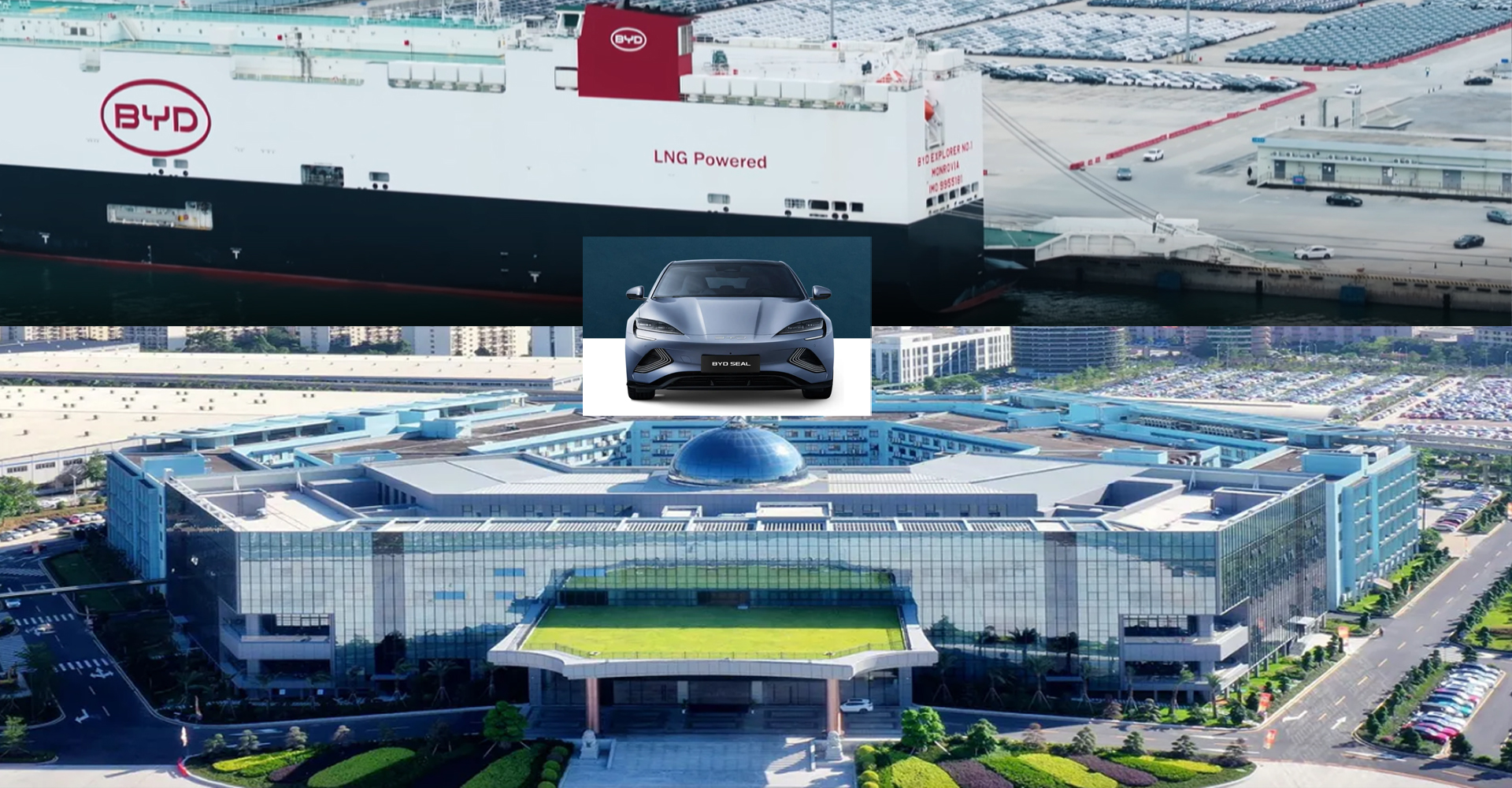
The report showed that BYD makes an incredible 75 per cent of all the car's components in-house, entirely on its own. It doesn't buy batteries either. Quite the opposite. BYD started out as a battery company and can therefore produce its own Blade batteries. It doesn't buy microchips either. It designs and casts its own semiconductors. It even owns its own lithium mines. Last but not least, it has acquired its own fleet of massive car carriers (RoRo vessels) to ship the cars directly to foreign and European ports without costly middlemen.
The myth of the cheap worker
When Western politicians and industry leaders demand sky-high tariff walls against Chinese brands such as BYD, they point to an outdated and mistaken explanation. They claim China cheats with cheap labour and state subsidies. This is a fatal misreading of reality. China is not outcompeting Detroit or Wolfsburg because workers in Shenzhen are paid less. They are crushing the West on price because they have redefined how a car is made – from raw material extraction to the finished assembly line.
BYD does more than make all the parts itself. It even owns the mines and the ships that carry the cars to customers. The fact that it also has the technology to make semiconductors and the world's best batteries makes it almost invulnerable. German and American factories are giving up.
Asset light
The West has fallen victim to its own financial logic. Over the past three decades, European and American carmakers have cultivated a so-called "asset-light" model. They have outsourced the production of components to global suppliers such as Bosch and Continental. They did so because they thought it was smart. They did it to keep their own balance sheets clean and push the risk onto others. This would have worked in a world without countries like China. Unfortunately, that is like saying that if winter didn't come every year, we could have two apple harvests.
Deadly combination
Another important factor is that a lot has changed since the age of the petrol car. In an electric car, the battery, the electronics and the semiconductors make up sixty per cent of the car's total value. By outsourcing these, Western brands have given away their entire margin. Every single link in the supply chain has to have its mark-up, and the result is a rigid, bloated and expensive structure.
On top of that, it has produced worse cars. That is a deadly combination for a carmaker.
According to UBS, BYD's extreme integration gives it a structural cost advantage of 25 per cent over existing European carmakers, even if the cars were built in Europe. So this is not about subsidies. It is about eliminating supplier margins and logistical bottlenecks.
Top
BYD can spit out a car every sixty seconds. It is vulnerable to neither lithium prices nor shipping costs. It owns both the mines and the ships itself.
Wrong recipe
A German carmaker has to deal with ten external suppliers to get a battery to talk to an inverter. BYD designs everything under one roof. It designs for manufacture (Design for Manufacture). BYD does it all itself and updates and changes its models at a pace reminiscent of the smartphone industry. Western companies take 6–7 years for a model cycle like that. Everything is faster at BYD. Everything is cheaper. Both without compromising on quality. On the contrary, everything gets better.
Housing crash and car exports
This brings us to the macroeconomic paradox now shaking world trade. Chinese factories are now producing with enormous overcapacity. According to the International Energy Agency (IEA), China's electric car production exceeded domestic demand by around 20 per cent last year. Because many Chinese recently lost fortunes in the housing crash, they are now keeping their wallets shut. When so many do that, the industrial machinery has no choice but to export the surplus to the rest of the world. And then it sometimes becomes even cheaper than the 25 per cent being talked about, thanks to operational advantages. But that is not subsidisation in the traditional sense.
Believing in tariffs
Both the US and the EU are responding sharply with punitive tariffs and anti-subsidy investigations. It is a desperate defence mechanism. The tariff walls are not being raised to stop cheap junk, but because Western democracies realise that their most important industries have been overtaken in purely evolutionary terms. The West faces a brutal choice. It can keep protecting its own old-fashioned factories behind ever higher political walls. If it does, the consequence is that Western consumers have to pay dearly for yesterday's technology. The other option is to tear up its own financial model.
Big blunder
Last but not least, Europe has given itself an extra giant problem. In an orgy of chivalry topped with dogmatic certainty that Europe is the cradle of democracy and freedom, Europe has cut its own businesses off from cheap energy. On a permanent basis. Europe cut off cheap Russian energy before a credible alternative was available. You cannot rely on American LNG that costs four times as much.
Permanently expensive energy
In Norway there is no political will to triple production. It wouldn't be done overnight either. And it wouldn't be enough. Germany has shut down its nuclear power plants under pressure from the environmental movement. In this inferno of stupidity, business leaders at factories such as the chemicals giant BASF and the industrial giant SIEMENS saw no choice but to flee. One to China and the other to the USA. Perhaps Europe is on its way to becoming a second-rate continent. It looks bleak.
Front page