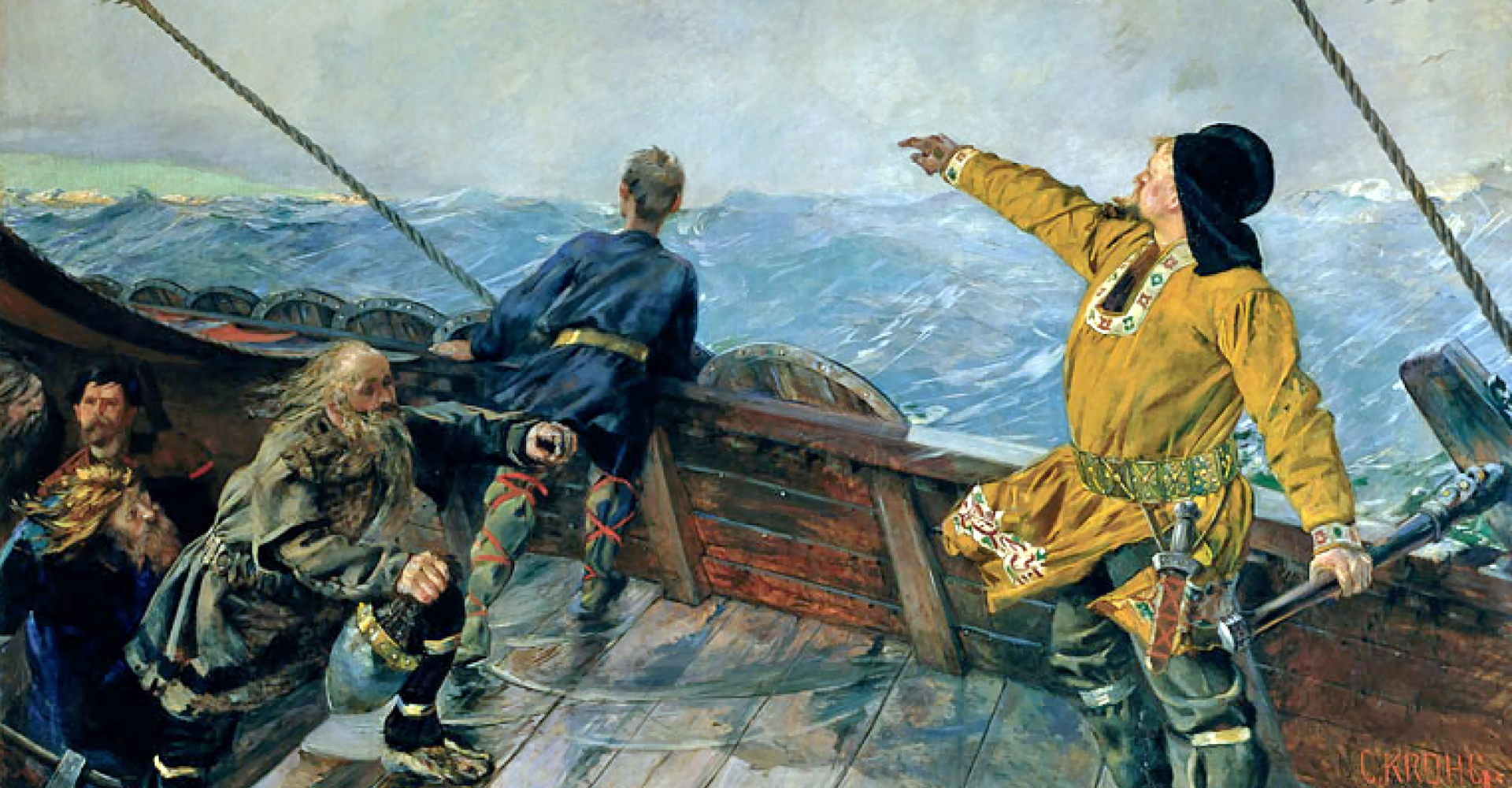
Photo: Christian Krohg/Nasjonalgalleriet Oslo/Hovedside foto:Leif Eriksson-statue utenfor delstatsforsamlingen i Minnesota:Mulad-Offentlig eiendom/theContrapart
Text: Christer Andre Mæland
Date: 4 July 2026
Translated from Norwegian with the help of AI · Read the original
In these football World Cup times, with plenty of ROWING (and keeping calm) going on everywhere, it should be a joy to think that America was discovered by the Norwegian Viking Leif "Heppni" Erikson. He found America several hundred years before Amerigo Vespucci. What is less well known is that Erikson had a nickname that would later become the Vikings' contribution to the English and American languages. Leif Erikson was known as "Leif the Lucky", or as the Vikings themselves put it: Leif Heppni Erikson. Today there is no doubt, not even among British language scholars and linguists: the word HAPPY is Norwegian! ROW easy on that one, folks!
Well documented
Language scholars have documented that the roots of the term "happiness" were carried across the North Sea by Norwegian settlers during the expansion that began around AD 800. Over centuries of linguistic evolution, the Old Norse word "happ" was transformed into a legal and moral cornerstone of the American Declaration of Independence.
Happy Norwegians
These days, thousands of Norwegians are making a name for themselves in the USA precisely for being "happy". Even the normally self-absorbed Zlatan Ibrahimovitch tips his hat to what he describes as perhaps Norway's greatest advantage: Norwegians seem HAPPY!
In the streets of Oslo there was enormous joy after the victory over the Ivory Coast. People were HAPPY. So they were in the USA, too, where Norwegians are making a name for themselves for being exactly that: HAPPY. The Norwegian supporters do this unaware that it is they themselves, through their Viking heritage, who created the word HAPPY.
Definition
In the Vikings' original language, the word carried a deeper and more complex meaning than the modern definition of being glad or content. The Old Norse dictionary published by the University of Oslo (UiO) defines the original noun "happ" as luck, good fortune or a favourable event. Linguistic analyses show that the word did not describe a passing emotional state, but rather a concrete form of prosperity or a manifestation of the fate an individual brought with them into society.
Important word
This specific understanding of the term emerges clearly in the Icelandic family sagas, where the word is linked directly to historical key figures such as explorers. Else Mundal, Professor of Old Norse philology at the University of Bergen (UiB), explains that this kind of luck was regarded as a real and personal quality of the individual in Old Norse society. Luck or good fortune, as in the Old Norse word heppni, was not merely coincidence to the Vikings. It was a solid, almost tangible force that followed certain people and shaped their ability to succeed on perilous voyages.
Top
Even the self-satisfied Zlatan Ibrahimovitch praises Norwegians, though not mostly for their football. He says Norwegians look HAPPY! What Zlatan doesn't know is that it is Norway and Norwegians who created the word HAPPY! The word is even central to the American Declaration of Independence!
Leifur Heppni
One of the best-known explicit examples of this usage is found in the Saga of the Greenlanders, where the explorer Leif Eiriksson is given his permanent historical nickname. The text recounts that Eiriksson rescued a shipwrecked crew on the way back from Vinland, which cemented his status as a man endowed with extraordinary luck. In the saga text he is consistently referred to as Leifur heppni, an epithet that modern Norwegian historical writing has translated as "Leif the Lucky", and which refers directly to his ability to navigate and survive.
Shit Happens
After the Scandinavian settlers established themselves in the British territories under the Danelaw, Old Norse vocabulary was gradually integrated into the Old English language system. The Oxford English Dictionary documents that the transition took place through a process in which the original sense of fate-determined luck was preserved, but at the same time widened to include events beyond human control. This linguistic legacy is still visible in core modern English words such as "happen", which describes something occurring by chance, and the adjective "hapless", which denotes a person who is unlucky or lacks this original force.
A long row
The evolution from the Old Norse "happ" via the Middle English adjective "happy" marks a shift from external circumstances to an inner mental state. In its etymological overviews, the Merriam-Webster dictionary editorial team points out that it was only in the 16th century that the word began in earnest to shift in meaning towards personal joy and contentment. This semantic development culminated in the 18th century, when the conceptual framework around the rights of the individual was redefined in line with the philosophical currents of the Enlightenment in Europe and North America.
Jefferson
When the American Declaration of Independence was drafted in 1776, the statesman Thomas Jefferson chose to include the transformed Viking word in the document's most central passage. The Declaration holds as a self-evident truth that all men are born with certain unalienable rights, and here places the term in a legal context. Historian and Jefferson biographer Jon Meacham points out that the choice of words reflects a deeper philosophical tradition stretching far back in time.
HAPPiness
When Jefferson wrote the phrase about the right to seek happiness, 'the pursuit of Happiness', he moved the concept from being about passive fate to being an active, political right for the individual. The American Declaration of Independence reads: "Life, Liberty and the pursuit of Happiness".
Home page