The Soviet Union ruined a classic hero story
A team first to the North Pole
Unfortunately for Netflix and Hollywood, no lone, exhausted hero came crawling into the North Pole after eating his own dogs and amputating his frostbitten toes. The Russians sent a whole team, who arrived together.
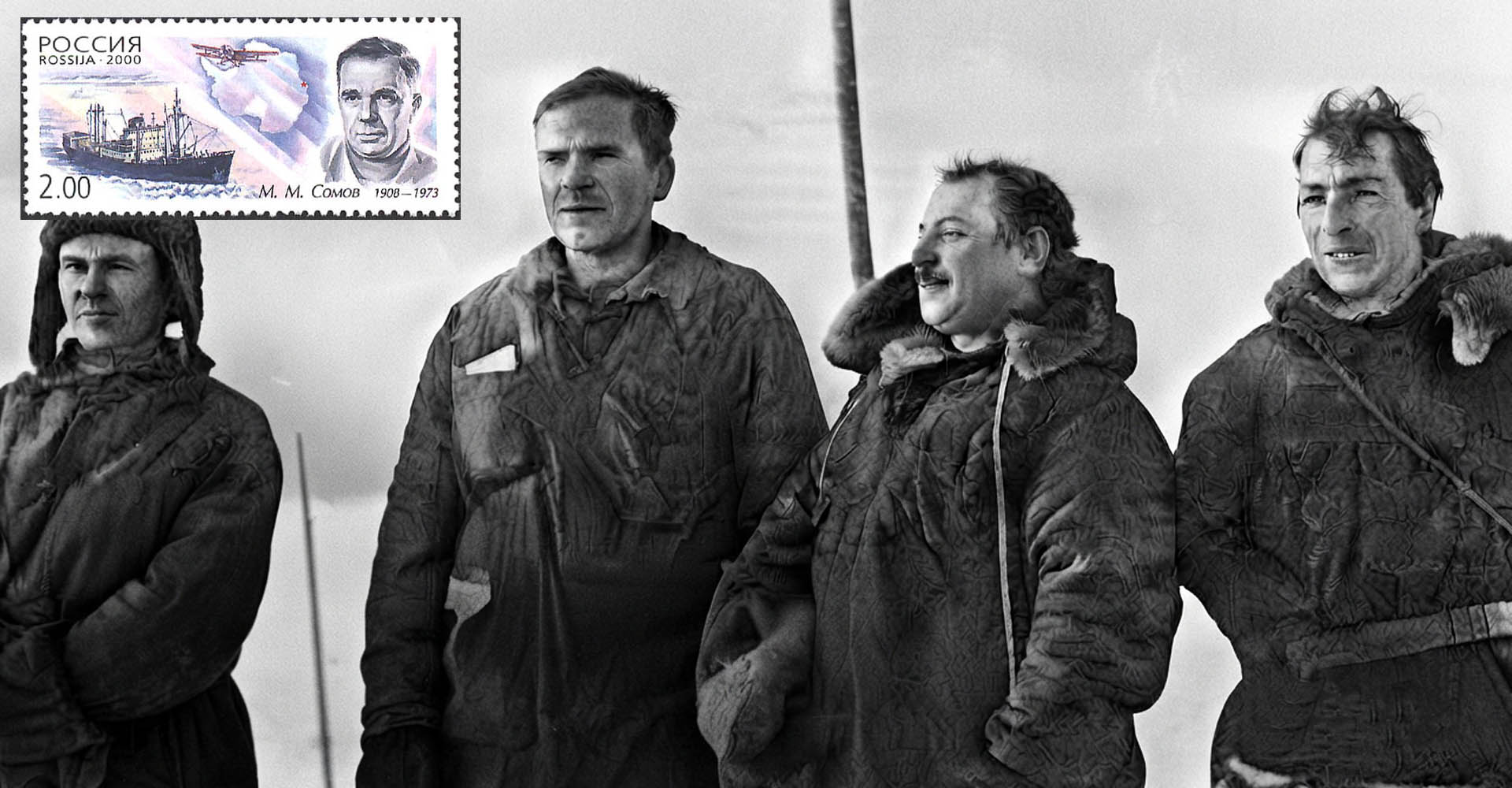
Because of secrecy and the Cold War, none of them became heroes, but one at least got to grace a postage stamp.
TopPhoto: Novosti/motparten
Text: Christer Andre Mæland
Date: 11 October 2026
Translated from Norwegian with the help of AI · Read the original
Hello Roald Amundsen! Hello Yuri Gagarin! Hello Thor Heyerdahl! You have a competitor! The Russian Kuznetsov managed what Norwegians and Americans could not. He reached the North Pole first. That is how a story about the world's first man at the North Pole could have gone. It didn't. Kuznetsov was merely the head of the group of four who got to the North Pole first.
Four scientists
Today, no single individual is officially regarded as the first at the North Pole, in the way Amundsen is at the South Pole, Armstrong on the Moon, or Gagarin in space. Major General in the Soviet air force Aleksandr Alekseyevich Kuznetsov was in charge of the whole operation. Those who actually stood first on the exact spot were four scientists who were flown in, walked the last few metres on foot, and then wrote themselves into history in lower-case letters. None of them ever became a world-famous hero.
Motparten presents
To honour them, we are making a small exception at Motparten today. Here are the names of the first people to set foot at the North Pole. According to the Guinness World Records too, these are the first who with absolute certainty stood on the exact point 90° N on 23 April 1948:
- Pavel Afanasyevich Gordienko
- Pavel Konovich Senko
- Mikhail Mikhailovich Somov
- Mikhail Yemelyanovich Ostrekin
Three cheers!
This gang was flown in, walked the last short stretch on foot and together planted the flag of the Soviet Union at the pole. Aleksandr Kuznetsov was the overall leader of the expedition. He bore the responsibility, flew himself in critical situations and was later made a Hero of the Soviet Union for his efforts. Both Russian and Soviet sources, as well as most Western reference works since, therefore consistently speak of a team being first at the North Pole, not a solo hero. They are now recognised in the Guinness World Records.
Not solo
Unfortunately for anyone who would have preferred a solo achievement, this was the exact opposite. A textbook example of teamwork. Operation North Pole was a state-organised affair. In fact, the entire expedition was classified as secret because of the Cold War. It never became a personal triumph in the Amundsen style.
Stalin had no problem letting poor Americans and other unlucky wilderness heroes freeze their backsides off, unaware that someone had already been there.
Nobody knew
In Norway, people lived happily unaware that "the Russians" had already ruined a potentially fantastic hero story. Many others, too, floated around in ignorance. This resulted in a series of failed expeditions, but in this article we will do justice to the four who actually got there first. They were also part of important world history.
Home pagePerhaps the men let one of them run ahead for the last hundred metres. We will never know, unless an old diary or more verifiable photographs turn up. Until we know better, the world will have to settle for the conclusion that the conquest of the North Pole was a team sport.
Resolution
Nothing in the post-war Soviet Union was carried out without a proper resolution! In March 1948 the politicians passed resolution no. 875-277. It was decided that an expedition named North-2 would be launched. The expedition was to be a collaboration between scientists and the air force of the Soviet armed forces.
The Red Army
Major General in the air force Aleksandr Alekseyevich Kuznetsov was appointed leader of the expedition. His deputy, responsible for the scientific work, was the geophysicist Mikhail Yemelyanovich Ostrekin. They also got the oceanographer Mikhail Mikhailovich Somov on the team. He was important because they planned to land on floating ice.
Made themselves useful
In total, 251 people took part in the effort to make a Russian the first man at the North Pole. Of these, 128 were military personnel. The scientific team consisted of 23 specialists. The aircraft used were the Li-2, Il-12, Pe-8, and military fighters of the La-11 type. The Russian scientists stayed at the North Pole for three days. They measured the thickness of the ice and the depth of the sea, which they concluded was 4039 metres. On 18 April 1948, while measuring depths in the central Arctic, the oceanographer Yakov Yakovlevich Gakkel and his colleagues discovered data confirming the presence of an underwater ridge, later named the Lomonosov Ridge.
Unknown ocean
In total, eight temporary bases were established on the ice during Operation North-2, and the pilots carried out 121 landings on ice airstrips. The Russians drilled holes in the ice and carried out hydrological, hydrochemical, meteorological, geophysical and magnetic observations. Only the gods know in what order. Among other things, they found that Atlantic currents and warm air masses from the Pacific penetrate into the Chukchi Sea.
History
Expedition "North-2" was a preparatory phase for the establishment of the second Soviet floating station, "North Pole-2" (SP-2), which was set up on 2 April 1950 north of the Bering Strait. Mikhail Somov, the same man who landed at the North Pole in 1948, was appointed head of the station. He developed a new instrument that can automatically record the drift of the ice. The station was in operation for 376 days. During this period it moved about 2,600 km, 58 people were on board, and 71 aircraft landings were carried out. 96 tonnes of cargo were transported to the base. When the Soviet Union did something, it was done properly. After all, there was a resolution behind it all. It would later be evaluated. And heaven help anyone who had blundered!
Important foundation
The expedition showed that the Arctic could not be studied through isolated expeditions. A system of permanent floating stations was needed. This became the foundation of all subsequent Soviet Arctic research.
MOTPARTEN
The other side of the story. An independent newspaper from Norway.
Contact
- Newsroomredaksjon@motparten.no
- Advertisingannonser@motparten.no
- General enquiriespost@motparten.no
Address
Motparten.noElevine Heedes vei 2
4839 Arendal
Norway Editor-in-chiefJesper Enerstvedt