Always used drugs
Nuts are global No. 3
Australian researchers have proved that humans were using drugs 25,000 years ago. But it was not alcohol, mushrooms or coca leaves. People walked around chewing betel nuts! Many people around the world still do.
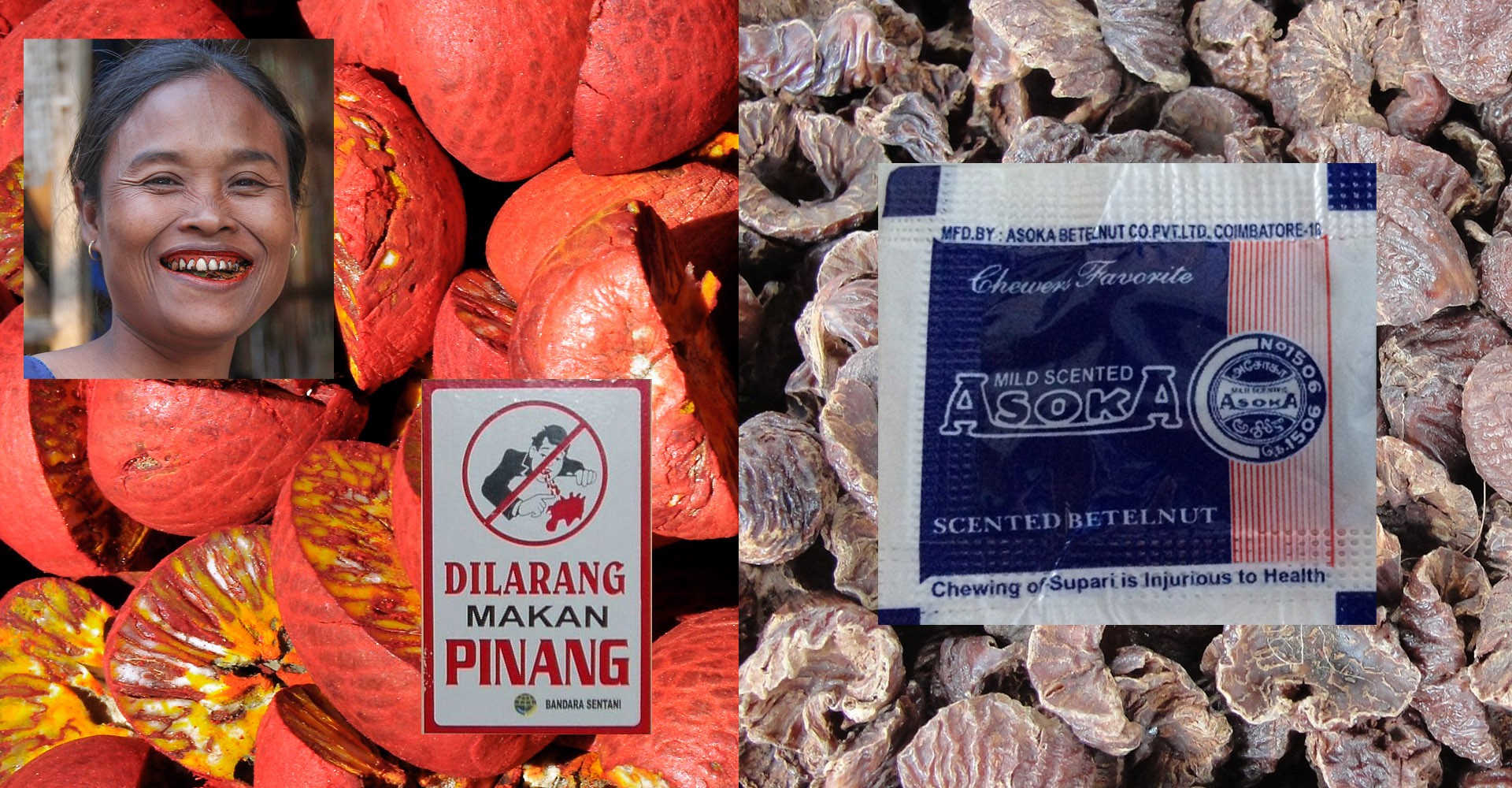
Don't spit! That is the message on the sign on the left. Betel nut use can be recognised by the red gums when chewing, but dried and powdered versions, with the dye removed, are also sold (right).
TopPhoto: Basile_Morin/CC BY-SA 4.0/LBM1948//motparten
Text: Rune Ollestad
Date: 18 October 2026
Translated from Norwegian with the help of AI · Read the original
Although betel nuts are little known in Western societies, they are still the world's fourth most used psychoactive substance, after alcohol, caffeine and nicotine. The betel palm is cultivated and grows wild in South and Southeast Asia, as well as parts of the Pacific islands (Oceania). Major producing countries include India, Bangladesh, Indonesia, Myanmar, Thailand and Taiwan. Chewing betel nuts is an ancient tradition for hundreds of millions of people in these areas.
Researchers on a trip
It was researchers from Griffith University in Australia who first discovered that early humans used drugs. During excavations in Indonesia, they noticed that something was not right with the skeletons they found. What puzzled the researchers were unusual patterns in the skeletal remains that should not normally have been there. After painstaking detective work, the researchers found that they came from sucking on betel nuts.
Actually, they're berries
Betel nuts are the seeds of the betel palm Areca catechu. They are referred to as nuts, but botanically speaking they are in fact berries. Betel nuts are still used today as a stimulant in Indonesia. Traditionally they are chewed by crushing the seed and mixing it with lime before the powder is wrapped in leaves from the betel pepper plant.
A pick-me-up
I, the undersigned, have not tried chewing betel nuts myself, but the high is said to have a mild pick-me-up effect. The World Health Organization (WHO) classifies betel nuts as carcinogenic to humans. Long-term use is today linked to an increased risk of cancer of the mouth and throat. On top of that, users suffer serious tooth damage. In other words, munching betel nuts is not exactly a bright idea. It is actually quite nuts!
Home pageIn Asia, people are still chewing betel nuts like there's a gold medal to be won. So many chew them that the drug is still in the top three of intoxicants. Few care about the health risk.
They didn't know
Nobody was aware of the health risk 25,000 years ago. The so-called MAPANG project in Indonesia shows that jaws from early human settlers have unusual tooth wear, which the researchers believe comes from sucking on whole betel nuts that had not been crushed and mixed with lime. According to Professor Adam Brumm of Griffith University, this is the earliest evidence of drug use ever found on Earth. That does not mean it is the oldest. It may also mean that other researchers have not looked specifically for such finds.
Hard facts
In a recent study published in Science Advances, the researchers describe the discovery they made on the Indonesian island of Sulawesi. One find is dated to 25,000–16,000 years ago and the other to 7,600–6,300 years ago. Both showed the same unusual pattern of tooth wear. The researchers are not very surprised by the findings. Although betel nuts are not known in Western societies, they are the world's fourth most used psychoactive substance, after alcohol, caffeine and nicotine.
Thought alcohol came first
Researchers have previously believed that drug use began after humans moved from hunter-gatherer societies to farming. This was based, among other things, on the emergence of drinking fermented alcoholic beverages. That culture most likely began around 13,000 years ago. Now we know that the hunter-gatherers who lived before this period also had their own drug.
The party was on
The Australian researchers soaked betel nuts in artificial saliva and found that sucking on betel nuts released enough of the psychoactive compounds to alter brain function. Rai-rai. And that got the party going.
MOTPARTEN
The other side of the story. An independent newspaper from Norway.
Contact
- Newsroomredaksjon@motparten.no
- Advertisingannonser@motparten.no
- General enquiriespost@motparten.no
Address
Motparten.noElevine Heedes vei 2
4839 Arendal
Norway Editor-in-chiefJesper Enerstvedt