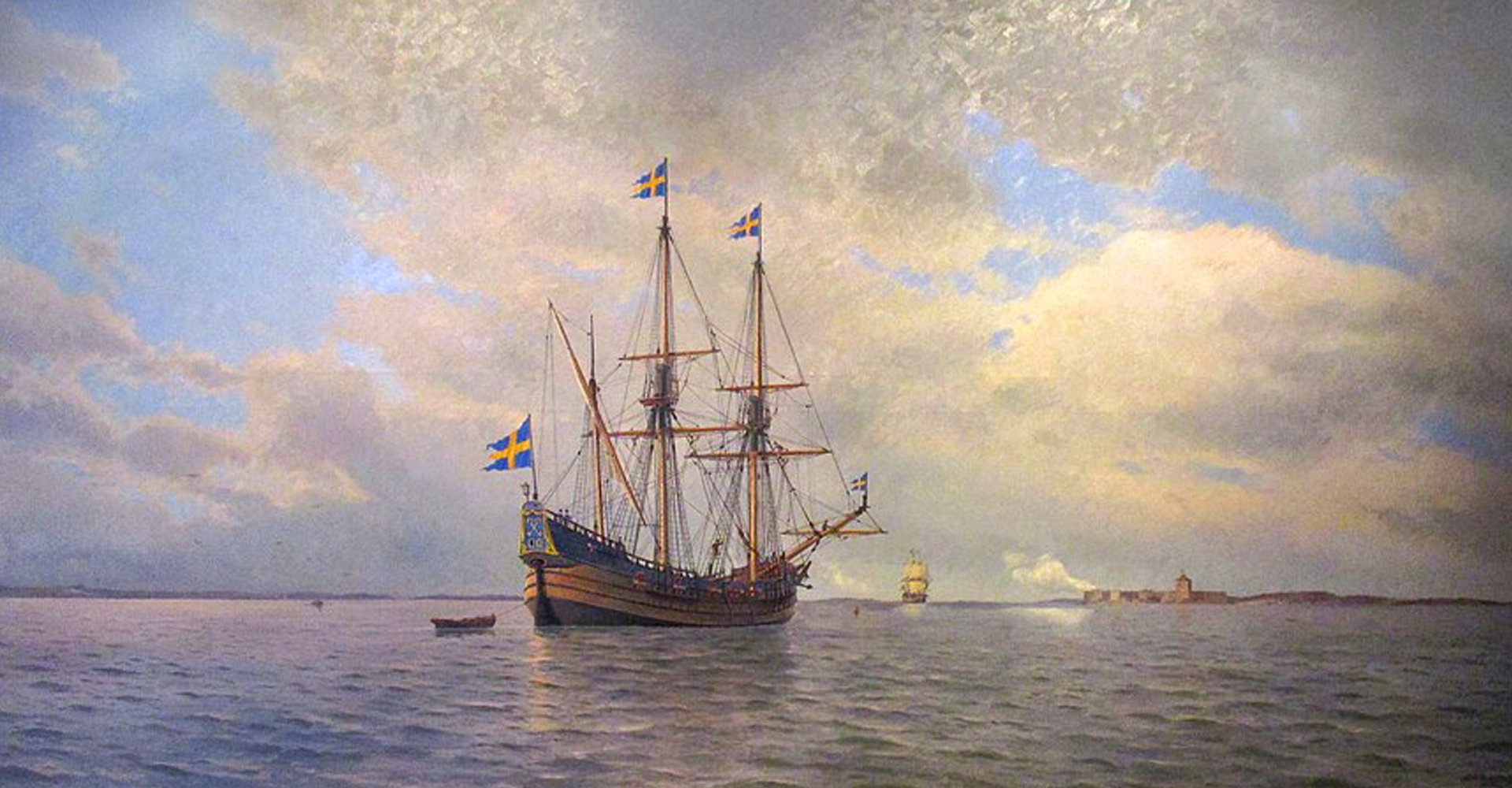
Photo: Sjöfartsmuseet /theContrapart
Text: Marius Kleppe Kolstad
Date: 11 July 2026
Translated from Norwegian with the help of AI · Read the original
At the beginning of the 1600s, the European powers had long since carved up America's Atlantic coast among themselves. Just like the Swedish national team, the great Swedish nation arrived far too late and badly prepared in the New World. In Europe, Sweden was a great power, but it had completely forgotten to keep up with developments when a new world was discovered on the other side of the ocean.
A blue-and-yellow idea
The former governor of the colony of New Netherland, Peter Minuit, was given the task of saving Sweden's honour. As brilliant as the Swedish national coach's tactics, he proposed that Sweden should occupy an area between England's "Virginia" and the Netherlands' "New Netherland". The Swede was right that there was an area there that had not yet been occupied, but squeezing in between the Dutch and the English proved to be a very bad idea, with absolutely no room for expansion.
Arriving in the New World
In the year of our Lord 1637, two Swedish ships set out from Gothenburg. The mission was to occupy the new territory and sabotage the Dutch lucrative trade monopoly with the Native Americans. The Swedes met no resistance as they glided into the Delaware River and settled in what is now Wilmington. So far, so good. It must have been roughly the feeling the Swedish national team coach had after winning the first match of the group stage at the World Cup.
In hindsight, it is clear that it could never end well. No matter how hard the poor Swedes fought, all the odds were against them, squeezed between strong nations that were willing to back both militia and settlers. It went the way it had to go. A total, unconditional surrender, without a single shot being fired. And then straight home in disgrace.
Dubious payment
After the successful landfall, everything went to hell. Both the Dutch and the English naturally found out quickly what the Swedes had done. Neither of them looked on it kindly. They were no less irritated when the Swede Peter Minuit "bought" an area from five Native American tribes. It is unclear what the means of payment was. It was probably not fermented herring, but it has not been proven whether it was silver or gold either. Perhaps blue and yellow glass beads?
They were pioneers
Like Swedish football players, they did not lack self-confidence and enthusiasm. The Swedes immediately built a fortress which they christened Fort Christina. Even though the Swedes' attempt at creating a colony ultimately ended no better than the football national team's attempt to reach the World Cup final, there were nevertheless a number of elements of historical value. Among other things, the Swedish settlement was the first European one in the Delaware Valley. Not only that. It was also the first in what later became the first state of the USA.
Top
Like the Swedish football team's participation in the World Cup, the colonists lacked almost everything. At every level they were poorly equipped. In attack they had no force capable of frightening their opponents. They were too weak and too few in defence. Even the midfield did not work, because the colonists received no supplies from the nobility back home in Sweden.
Ambitious
In 1643, Johan Printz was appointed governor. His most important task was to secure Sweden's foothold in the New World. Instead, he secured Sweden's downfall. Before he got that far, however, he managed to build two more forts. They were called Fort Elfsborg and Fort New Gothenburg. In this way he extended the Swedish colony from present-day Cecil County, Maryland, to Trenton, New Jersey. Incredibly, Sweden managed to create a capital south of Philadelphia.
Poor tactics
One might have imagined that the territorial expansion would make the colony stronger, but for some reason the opposite happened. The reason was most likely that the Swedes were unable to make it profitable. Another reason was that nonchalant Swedish noblemen back in Sweden neglected the colony. In the period between 1648 and 1654 they did not send a single supply ship. It was at least as great an underestimation as the one the Swedish national team recently made of its opponents in the football World Cup.
Angry neighbours
As the Swedish colony fell into decline, the neighbouring countries had finally pulled themselves together to do something about the annoying intruder. The governor of New Netherland, Peter Stuyvesant, therefore sent seven warships down the Delaware River in 1655. The Swedes were in no position to object. Not even a single shot was fired. In the embarrassing Swedish surrender, they simply put down what they had in their hands and gave up.
They kept Swedish culture
Perhaps because of the easy victory, the Dutch largely let the Swedes run things as they pleased, but under the New Netherland flag. That is, the Swedes themselves had to provide law and order, including through their own militia. But for the nobility back home in Sweden they were forgotten, a closed chapter in Swedish history. Like the national team's World Cup participation, the whole episode was something Sweden would rather forget.
Swedesburg
To this day, traces of the Swedish presence can be seen in this part of the USA. They even have a replica of the first Swedish ship to arrive, the Kalmar Nyckel. The ship, more than forty metres long, offers tourists guided cruises. In the area you find names such as Swedesboro in New Jersey. In Pennsylvania there is Swedesburg, where you find the church Gloria Dei. It is the oldest brick building in Philadelphia. Whether a statue, or so much as a doghouse, will be put up after the Swedish national team's participation is doubtful. The Blue and Yellow left the World Cup in disgrace. The first settlers at least clung on in the area, even though they lost to the Netherlands. Perhaps they even had a good football team.
Home page