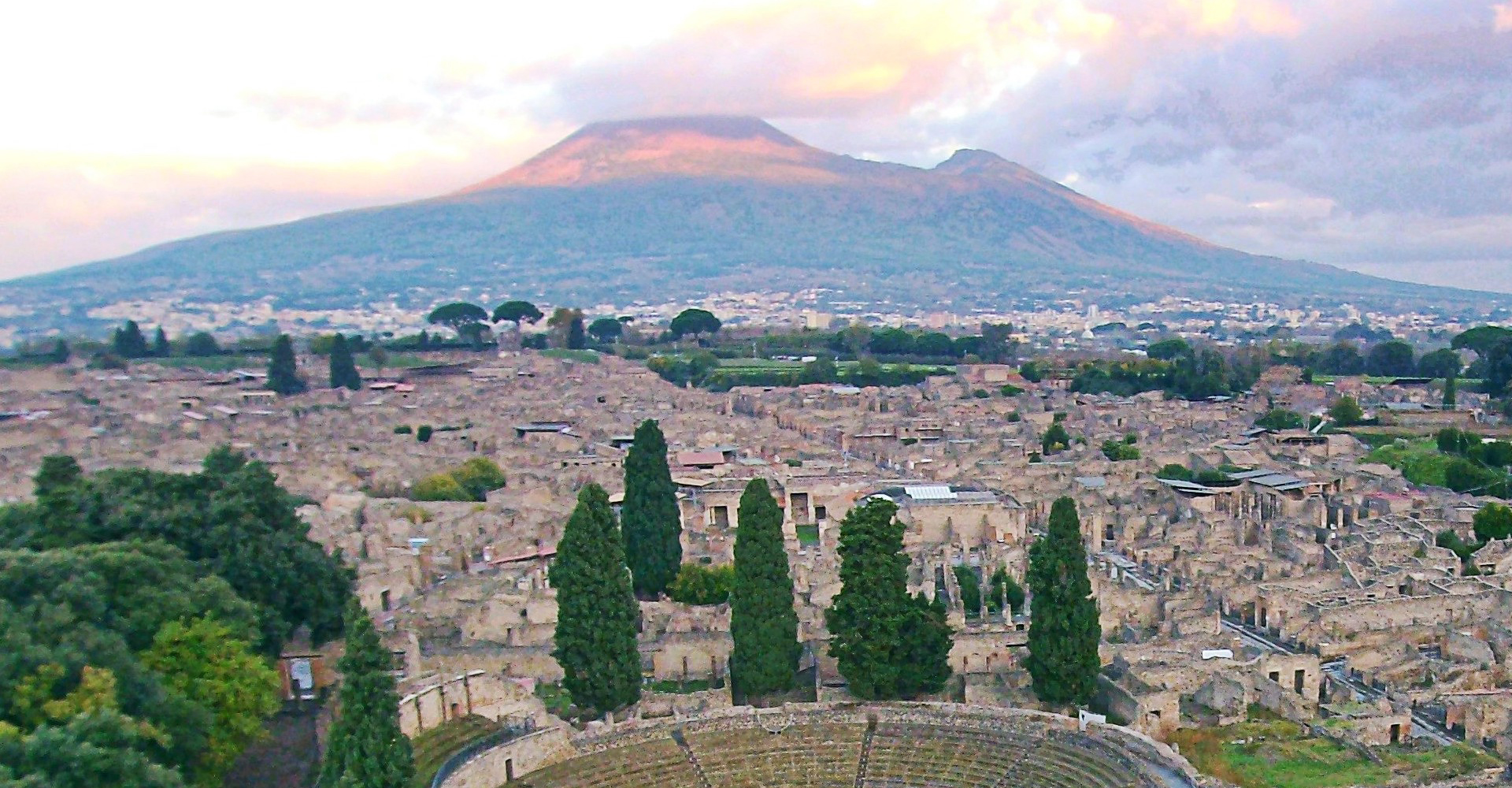
Photo: ElfQrin CC BY-SA 4.0 / Heinz-Josef Lücking, CC BY-SA 3.0/theContrapart
Text: Atle David Torkildsen
Date: 27 June 2026
Translated from Norwegian with the help of AI · Read the original
It is causing a global stir that the University of Naples has used AI to create a video of people fleeing the volcanic eruption. The archaeologists fed in a number of key facts about the consequences of the eruption. After working for a good while, the AI came up with a video you can watch at the bottom of this article. It shows a man fleeing with a protective bowl over his head. That is, according to the experts it is a classic mortar, of the kind used for crushing, for example, nuts, chilli or garlic.
Not exaggerated
The AI video now going viral makes the Pompeii victim's last moments look shockingly real
The archaeologists behind the video believe the man covered his head with a bowl as he fled from raining, glowing ash. Although the video was made by sober-minded researchers who have not been tempted by certain Hollywood tricks, the film is more than exciting enough to capture the public's interest. It also heralds a new development for the museum. Soon such videos will be shown on larger screens for visitors inside the museum grounds.
An awesome experience
For those who need a little refresher in historical facts, we can inform you that the city lies just outside Naples on the mainland. Not far out to sea you find the island of Sicily. The ancient city of Pompeii vanished from the face of the earth one August day in the year of our Lord 79 AD. The ruins of the ancient Roman city are among the most awesome archaeological experiences on the planet. The reason is a number of special circumstances that occurred at the very moment the volcano exploded.
Time stood still
What is positive for us today is that lava never flowed into the city. Nor was it totally destroyed by subsequent earthquakes and the like. A very tragic fact is that many people died from toxic gas. For those of us who visit museums, unfortunately, one man's loss is another's gain. It gives us a unique opportunity to see the city as it was. It is just as if time stopped. People were left lying almost intact in their beds, or at the dining table for that matter. In the weeks after the eruption, the volcano slowly but surely covered the city with a protective layer of ash several tens of metres thick.
Intact city
When the archaeologists started digging almost two thousand years later, their eyes widened. They found an almost intact Roman city where the jars were still in place on the kitchen shelves. Slowly but surely the archaeologists uncovered cobbled streets, an amphitheatre and everything else a modern Roman city had at the time. As a museum, Pompei is utterly unique, and because of the somewhat bizarre circumstances, with skeletons sitting eating dinner, it is just as exciting for old as for young.
Top
Gabriel Zuchtriegel, director of the park in Pompeii, writes frequently about the new AI possibilities on social media. He believes AI can give the whole experience a major boost. Many visitors cannot picture how it was before, simply by looking at the ruins. For demanding young people who are used to AI, films can be a way to increase interest in archaeology.
Well documented
The Roman writer Pliny the Younger witnessed the eruption of Vesuvius. He described how people tried to protect their heads from the falling hot ash. The university's AI video shows precisely this. The advantage of AI technology is that it can produce a highly advanced and realistic depiction almost entirely free of charge. The more information the archaeologists give the AI generator, the more accurate the result that comes out.
The museum of the future
For the museum, this kind of technology offers hope of a more interactive and technologically advanced museum in the future. People who are not experts, and who find it hard to imagine life in the city just by looking at the ruins, can step into small cinemas where they can see what it was really like.
It is good that museums all over the world understand that AI can help bring to life how things looked before. Museums are often so proud of the ruins that they forget that they were in fact not ruins back when people lived there.
Professionals are professionals
Gabriel Zuchtriegel, director of the park in Pompeii, writes frequently about the new AI possibilities on social media. He believes AI can give the whole experience a major boost. To Popular Science magazine, however, he stressed the importance of professional archaeologists being the ones behind the AI videos, to ensure that the details are correctly rendered. Even though the aim is to make it exciting for the public, this does not mean one should give in to the temptation to exaggerate or add elements that did not happen in reality.