Photo: The Independent/theContrapart
Text: Stein Olav Krosby
Date: 20 March 2026
Translated from Norwegian with the help of AI · Read the original
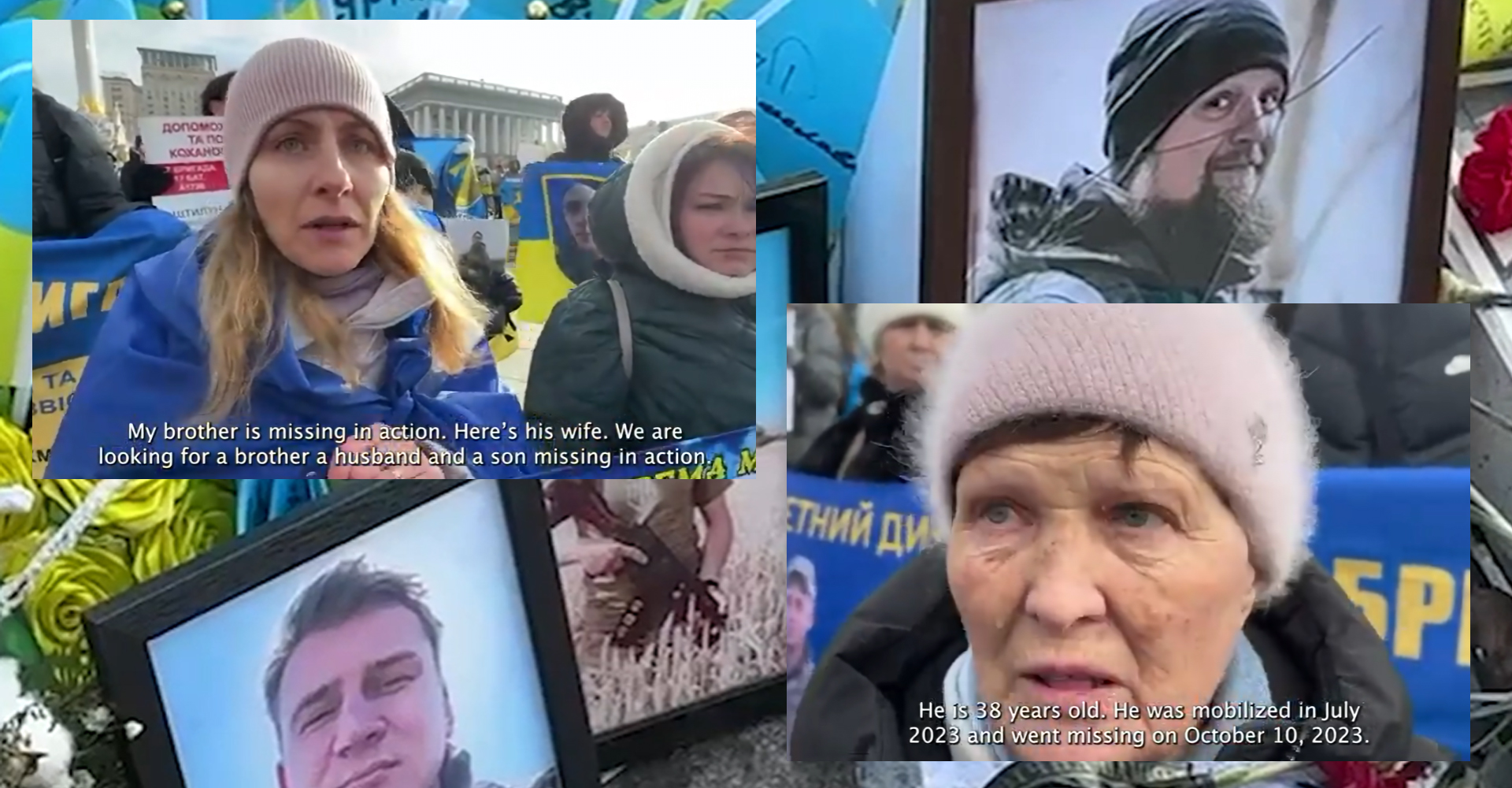
Video footage from both Kyiv and local regions such as Kirovograd shows a growing wave of fury. On Maidan Square in Kyiv, relatives now gather every single weekend. They carry placards bearing the faces of men who have been gone for months without a single word from the authorities. This is not just a protest; it is a collective cry for justice from families who have lost everything.
Testimonies from mothers and widows
In the documentation, we meet women who have lost their entire family's livelihood. One woman says she is searching for her brother, her husband and her son all at once. All three were reported "missing in action" in October, but since then there has been total silence from the military leadership.
Disappeared
Another mother holds up a picture of Andriy (38), who was mobilised in July 2023 and vanished without trace in the fighting in the north shortly afterwards. At home, a daughter in fourth grade waits every day for a father who will probably never come home. For these families, the cost of war is not abstract figures but a personal tragedy ignored by the official apparatus.
Because of constant drone surveillance and artillery fire, it is impossible to recover the fallen. The result is that hundreds of soldiers are left on the riverbed or along the banks.
The river of death
During the fighting at Volchansk, the name "Voltsja" (the Wolf River) has taken on a new and chilling ring. During the winter offensive of 2026, wave after wave of Ukrainian soldiers, including from the 121st Territorial Brigade, were sent across the river without adequate support. Analysts point out that the river has become a death trap. Because of constant drone surveillance and artillery fire, it is impossible to recover the fallen. The result is that hundreds of soldiers are left on the riverbed or along the banks. By categorising them as “Missing in Action”, the authorities achieve two things: they keep the official casualty figures down, and they save billions in payments to the bereaved families.
Top
A mother holds up a picture of Andriy (38), who was mobilised in July 2023 and vanished without trace in the fighting in the north shortly afterwards. At home, a daughter in fourth grade waits every day for a father who will probably never come home.
Blackout
The contrast with the coverage of other conflicts is striking. It was recently documented that remnants of American “Tomahawk” missiles were found at a school in Iran after an attack that killed 175 people. While such technical evidence is gradually forcing its way into the Western press, the suffering of the Ukrainian families at the "river of death" remains a non-story at NRK and Aftenposten.
Norwegian media largely follow the official line, which presents the war as a series of controlled movements, while in reality we are seeing the complete exhaustion of Ukrainian society. The many thousands of small flags covering the lawn on Maidan are silent proof that the real losses are far higher than the 55,000 President Zelensky has officially stated.
The right to know
For the families in Kirovograd, this is no longer about geopolitics or Western arms deliveries. It is about the right to know what happened to their fathers and sons. The growing wave of protest shows that the information monopoly is beginning to crack. When mothers have to take to the streets to find out whether their son is lying at the bottom of a river, the military and political system has failed utterly. Motparten will continue to follow the story and give a voice to those who get no room in the evening news.