Thailand's secret war in the south
Police station attacked
A military unit opened fire on the police station. Shocked residents watched as regular combat went on for several minutes. People who associate Thailand with peace and meditation rarely hear about such episodes.
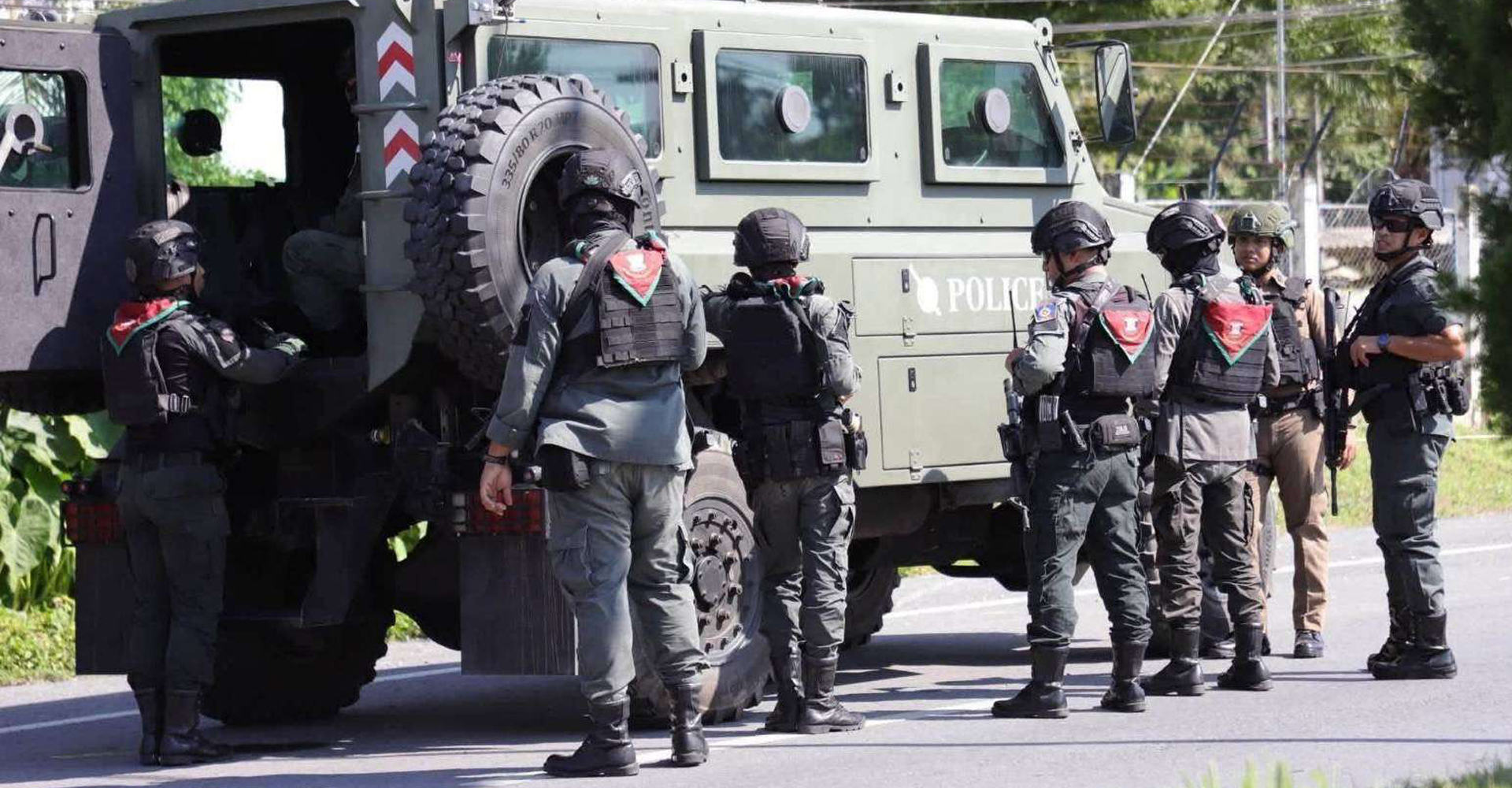
Being a Thai soldier or police officer in the three southern provinces is downright life-threatening. Here we see Thai forces outside a police station that has just come under attack.
TopPhoto: Thaibloid/theContrapart
Text: Rune Ollestad
Date: 16 August 2026
Translated from Norwegian with the help of AI · Read the original
Thailand is a Buddhist country where 99 per cent of the population are peaceful people who don't even raise their voices when they are furious with each other. But Thailand also has a dark secret that the authorities do their best to hide. Down in the far south lie three provinces where almost everyone is Muslim! No tourists come here. That is hardly surprising, because for decades a regular war has been raging, with tens of thousands dead.
More than guerrilla warfare
The Muslim guerrillas' usual way of waging war is ambushes and traps, along the lines of the Vietnamese defence against the USA. But unfortunately the Muslims also kill peaceful, unarmed teachers on their way to work by moped or bicycle. The reason is that they teach Buddhism, which is heresy to the Muslim majority. The war has gone on for decades, with constant killings and skirmishes.
Police station attacked
The residents of Mueang Yala district found this out recently, when a well-organised Muslim military unit attacked the local police station. The officers inside the station returned fire. This led to an intense exchange of gunfire that went on for a long time. The Muslim force then withdrew in good order without losses, using its local knowledge to escape. Although Thai security forces surrounded the area in the hours afterwards and searched for the suspects, few believe anyone will be arrested.
A mighty sultanate
Ninety per cent of the population are Muslims, and the Thai army is seen as an occupying force. And perhaps it is one. The three provinces of Pattani, Yala and Narathiwat once formed the core of the Sultanate of Patani, which existed from the 15th century until Thailand conquered it in the late 18th century. Back then Thailand was called Siam. Many are unaware that the sultanate was so powerful that Siam feared it. Many things made the sultanate powerful. Not just weapons and a large merchant fleet.
Home pageUp to 90 per cent of the people in the three southernmost provinces of Yala, Narathiway and Patani are Muslim.
Ruled by women
Strangely enough, the Muslim rulers had a tradition of putting women on the throne. In a story that could have come straight out of the Arabian Nights, male heirs were murdered in a brutal power struggle in the 16th century. A woman, Ratu Hijau, known as "the Green Queen", took the throne. She became the first of four queens to rule the sultanate. Historians call this Patani's golden age.
Beat Thailand
In 1603 the Thai (Siamese) king Naresuan attacked the Sultanate of Patani. Thailand lost, partly because Patani had foreign backing and good firearms. Her successor, Ratu Ungu, learned from this. Nor was she afraid to use force. When her sister was refused permission to travel home by her husband, the Sultan of Pahang, the queen sent four thousand soldiers and seventy ships to bring her back by force. There was turmoil at the top in the old days too.
It has not been proven that neighbouring Muslim Malaysia is helping the rebel army, but there is little doubt that many of its members have a base on the Malaysian side of the border.
Thailand took revenge
The last of the queens, Ratu Kuning, ruled over a city that had developed into one of Southeast Asia's most important trading centres. She is said to have refused to spend the state treasury on her own expenses and instead set up her own shipping company to finance herself. Her wealth was reportedly so enormous that it took three days just to gather up her belongings. Even so, the riches were not enough to withstand a superior force. Thailand was a much bigger country and had many more soldiers. Patani was finally conquered by Siam in 1786, but it is important to note that Thailand did not gain full control until 1902. Today many wonder whether it actually has it.
MOTPARTEN
The other side of the story. An independent newspaper from Norway.
Contact
- Newsroomredaksjon@motparten.no
- Advertisingannonser@motparten.no
- General enquiriespost@motparten.no
Address
Motparten.noElevine Heedes vei 2
4839 Arendal
Norway Editor-in-chiefJesper Enerstvedt