China has built a wind turbine that can withstand a
Category 17 typhoon
Far out at sea, China has built the offshore wind turbine of the future. It would make the offshore wind companies so heavily represented at Arendalsuka (Arendal Week) drool at the prospect of squandering even more money on something made with coal that cannot be recycled, but which they love to call GREEN energy.
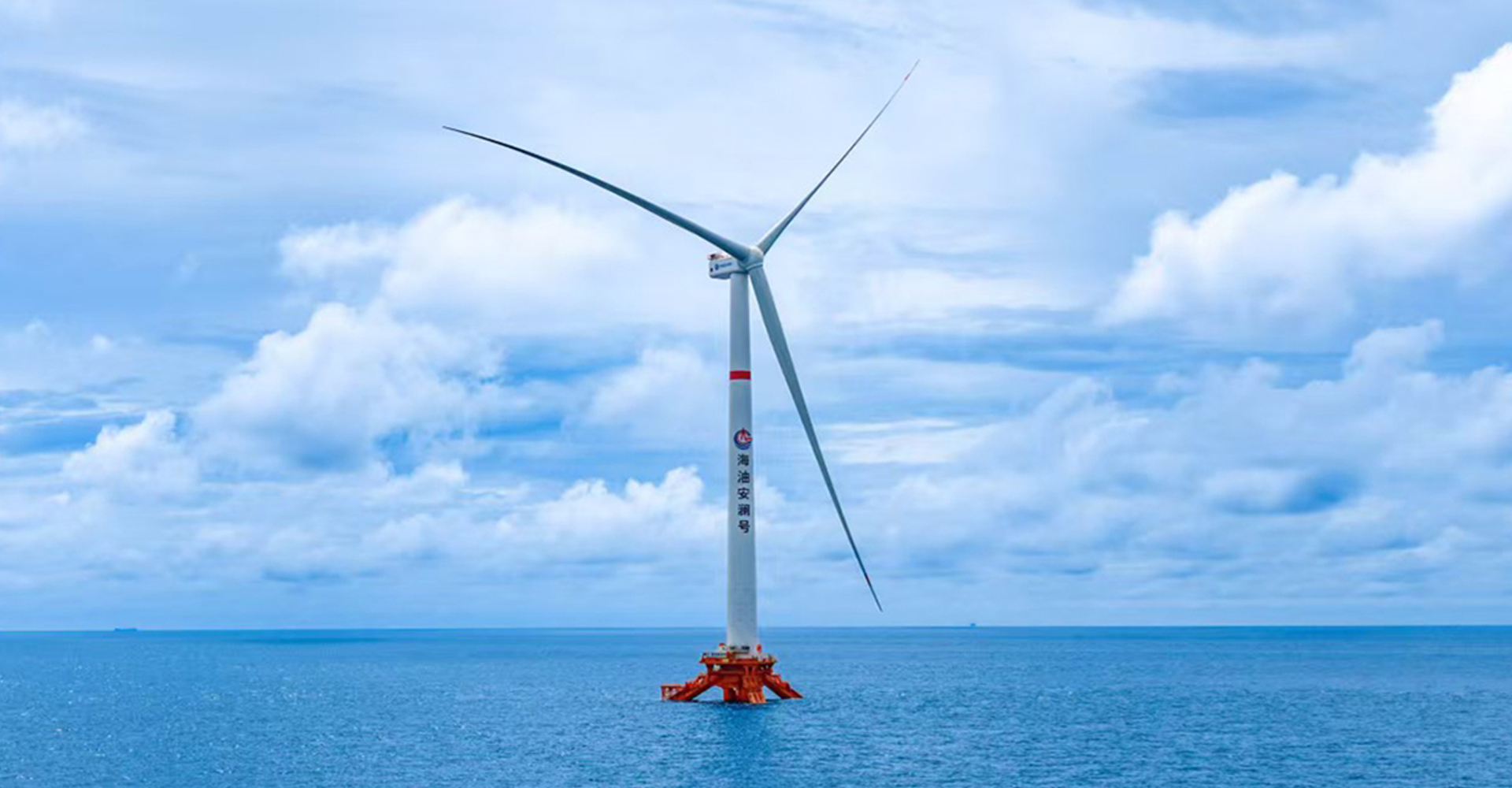
It may not look all that impressive from a distance, but that is before you realise you are dozens of kilometres away. Drive closer and it just keeps growing, until you see that it is as tall as a 110-storey skyscraper.
TopPhoto: CNOOC/theContrapart
Text: Rune Ollestad
Date: 27 August 2026
Translated from Norwegian with the help of AI · Read the original
China's first floating wind turbine with tension legs and a 16 MegaWatt turbine is a reality. It is an impressive feat of engineering. It is impressively big. It delivers impressive amounts of electricity. It withstands impressive amounts of bad weather. The only bad news is that it is impressively dirty, because the factories that make it run on coal, and the materials it is made of have to be buried in the ground because something so toxic cannot be recycled.
Odd legs
Tension legs, or more precisely tension tethers, refer to the mooring system. The platform floats, but is held steadily in place by taut tethers anchored to the seabed. These tethers restrict movement far more than ordinary mooring systems. That makes the TLP concept suitable for deeper water and larger turbines, with potentially lower material consumption than any other floating solution.
"Green electricity"
The new Chinese super-turbine is to be connected to the Lufeng oil field's power grid and begin supplying green electricity to offshore operations in the South China Sea. In other words, the Chinese are at least as mad as the Norwegians. They too supply expensive green electricity to people who produce fossil oil and gas that could be used to make cheap electricity. When we say so-called green energy, it is because giant wind turbines like these do not make themselves. They are made of materials that are almost impossible to recycle. Neither the manufacture of the big rotor blades nor what happens to them at the end of their lives is green. On the contrary, there are enormous pollution problems associated with both production and scrapping.
Typhoon-proof
According to the operator, the platform is built to withstand level 17 typhoon conditions. That makes it virtually invulnerable to wind and weather. It also marks a major step forward in China's deep-sea technology for floating wind power. In Norway people like to think they are the best in the world at offshore wind, but they clearly still have some way to go before reaching the Chinese level.
Impressive figures
The new platform is located in the Pearl River Mouth Basin. That is only 200 kilometres south-east of the technology city of Shenzhen in Guangdong province in southern China. The turbine operates at a depth of 136 metres. There is nothing to complain about when it comes to size. It towers as high as a 110-storey skyscraper. Its lifespan is stated as 25 years. This turbine can actually produce quite a lot of electricity too. Once in operation it is to deliver 54 million kilowatt-hours of so-called green electricity to the oil field every year. That is roughly equivalent to 15,000 cubic metres of heating oil and cuts carbon dioxide emissions by 35,000 tonnes.
Better than before
If one is to try to say something environmentally friendly about this type of platform, it must be that, compared with semi-submersible platforms, they require far less steel per megawatt. They also have greater stability. The technology is regarded as one of the most challenging in floating wind. This is serious engineering we are talking about. So far the world has not seen commercial use. It sounds great that it can be located far away, but then the cables that carry the electricity also have to be longer.
Home pageIt is as tall as a skyscraper and delivers enormous amounts of electricity. It can also withstand hurricanes and proper Norwegian storms, but claiming that it delivers green electricity is true only with some modifications. It is well documented that producing the rotor blades has a large environmental footprint, and it is just as well known that you cannot toss the blades into a recycling furnace once they reach the end of the road.
Norway neither the biggest nor the best
For the Norwegian offshore wind sector this is probably both good and bad news. Nobody likes to be beaten by the Chinese, least of all at something one claims to be the best in the world at, but on the other hand. Anything that gives the industry a nudge in the right direction and makes it a little greener is gratefully received.
Football pitches
The wind turbine haters and the experts who have got the entire industry choking, however, have no shortage of arguments to prove that this is the devil's work. Compared with what a nuclear power plant, for example, produces, or the cost of producing electricity from gas, wind turbines at sea look like sheer madness. The new Chinese super-turbine is no exception. It weighs 7,800 tonnes and occupies a windswept area equivalent to 7.5 football pitches.
Off the beaten track
The dimensions therefore require materials and construction methods that can withstand extreme stress. This is one of the reasons why Lin Boqiang, director of the China Center for Energy Economics Research at Xiamen University, told the Chinese newspaper Global Times that the project represents an important technological breakthrough. The director points out that floating wind systems using this technology can move far beyond the limits of the coast and use wind where it is a nuisance to no one. The director admits, however, that costs remain a main challenge. Building the new super-turbine was anything but cheap.
Most have changed their minds
Friends of the Earth Norway (Naturvernforbundet) has gone from uncritical support for offshore wind to being strongly critical of wind turbines in general. It focuses mostly on interference with nature. It now talks about "green colonialism" and the industrialisation of landscapes. It is also concerned about the turbines' coal-black origins. Most of them are made in China. Research communities, too, have changed their minds about wind turbines. It is pointed out that wind power's material and energy needs make it less clean than had been hoped. The former Norwegian diplomat Sverre Jervell has pointed out that without Chinese coal power we would not have had cheap wind power. He says outright that wind turbines have a coal-black past.
Enormous environmental footprint
The problem is that blades and rotors come from highly polluting production plants in China. The biggest Chinese manufacturers are Goldwind, Mingyang, Envision, Sinoma, China National Building Material (CNBM), Zhongfu Lianzhong, Sinoma Wind Power Blade and Shanghai Electric. They have large factories in provinces known for big steel and cement industries with high coal consumption. It is an enormous paradox that the energy used to produce the blades and steel components for Norway's green miracle comes from coal-fired power plants with a high carbon footprint.
MOTPARTEN
The other side of the story. An independent newspaper from Norway.
Contact
- Newsroomredaksjon@motparten.no
- Advertisingannonser@motparten.no
- General enquiriespost@motparten.no
Address
Motparten.noElevine Heedes vei 2
4839 Arendal
Norway Editor-in-chiefJesper Enerstvedt