Brazen politicians and economists
Think people are idiots
Most people understand what both inflation and wage growth are. People are not idiots. That is why most ordinary families with loans can work out that increased interest costs amount to far more than the difference between wage growth and price growth.
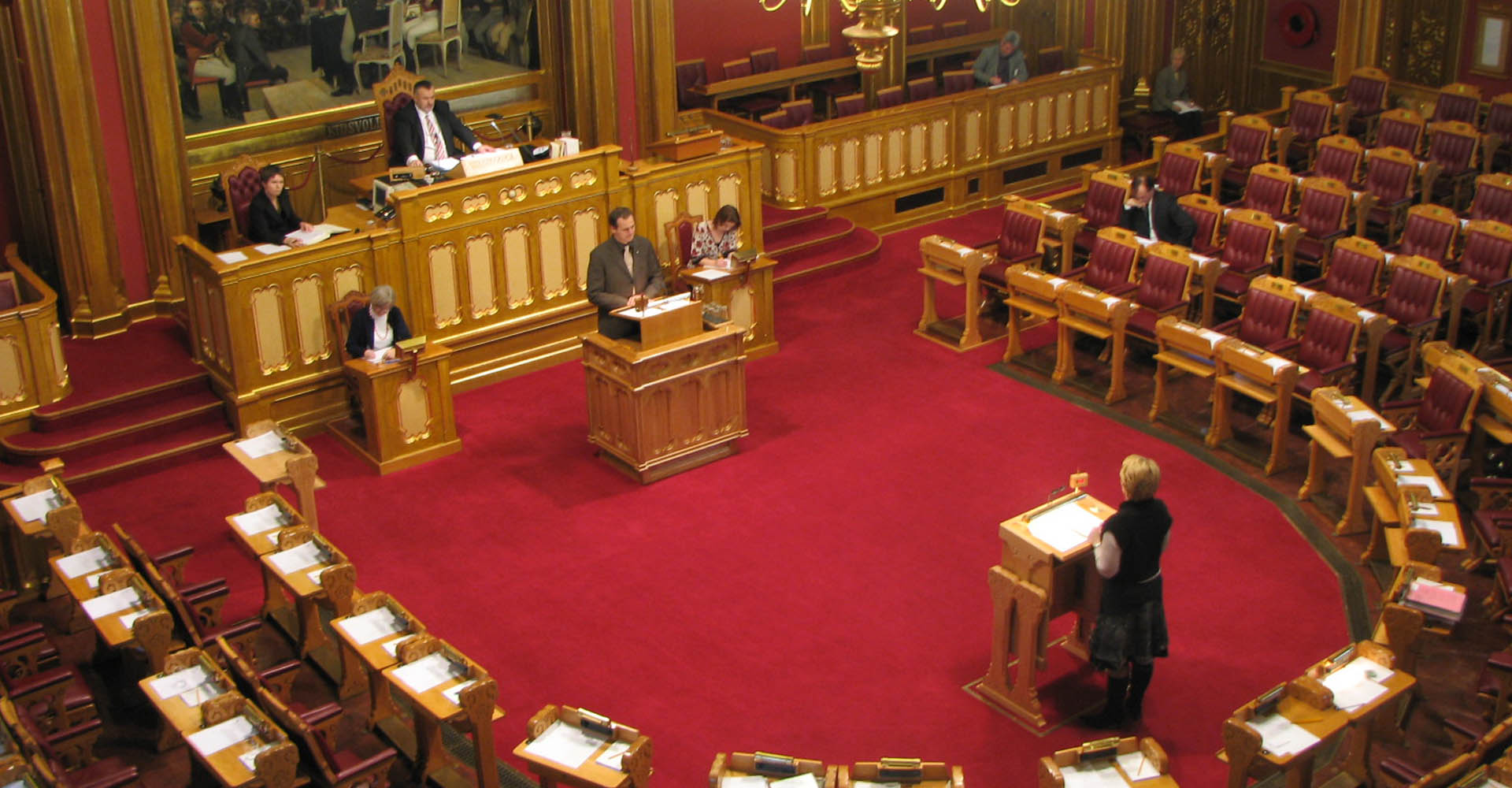
The chamber of the Storting (Norway's parliament) is often empty. So are the heads of many politicians who think people won't notice that higher interest rates are eating up their pay. It helps little that the pay rise is slightly more than inflation.
TopPhoto: Røed_CC BY-SA 2.5/Stortinget/CC BY 2.0/motparten
Text: Ludvig Storn
Date: 15 October 2026
Translated from Norwegian with the help of AI · Read the original
An average mortgage for a family is around 3.5 million kroner. With an interest rate of 1.5 per cent, the interest cost was about 4,100 kroner a month after tax deductions, while an interest rate of 5.5 per cent came to roughly 13,100 kroner a month. You don't need to be a rocket scientist to see that this is 9,000 kroner extra straight out of your account every single month. All the waffle about wage growth outpacing price growth is hardly relevant. The growth doesn't cover a fraction of those 9,000 kroner.
Just nonsense
Over five years, an average salary of 650,000 kroner has risen by around 115,000 kroner gross, which gives about 70,000 kroner more paid out per year after tax. But at the same time, general price rises on food, electricity and fuel have eaten up more than 50,000 kroner of that increase for a household. That leaves perhaps 15,000–20,000 kroner in real wage growth to cover an interest explosion of over 100,000 kroner, and that proves in black and white why the claim that "purchasing power has increased" is a pure illusion dreamed up at a desk.
Brazen economists
Olav Chen from Storebrand, chief economist Harald Magnus Andreassen from SpareBank 1 Markets and representatives from Statistics Norway (SSB) caused an uproar in Norway after an NRK debate at the beginning of October, where they were accused of not taking people's complaints about a worse economic situation seriously enough. Bankers and statisticians stood shoulder to shoulder and told the Norwegian people that they are not badly off. Wage growth beats price growth, the experts said. To them, that was proof of strengthened purchasing power. That the average citizen has had an enormous increase in interest costs that exceeds the difference between price growth and wage growth was hardly even discussed.
People aren't stupid
Many viewers said afterwards that they found the debate surreal. How can the country's leading fund managers and macroeconomists say something like that? Everyone with a loan knows, of course, that they are left with less disposable income after fixed expenses. Nor are people so stupid that they don't understand that real wages are growing because annual wage growth exceeds growth in the consumer price index (CPI). People are not idiots. They can read the curve showing twelve-month growth of around 3.5 per cent, while the wage settlement ended above 5 per cent. But to put it in plain terms, most people couldn't give a damn about that when increased interest costs are piling up. Most people have of course not got better purchasing power. They have got much worse purchasing power. Pardon the expression again. Any idiot can see that.
It is very provoking when politicians smile and tell you that you are better off, when there are weekly crisis meetings at home about how to cope with the new everyday life with MUCH less to get by on.
A slick crowd
Treating your own voters like fools is not the smartest way to win new voters. Nor to keep the old ones. The parties that smile at the voters and tell them they have gained purchasing power will notice that.
Home pageWhen the youngest hisses over the Christmas presents and the teenager flips because he doesn't get this year's model of slalom skis under the Christmas tree, the young have pointed to something the adults understood long ago. Purchasing power has got worse. Many will no doubt draw the consequences and vote for a party that doesn't lie to their faces. The first party to admit that purchasing power has got worse will get wind in its sails. From young and old.
Three kinds of lies
The famous author Mark Twain said that there were three kinds of lies. Lies, damned lies and statistics. That Statistics Norway's (SSB) methodology for the consumer price index leaves interest costs and debt servicing on mortgages out of the CPI is fine with most people too, as long as it isn't abused by silly economists and experts who appear on TV and claim that you are better off. That gets too stupid. Economists on TV who fixate on the index capturing what a basket of groceries costs, but who haven't noticed that the price of households' biggest debt item has quadrupled in a short time, do not impress viewers. It just leaves them exasperated, and many of them pretty furious too.
Weaker purchasing power
The consumer director at Huseierne (the Norwegian Homeowners Association), Carsten Pihl, has on several occasions pointed out that "When the economists talk about real wage growth, they forget that Norwegian households have a world record in debt". He points out that the interest rate hikes eat up the pay rise long before the money reaches the grocery store. For a family with three to four million in loans, we are talking about tens of thousands of kroner in lost purchasing power every single year, which never shows up in the inflation figures.
Covers only a quarter
The Financial Supervisory Authority of Norway (Finanstilsynet) mortgage surveys and OECD figures show the same thing. Norwegian borrowers have an average debt ratio of between 230 and 240 per cent of disposable income. Almost 80 per cent of the population own their own home, and over 90 per cent of loans have a floating interest rate. In the reports from the Norwegian Technical Reporting Committee on Income Settlements (TBU) we see it clearly. Households' interest burden as a share of disposable income has more than doubled since 2021. For a standard loan of 3.5 million kroner, the interest rate rise from 1.75 to nearly 5.7 per cent has increased the annual interest expense by more than 130,000 kroner before tax. Even after the 22 per cent interest deduction, over 100,000 kroner net disappears straight out of the household budget. A gross pay rise of 25,000 to 30,000 kroner doesn't even stretch to covering a quarter of the interest rate rise alone.
Calls a spade a spade
Chief economist Jan Ludvig Andreassen at Eika Gruppen deserves a diploma. He is the most down-to-earth of the economists motparten has found on this topic. It almost looks as if Jan Ludvig mixes with ordinary people in daily life. He has understood that increased interest costs are bigger than wage growth. He even points to the wrecked krone exchange rate. "A weak krone works in practice as a collective pay cut for the entire Norwegian population. We have made ourselves poorer measured against other countries, and we are importing price growth that neither the central bank nor ordinary wage earners are able to neutralise." As Statistics Norway's analyses of import prices underline, this feeds through into the cost of living.
Follow the story in motparten
MOTPARTEN
The other side of the story. An independent newspaper from Norway.
Contact
- Newsroomredaksjon@motparten.no
- Advertisingannonser@motparten.no
- General enquiriespost@motparten.no
Address
Motparten.noElevine Heedes vei 2
4839 Arendal
Norway Editor-in-chiefJesper Enerstvedt