Industry flees sky-high energy prices
Self-inflicted price crisis
Who on earth came up with the daft idea of taking potshots at Russia while shutting down every nuclear power plant? Financial analysts in the US and Asia can barely believe what they are seeing in Europe. The leadership in Brussels has managed to remove all cheap energy without having a good alternative.
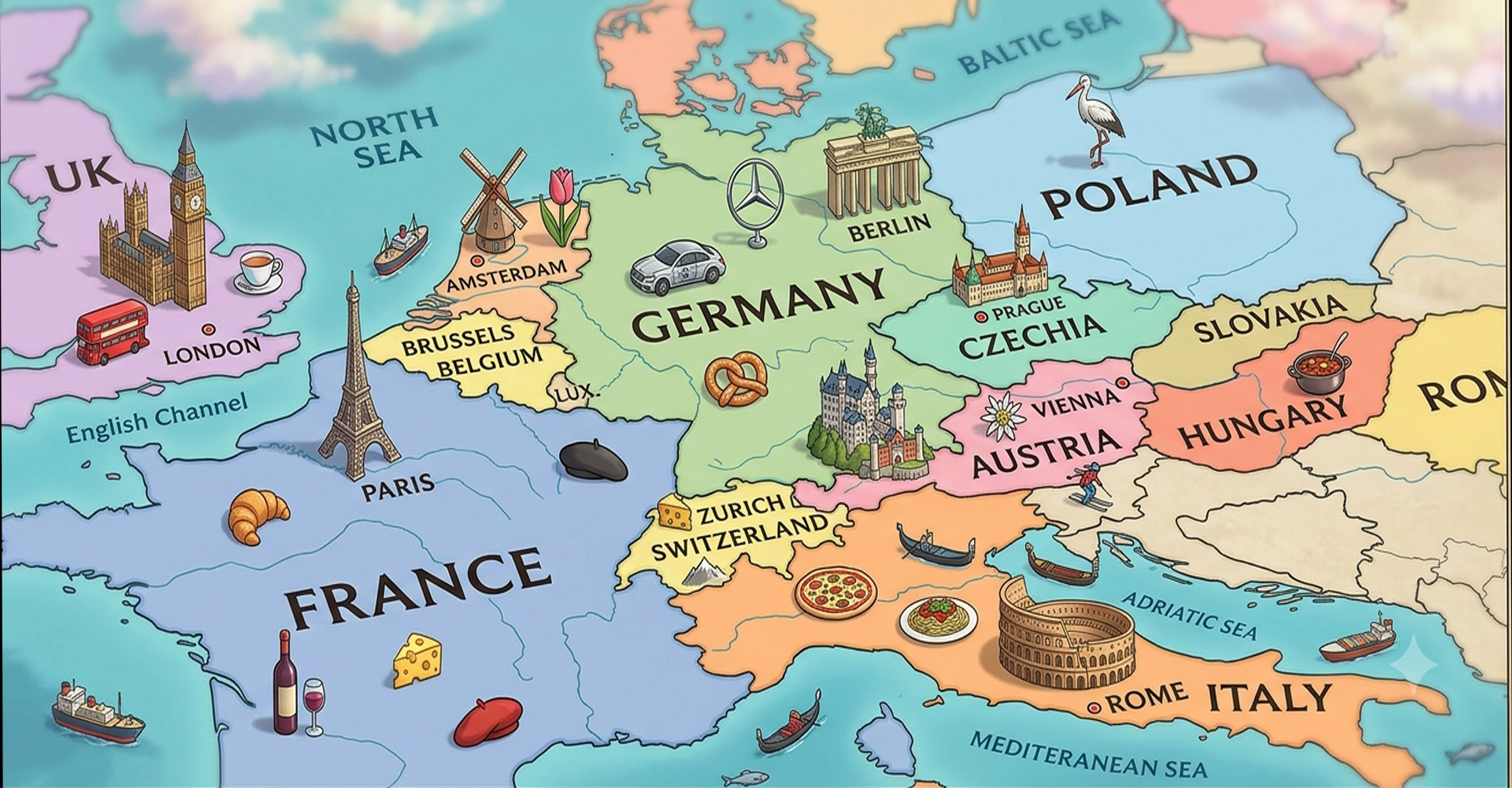
The once rich and proud nations of Europe are now on their knees thanks to a headless war and climate policy. They have quite literally shot themselves in both feet.
TopPhoto: Desken/Gemini AI/theContrapart
Text: Ludvig Storn
Date: 12 August 2026
Translated from Norwegian with the help of AI · Read the original
Sky-high electricity prices and steep raw material costs are strangling the industrial heart of the EU. As you make your bed, so you must lie in it, as the saying goes. That can safely be said of Europe. The continent is now flat on its back, and no wonder. You would have to search long and hard for a more self-inflicted tragedy.
Alarm in Italy
In Italy, the industry organisation Confindustria has sounded the full alarm over the country's steep electricity and gas prices, which threaten to trigger a new cost shock of up to 21 billion euros for Italian manufacturers. The organisation warns that energy costs are eating up more than seven per cent of total production costs in industry.
In recent weeks Motparten has run a series of articles on Germany, France and Spain, but the rest of the Eurozone is also struggling with permanently high energy prices.
Energy-vulnerable industry
The metal and steel industry is struggling with Italian electricity prices that are far above the EU average. The ceramics and tile industry around Sassuolo in Emilia-Romagna has the same problem. The glass and foundry industries are also going to the dogs. So is the long-established paper and pulp industry. Last but not least, both the chemical industry and the fertiliser industry are in trouble too.
An extra tariff
Italy's Minister of Enterprise Adolfo Urso aimed sharp criticism at Brussels during a meeting of the EU Council, as reported by the trade publication Industrial Info Services. Urso said that the EU's quota system works like a pure extra tariff on energy-intensive companies, and warned that Europe is facing a total collapse of the chemical industry and the European steel sector.
From Brussels
The climate quotas are created and distributed by the European Commission in Brussels through its own quota system (EU ETS). A quota is in practice a "permit to pollute": for every tonne of CO₂ a factory emits, it is forced to buy one quota on an open market.
Green shift
Because Brussels cuts the number of available quotas every single year in order to force through a green shift, prices are pushed sky-high. For power-hungry steelworks and chemical plants, the quota cost hits the bottom line directly the moment they fire up their furnaces, making it drastically more expensive to produce goods in Europe than in the US and Asia, where these charges do not exist.
Spain rescued by China
In Spain, the authorities have chosen to bring in foreign capital to prevent industrial death. Spain's Minister of Industry Jordi Hereu said at a press conference covered by the newspaper El País that the country welcomes international investment to protect local jobs. Hereu confirmed that China's Chery Auto has entered a joint venture with Spain's EV Motors to take over and restart car production at the closed Nissan factory in Barcelona.
Front pageOn top of the expensive energy the EU has inflicted on European companies, they must pay climate quotas. It is an outrageous cheek that makes many see red. Now one can glimpse the outlines of the entire EU system being on its way down. If the AfD wins the election in Germany, it could start an avalanche that in the end brings down today's system. We must stop believing in regime change in Moscow. It is easier to stop Brussels. Now we must tear down in order to build up.
Greece rages against Brussels
Greek heavy industry is likewise struggling with electricity prices that at times have reached almost 110 euros per megawatt hour, reports the trade publication Energypress. The Greek industry organisation for energy users, EVIKEN, warns that smaller manufacturers in the regions risk outright closure if no national support schemes are set up. The loss of gas from Russian pipelines has forced European players over to more expensive liquefied natural gas imported by tanker from the US. Statistics from the energy analysis institute IEEFA confirm a marked increase in imports of chilled gas after 2022, which has locked European business into a permanently high cost level.
Pitch-black future
The Greek industry organisation SVE said in a public announcement reproduced by the news outlet Voria that the effect of the EU's policy falls completely apart unless the measures are rolled out immediately at national level. SVE stressed that Greek companies need predictable framework conditions rather than short-term initiatives from Brussels.
Tragic
While the Eurozone struggles with its own climate measures and expensive energy, the International Monetary Fund (IMF) reports that trade volumes between the BRICS countries are rising sharply in oil, metals and agriculture. Germany's heavyweights are packing up their plants, while the car industry flees the continent. At the same time, business giants in Italy, Spain and Greece warn that the Eurozone is about to wipe out its own competitiveness against the US and Asia.
Driven into the ditch
German car groups such as Volkswagen, BMW and Mercedes-Benz are experiencing a catastrophe. An analysis report from the business newspaper Financial Times charts how the car sector in the Eurozone is losing market share at a rapid pace as a result of steep component prices and European emissions fines. The Financial Times analysts point out that company leaders are now cutting billion-euro investments on the continent in order to invest instead where energy is cheaper.
Historic decline
German heavy industry and European carmakers are in the middle of a historic decline as a result of explosive energy prices and failing access to raw materials, according to fresh data from the EU's statistics office Eurostat. The wave of factory closures and capital flight is now hitting the very core of the economy of the European single currency.The chemicals giant BASF has decided to close several of its long-established plants at its global headquarters in Ludwigshafen. BASF's former chief executive, Martin Brudermüller, said in a statement reported by the news agency Reuters that European energy costs make continued operations unprofitable. Brudermüller stressed that the chemical industry is completely dependent on predictable and cheap baseload energy if it is to be possible to compete with players in Asia and North America.
MOTPARTEN
The other side of the story. An independent newspaper from Norway.
Contact
- Newsroomredaksjon@motparten.no
- Advertisingannonser@motparten.no
- General enquiriespost@motparten.no
Address
Motparten.noElevine Heedes vei 2
4839 Arendal
Norway Editor-in-chiefJesper Enerstvedt