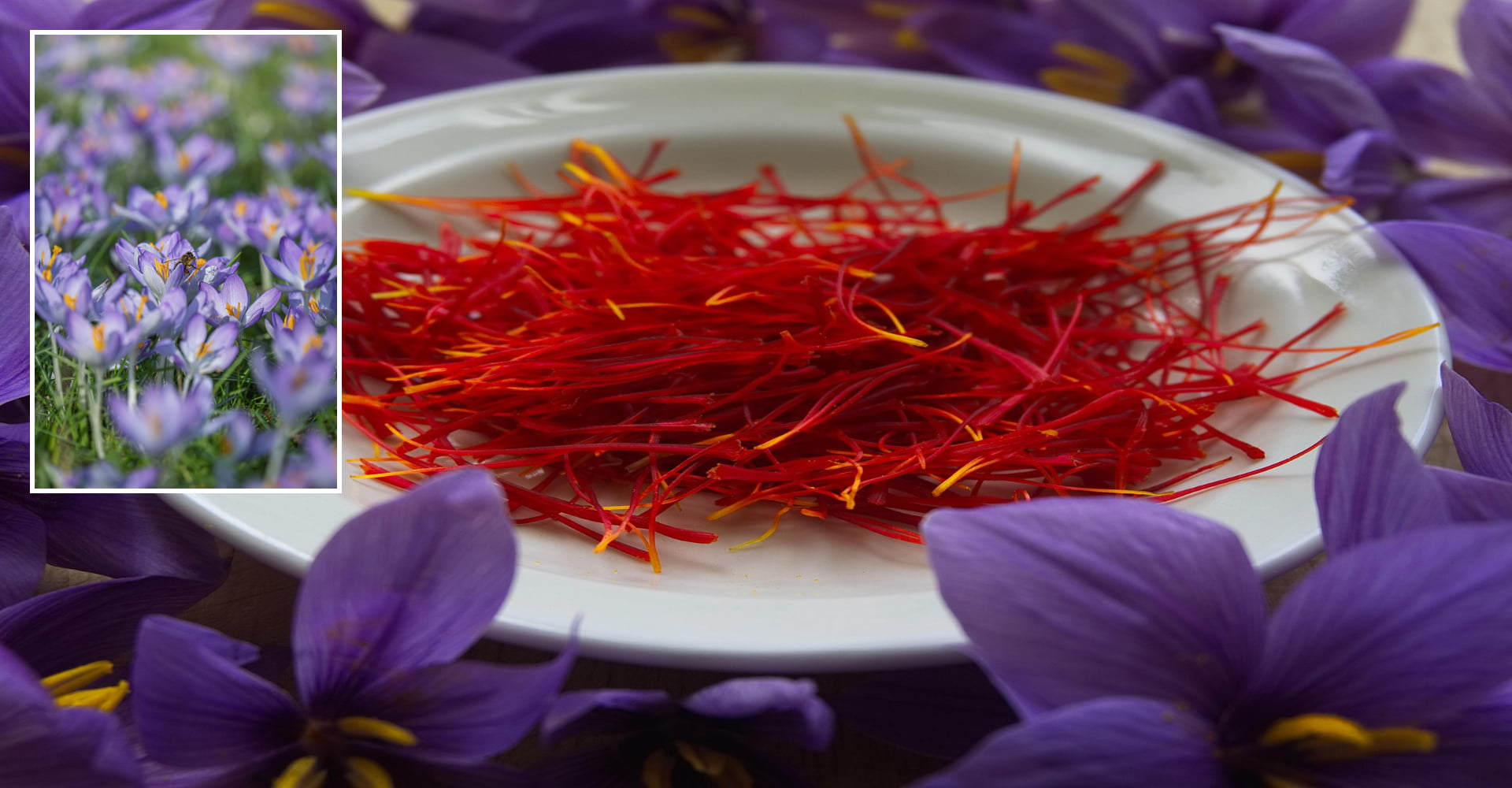
While war rages between Iran and the USA, an intense harvest of the world's most expensive spice is under way in Iran. What from a plane looks like a few poor farmers in a field of purple flowers is in reality the harvesting of the red gold – saffron.
The exclusive red spice costs about 10,000 Norwegian kroner per kilo, and even more for you and me, who only buy a tiny amount to add flavour and colour to our food.
Iran completely dominates the world's saffron production. According to the UN's Food and Agriculture Organization (FAO), the country accounts for almost 90 per cent of global production. In other words, Iran is good at more than making drones and ballistic missiles. It is the undisputed world leader in the production of so-called "red gold".
Exclusive flower
The world's total production lies somewhere between two and three hundred tonnes of dried saffron a year. Harvesting the raw material is extremely labour-intensive, and that is good for Iran. It creates many jobs. It takes roughly 170,000 flowers and many hundreds of hours of handwork to make just one kilo! No wonder the prices make both Norwegian and foreign food enthusiasts raise their eyebrows. It is astronomically expensive!
Khorasan saffron
The largest saffron fields in Iran are found in the Khorasan provinces in the north-east of the country. Those who know the country will nod in recognition at place names such as Torbat-e Heydarieh, Gonabad, Qaenat and Zaveh. Around 150,000 hectares are devoted to saffron production here. India also produces saffron on a smaller scale. The largest areas are in Kashmir, where the exclusive Pampore variety is produced. Afghanistan has its saffron production centred around Herat. They, too, export considerable quantities.
Europe and Africa
Saffron is also grown on a smaller scale in Europe. Greece, for example, has a number of fields and meadows devoted to the exclusive gourmet flower with the splendid red colour. Saffron is also made in Spain, Italy and Turkey. In Africa there is in part extensive production in countries such as Morocco, where the regions of Taliouine and Taznakht stand out. Further south in Asia than Iran, several countries have increased their saffron production in recent years. Among them are Azerbaijan and China, but their volumes are small compared with Iran's.
Re-exporting
Some smart countries have learned to take advantage of Iran's enormous production. One of them is Spain, which was itself once a major saffron producer. It is still an important international player because it imports large amounts of Iranian saffron, repackages it and re-exports it under Spanish brands.
Saffron is so expensive that many people with slimmer wallets are far more preoccupied with the absurd prices than with the taste, but saffron actually has a very good, distinctive, slightly rounded flavour that many gourmet chefs greatly appreciate. The characteristic red colour can be faked with turmeric, among other things, but the taste is impossible to copy.
Billions of kroner
Looking at the plain figures from Iran says a lot about why the spice flower is called the red gold. In the 2024/2025 season Iran exported around 214 tonnes of saffron. The value of this export alone was a barely believable 185 million dollars, or over 1.8 billion Norwegian kroner. And that is the pure export value, before prices start to climb on the way to ending up, in the final analysis, in your kitchen for a hideously large sum.
Astronomically expensive
Saffron is extremely popular, but most popular in countries such as the United Arab Emirates, Spain and China. Here saffron is used liberally in thousands of classic dishes, but it is also used in a range of other products. It is no exaggeration to say that the global trade volume for saffron is in the order of 3 billion Norwegian kroner. Officially, the price of one kilo of Iranian export saffron is around a thousand dollars per kilo. That is ten thousand Norwegian kroner for a heap of flowers. Retail prices internationally are several thousand dollars per kilo. The value of even small amounts of the red gold is so high that extensive smuggling and re-exporting are seen.
Too wet in Norway
Many countries try to build brands and protect their own saffron production. Greece supplies what it considers quality saffron under protected designation of origin (PDO) labelling. Some gourmet chefs can, for example, buy from Kozani in Greece or perhaps a little exclusive Indian saffron from Kashmir. Perhaps saffron could be grown in Norway? At any rate, almost all saffron is produced in dry, sunny areas with cold winters. Norway could vouch for the last two factors, but a dry season is something we have yet to see here. Internationally, the harvest takes place precisely in autumn. As mentioned, it is entirely manual. Saffron is almost as expensive as narcotics, but it is legal and secures a large number of jobs for unskilled farmers.