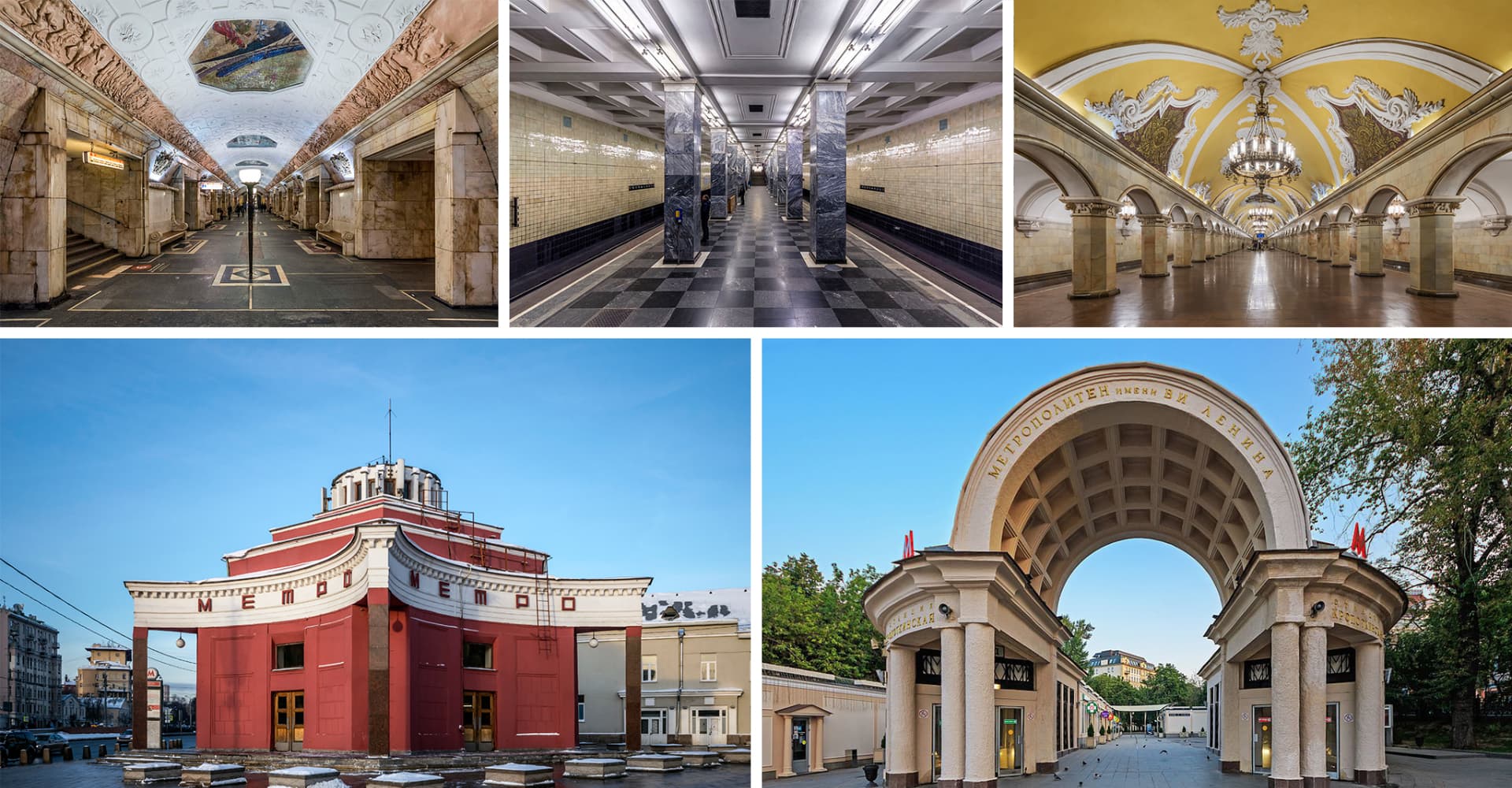
Far below Moscow's streets you will find the world's most beautiful and perhaps longest metro line. Self-driving, ultramodern trains are now being test-run here. The old Soviet jewel is aiming for fully autonomous operation before 2030.
The entrances (access) to the stations of the Moscow Metro are unique international architecture. The stations are pure works of art, built with the finest craftsmanship. Here, Komsomolskaya station.
In January 2026, test runs began of the Russian-built autonomous train "Moskva-2024" on the circle line. According to technical data from Railway Technology and the metro's own press releases, the train is for now running without passengers and under the supervision of a train driver. The goal is fully driverless operation on the circle line by 2030.
Fantastic details
The Moscow underground is internationally best known for its grand, palace-like stations from the Soviet era. Today the metro system is adding a new quality: high technology. According to the International Association of Public Transport (UITP), the Moscow Metro is right at the top for traffic intensity and passenger volume per kilometre of track. That is only possible with highly advanced technology. Millions of travellers are channelled through an ever more integrated and fully automated network every day.
Unique
The Moscow Metro stands out in a way most other underground systems do not. The classic stations Komsomolskaya, Mayakovskaya, Novoslobodskaya and Kievskaya have mosaics, marble, chandeliers and vaults that make them look more like underground palaces than transport hubs. They were built with enormous monumentality. Many who have seen them, myself included, experience them as something in a class of their own. This is not just a pretty metro; it is architecture on a scale and in a style that is globally unique.
Giant project
Modernising the Moscow Metro is without doubt the largest single project in recent Russian infrastructure history. The big circle line has 31 stations and around 70 kilometres of track. That is more than comparable circle lines in Beijing and Madrid. It is getting noticed internationally. The international trade journal Railway Gazette International recently documented and covered the whole splendour in depth, for it is fantastic to see the incredible stations in Moscow.
Moscow's myth-shrouded metro lies deep underground. With secret sidings to the Kremlin and the most beautifully decorated stations in the world, the metro is a tourist attraction as well as a means of transport for millions of people.
Bypassing the centre
The main purpose of circle lines is to break with the traditional transport pattern in which all traffic had to be routed through the city core. Moscow's circle line is no exception. The ring lets passengers cross directly between the outer districts. According to operational analyses from Moscow's transport department Mosgortrans and data cited by the Moscow city council, the line has reduced pressure on existing central sections by about 23 percent. Figures show that commuters now save up to 45 minutes a day in travel time. That is a lot.
Tying it all together
The circle line carries a barely believable 1.3 million journeys a day.
There may be even more once the growth outside Moscow's historic city limits is complete. According to reports from Moscow's building and urban development department, new sections on the Nekrasovskaja, Solntsevskaja and Ljublinsko-Dmitrovskaja lines have stretched the network all the way out to hubs such as Vnukovo International Airport and the suburban town of Dolgoprudnyj. Everything is linked together and relieved by the big circle line. With the stations on the MTSj (MCC) urban rail ring and the MZD (MCD) suburban railway in the capital region's integrated network, the number of stations has grown from 182 in 2010 to more than four hundred today.
New lines
The Rubljovo-Arkhangelskaja line was completed in September this year. It has five stations over 8.7 kilometres and runs between the financial district "Moscow City" and Bulvar General Karbysjeva. This improves the connection to Krasnogorsk in the north-west.Troitskaja line was completed as recently as 2025. It is a 25.2-kilometre radial line with 11 stations connecting the industrial area "ZI"L with Novomoskovskaja in Kommunarka. The line already handles around 90,000 daily journeys and connects south-western Moscow and "New Moscow" directly to central interchange stations.
Train connections too
The train fleet has also undergone a generational shift. Official delivery figures from the manufacturer Transmashholding (TMH) show that the share of modern trains has risen from 13 percent in 2010 to 80 percent in 2025. With the introduction of 320 new cars in 2025 alone, the fleet's average age has fallen from 20 to 12 years.
New ticketing system
Ticketing systems in Moscow are now gathered under the contactless Troika platform. Full mobile coverage and a wireless network have been provided in the deep tunnels beneath Moscow. The transformation of the Moscow Metro in recent years shows how it is possible to improve and modernise a historically heavy transport system. Today the Moscow Metro meets the demands of a modern megacity.