Kazakhstan and Germany have signed more than 30 trade agreements worth 2 billion dollars. Now the two countries also want to expand their research cooperation. The backdrop to the expansion is growing energy exports to hungry German companies.
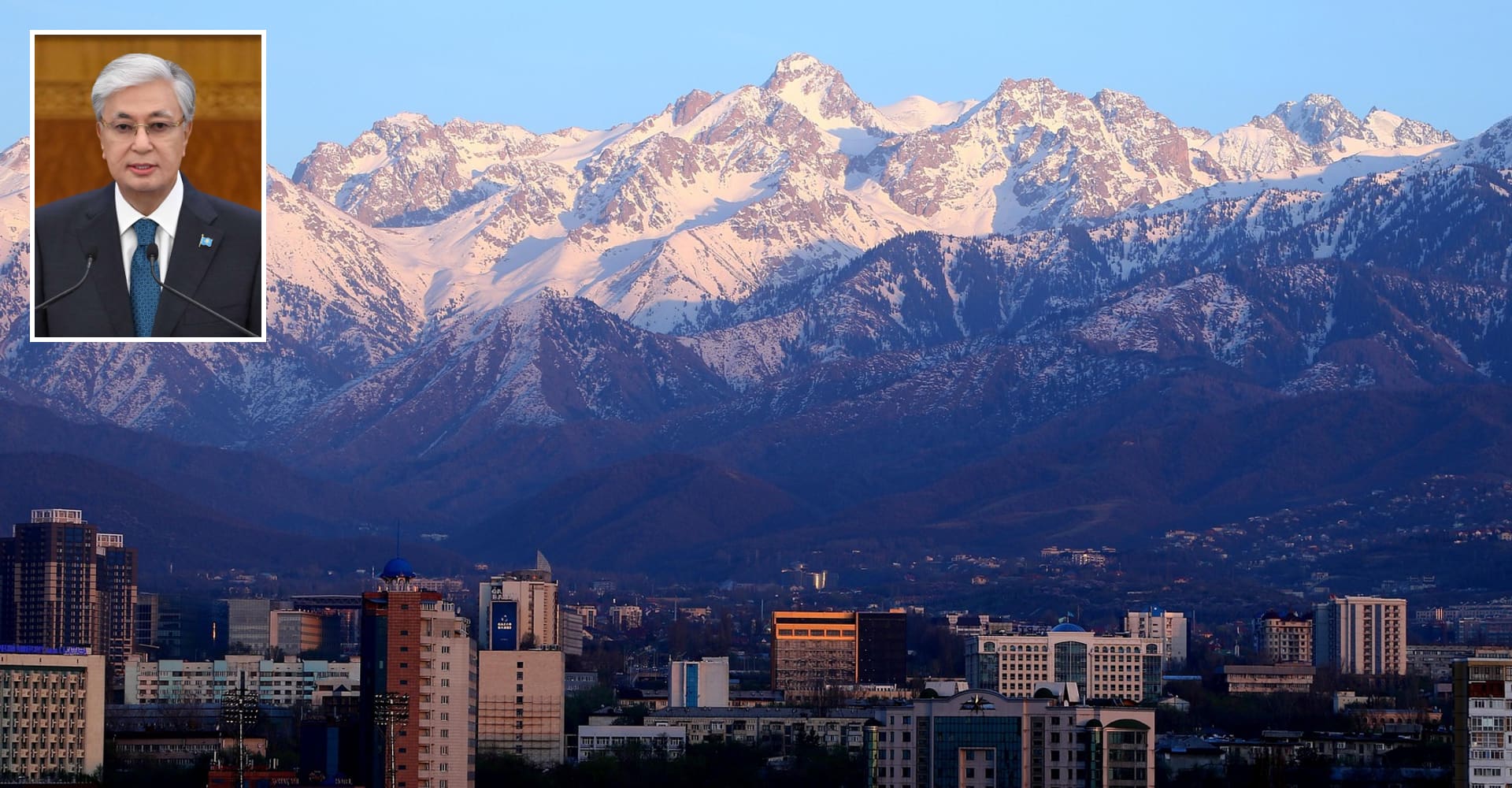
Almaty is the largest city in Kazakhstan. The picture shows the city with the snow-capped peaks of the Trans-Ili Alatau mountains in the background. Top left: Prime Minister Kassym-Jomart Tokayev was on an official state visit to Berlin on 28–30 September 2026.
Kazakhstan has taken over much of the export trade that Russia previously had with Europe. Large quantities of Kazakh energy are flooding into Germany. It is therefore natural that research and industry follow up with cooperation of their own. Within Kazakhstan, the authorities have a stated goal of spending 1 per cent of gross domestic product on research and development.
Growing fast
The Kazakh news agency Qazinform reports increased activity in all areas. The latest news is a more extensive cooperation between Kazakhstan and Germany. That is perhaps not so surprising. Kazakhstan is emerging as the new major supplier of energy to Europe, and energy is what Germany sorely lacks after "someone" blew up the supply of cheap Russian energy to the German industrial locomotive.
Doubling
Kazakhstan has sharply increased its oil exports to the EU over the past five years. From around 37 million tonnes in 2020, they grew steadily to over 52 million tonnes in 2024 and on to roughly 60–66 million tonnes in 2025. Its share of the EU's total crude oil imports has risen to around 12–13 per cent. That means Kazakhstan is now among the three largest suppliers to the EU, after the USA and Norway. It is almost exclusively crude oil, shipped via pipelines such as the CPC and by tanker.
Student exchange
Kazakhstan's head of state, Kassym-Jomart Tokayev, is now proposing an education and exchange programme between Kazakhstan and Germany. He recently met the rectors of several leading German universities. Around two thousand students from Kazakhstan are already studying in Germany. They do so because about fifty Kazakh universities have some form of cooperation with around a hundred German institutions.
Several channels
The ambitious head of state wants Kazakhstan to become a leading academic and research centre in Eurasia. Thanks to its large energy revenues, it has the means to do so. According to Comtrade data, Germany imported around 10.6 million tonnes of crude oil from Kazakhstan in 2024. That amounted to roughly 20 per cent of the EU's total imports from the country that year. Part of this went directly via the Druzhba pipeline to the Schwedt refinery. The rest arrived via other routes, including tankers following the CPC pipeline.
Kazakhstan is now a major supplier of energy to Germany and is regarded as an important country for Germany's industrial future. The Germans are therefore more than willing to forge closer ties with the oil nation.
Thousands
Traditionally, many students from Kazakhstan have studied abroad, but the authorities now also want to reverse that trend. They intend to do so by bringing the expertise of leading international universities to Kazakhstan. For example, the Colorado School of Mines, Cardiff University, KAIST and several other foreign institutions have now established themselves in Kazakhstan. At present there are about forty thousand international students in Kazakhstan. The authorities' stated goal is to pass one hundred thousand by 2029. Kazakhstan is a member of the so-called Bologna Process, which applies European standards for quality assurance.
Kazakh-German
Cooperation with Germany is now bearing fruit in other areas too. Recently, a Kazakh-German university opened branches in the Mangystau and East Kazakhstan regions, as well as in Almaty. Kazakhstan wants greater integration into the European Research Area. The country has therefore begun negotiations to join Horizon Europe as an associated country. Kazakhstan is already a participant in the European partnership for raw materials, with a total budget of over 300 million euros.
TiBeRIUM
One example of such integrated cooperation is the TiBeRIUM project, launched in 2026 with 7.5 million euros from Horizon Europe. The project is led by Freiberg University of Mining and Technology, in cooperation with East Kazakhstan Technical University and the Ulba Metallurgical Plant. The aim is to develop low-carbon production chains for titanium and beryllium.
AI certified
It is not only at the industrial level that Kazakhstan now wants to upgrade to international standards. Through the AI-Sana programme, more than 700,000 students have been certified with AI certificates. Kazakhstan has already passed its first laws on artificial intelligence.