Today Motparten can reveal that the equipment from the two mobile reserve gas power plants at Tjeldbergodden and Nyhamna, for which the state had paid billions, was sold to the Turkish industrial group Aksa Enerji in 2017.
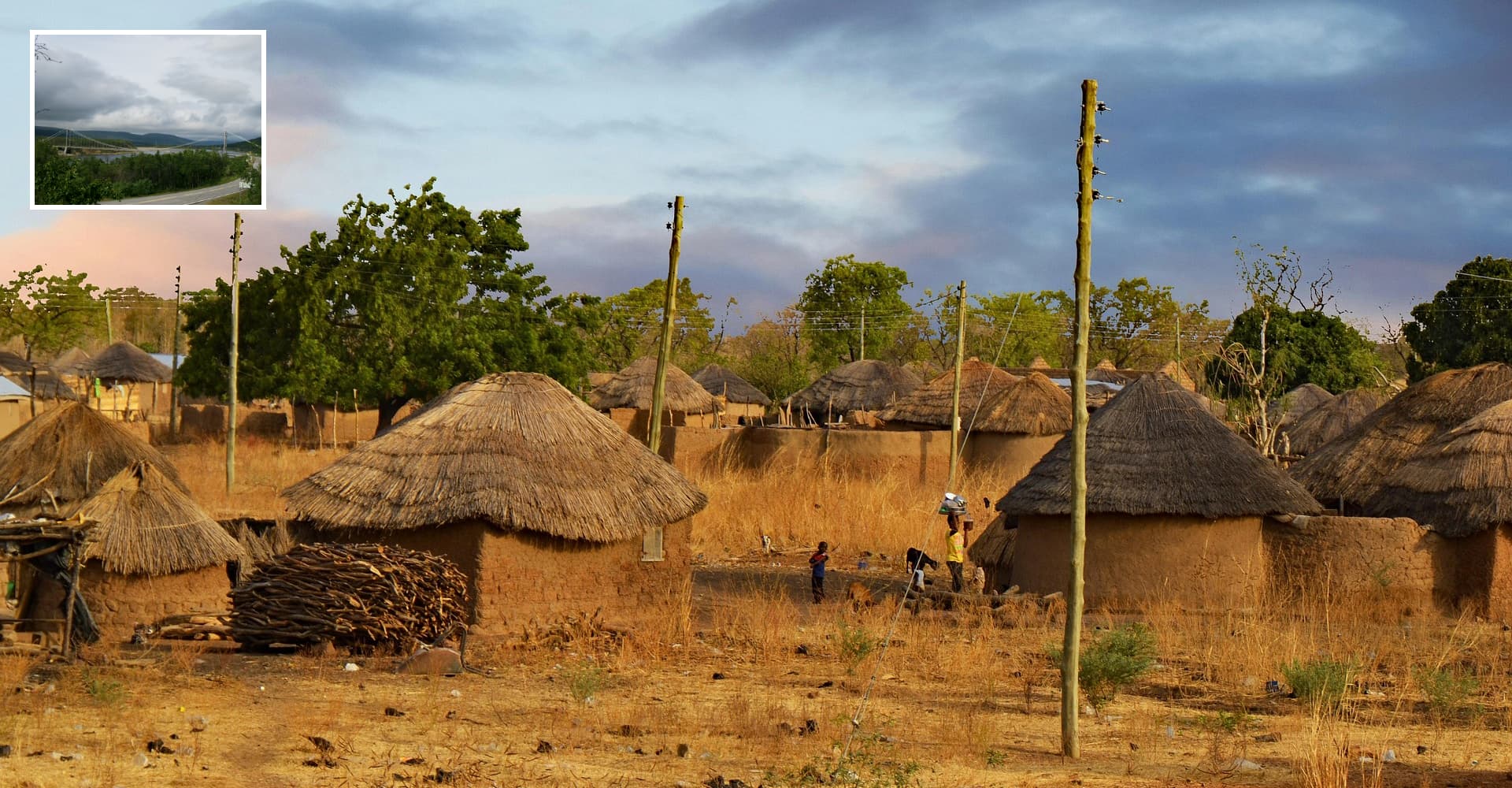
It could have given affordable power to Tana (top left) but ended up in Ghana. The brand-new Norwegian gas power plants were dismantled and sold off cheaply to a Turkish company.
The state spent over two billion kroner on a backup solution meant to ensure that Norwegians would not need foreign cables. The system was supposed to provide enough power in dry periods. Then the state suddenly got cold "environmental" feet and sold the lot to Turkey for peanuts.
Quality
This was not poor equipment that Statnett had invested in. On the contrary, it was top-quality stuff. The turbines were made by Pratt & Whitney. Sadly, they were dismantled, packed up and shipped out of the country. According to what Motparten has learned, the Turkish firm Aksa Enerji used the equipment for power projects internationally. Among other things, it generated electricity in Ghana in Africa, where Aksa built out gas power.
The same reason
The reason the backup solution was built in the first place was exactly the same as the arguments for building foreign cables. Around 2005–2006 there were fears of a regional power crisis in Central Norway if nature turned thoroughly uncooperative for short spells. At the same time, industrial consumption was growing. Licences were therefore granted for gas power plants on the condition that the facilities would only serve as so-called "emergency" capacity during an extreme dry-year crisis. In expert jargon this is called SAST, but in plain Norwegian – very strained power situations.
Sold to Turkey
Norway could have managed perfectly well without the foreign cables. All the talk of security of supply was just a show for the audience. The state had already built a fully usable backup solution that ran on gas. But no Norwegian politician was willing to put gas in the Tesla, even if it might be only a single day a year. So the whole shebang was taken apart and sold to a Turkish firm.
Sold for peanuts
Several sources put the construction cost at around 2.1 to 2.2 billion kroner when the plants were completed in 2009. In the years the plants stood idle on standby, they cost Statnett, and thus also Norwegian electricity customers through their grid rent, somewhere between 40 and 80 million kroner a year. The sale and decommissioning meant the money vanished from the state coffers and left taxpayers with a painful financial loss. The purchase price ended up at around 180 million kroner, or more precisely 21–22 million dollars at the time. That was the price for both plants combined.
Low emissions
The backup solution was never meant to produce in normal periods. The chances of significant CO2 emissions were therefore very small. Even so, it was precisely the paranoid CO2 policy that ultimately led to the closure and sale of the smart solution that could have saved us all from galloping electricity prices.
What could have become power in Tana ended up as power in Ghana instead! :-D
Strict rules
The criteria that NVE (the Norwegian Water Resources and Energy Directorate) and the Ministry of Petroleum and Energy set for starting them up were so strict that the threshold was never reached. CO₂ emissions were then, as now, like swearing in church. So the splendid backup solution was only test-run for a few hours a year to check that the turbines worked.
Chose foreign cables
Instead of using that backup solution, they started building foreign cables instead. At the same time, Fosen Vind was built out, adding new renewable production to Central Norway. NVE and the Ministry of Trade, Industry and Fisheries eventually concluded that it was no longer responsible to pay tens of millions a year to keep gas power standing idle. Nobody talked about the unfortunate effects that hooking up to expensive European prices would have for the man in the street.
Environmental madness
The two newest cables, to Germany and the United Kingdom, Nord Link and Sea Link, each have a capacity of 1,400 MW. That is a lot of power, but the point of the cables is not just to import what is needed, but to sell when prices are high and import when they are low. That is why Norway imports electricity with a share of both nuclear power and coal even when the reservoirs are not empty. It is sheer environmental madness when everything could have been avoided by firing up a backup solution now and then.
Would work today
Many wonder what such a gas-based backup solution would look like today. In a theoretical scenario with no imports via cables, the need at today's electricity consumption would be a so-called peak demand of around 25 GW. That means that in dry spells with low reservoir levels, there could be a risk of a deficit of 10–25 TWh of energy over a period.
Bigger and better
A new backup solution would therefore be larger in scale, more strategically located and designed for rarer but more serious situations. Instead of 300 MW in total, as with two × 150 MW in 2015, we would be talking about several GW of "firm reserve". Based on earlier assessments of dry periods without imports, a realistic estimate is 3–6 GW. That would require 20 older units of 150 MW each, or just 5 or 10 modern, larger units. That would be enough to cover the need in dry periods.
Ready to go
We are then talking about open gas turbines that can start up quickly, within minutes. Modern turbines have better efficiency and lower emissions than the 2008 model. The gas power plants would be placed close to existing gas infrastructure for easy supply. That means Tjeldbergodden and Nyhamna again, but also Kårstø, Kollsnes, Mongstad and other landfall sites. Possibly more locations in the south, where the reservoirs are often under the most strain, and in the centre/north for regional balance.
Rules
Ownership and operation would be managed by Statnett, with its system responsibility, and Statkraft. It would then be easy to comply with strict activation rules – only when there is a real danger of rationing or system collapse, and after approval from NVE. This would not be purely market-driven production, and CO2 emissions would be minimal.